Waking up in a new world

I dont really know where to begin. I remember as though through a haze… the feeling of mingled anticipation, dread, and sense of unreality leading up to the 2024 election. Logic said no, of course good must prevail, we can’t lose. Look at the numbers, I thought, there is no way this can go astray after the statistics of 2016 and 2020. If I’m being honest, it’s been days and it still doesn’t feel real. I woke up on November 6th in a different world, and Ive been going about my life, waking and sleeping and waking again feeling like I’m still in a living nightmare and it just simply can’t be real. 

Lives were dismantled on Wednesday. My outlook on the rest of my life and on the entire world changed. 

I remember waking up, rolling over, and checking my phone, a bit apprehensively. The first thing I remember processing was a text from my aunt saying how sorry she was for my generation, and how we will find a way rise above. The second I saw it I knew, before I even read the dozens of other messages. 

I immediately had a panic attack. 

I texted my girlfriend.

I called my mom.

I don’t think I’ll ever forget that morning. 

I remember panicking the night before, just anticipating the results with my girlfriend. My girlfriend is a hispanic immigrant, an amazing female athlete who came to America to pursue her dreams. I knew what this election could mean for her very directly.

I knew what it could mean for every immigrant, every queer and trans person, every woman, every minority living in this country. 

This country that was built on native land. 

Built on the dream for a better future, a better democracy. 

A place for people to come from all walks of life to live the “American dream”.

What happened? 

When did it go so wrong?

 I think we have lost the definition of patriotism. These self centered, bigoted, so-called patriots who claim to seek salvation for their country… How don’t they see it? 

Is it so easy to follow along, to parrot what you’re told by The Man?

Were this many people really just waiting for someone to come along and validate their hatred and say, “no please, go ahead, it’s ok to be a bigot and oppress that which you do not understand”? That which doesn’t have quite literally anything to do with your life. Individual and private parts of other people’s lives. 

I really don’t understand what happened, I don’t understand the logic, I don’t understand how we got here, I will simply never understand the hate. 

I fear for my country, for every person less fortunate than me. For my girlfriend. For my friends. For every young girl growing up in a world teaching them that they actually cannot achieve anything. That they are objects. I fear for all those stuck in deeply red states who have to worry for their safety every day. I fear for everyone who is in danger of losing their home. Their rights. Their fundamental human rights. And really, I fear for everyone living in ignorance. What a sad existence it must be to live a life governed by hatred. To lack the privilege of independent thought. Now though, it is time for those of us who can to fight, and keep fighting. We may not live to see the future that we are fighting for, but it is crucial that we carry on. It’s not about us, maybe it never has been. But we are strong. And we are living in this world which is demanding us to take action. I am tired. We are tired. But it is never easy. Yet when we fight for love and we fight for hope, and when we fight together, we truly embody our full power and I have faith that we can make that future that we dream of.
My Kink is Subversive Sapphic Music Videos- How Chappell Roan subverts gendered rules of embodiment in “My Kink is Karma”

My Kink is Subversive Sapphic Music Videos- How Chappell Roan subverts gendered rules of embodiment in “My Kink is Karma”

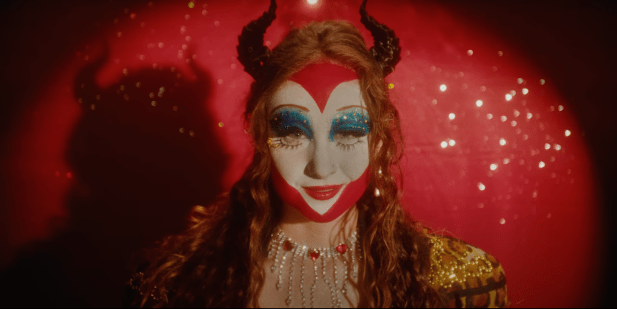
It’s 2023. I have just shut my computer after a grueling day of classes and homework, all to turn my attention to yet another blue-lit screen. As I catapult myself into my bed, I open YouTube in search of the Bob Ross marathon live-stream that I can always count on being my first suggested video. As the app opens, instead of Bob Ross’ comforting face, I am greeted by a smirking woman with curly red hair, glittery clown makeup, and devil horns. Her name is Chappell Roan. As a drag queen myself, I was instantly intrigued. I click on the video, named “My Kink is Karma”, and watch intently.

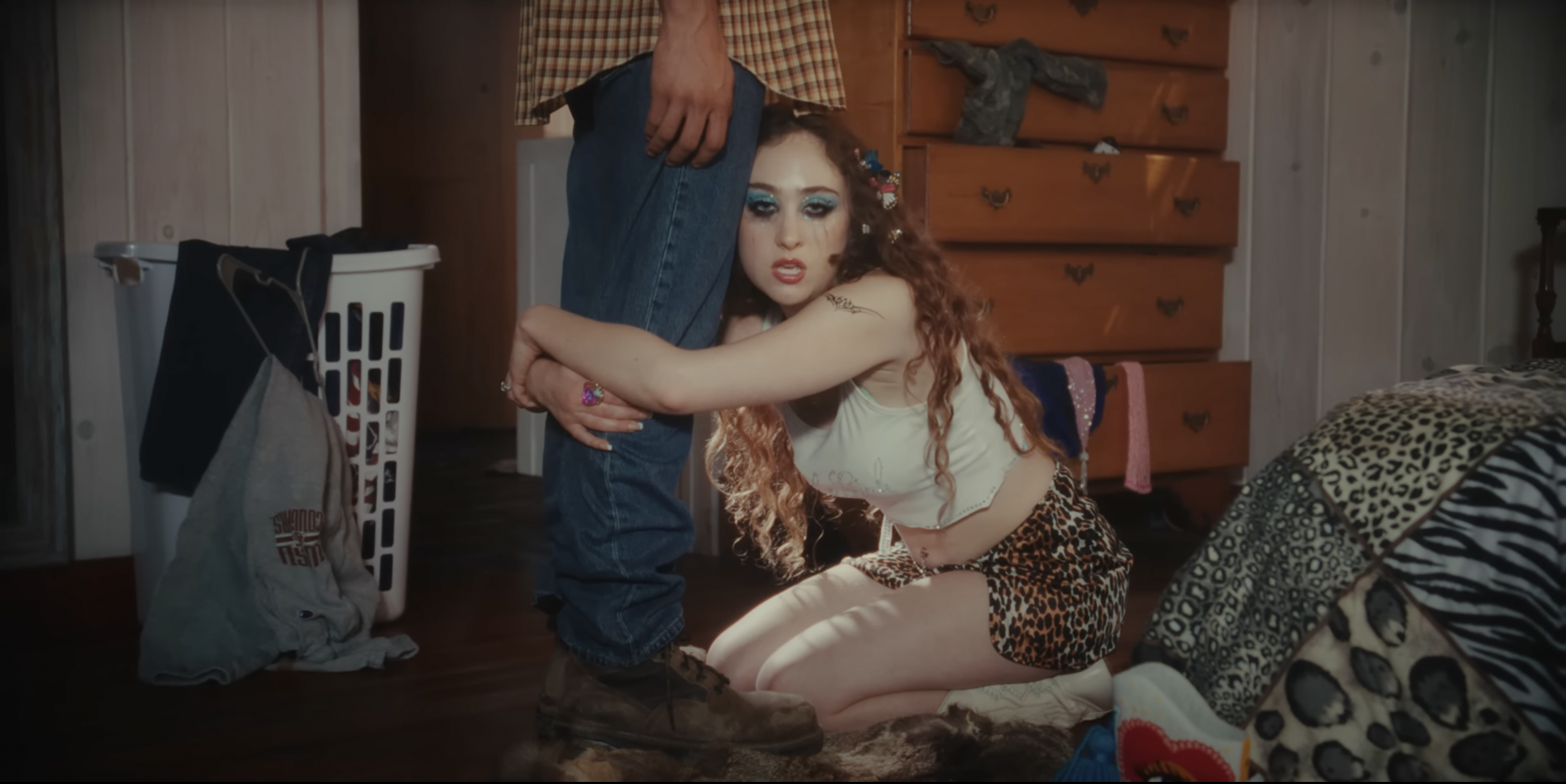
Chappell Roan and Clownie: Woman with red curly hair, white tank top, and cheetah print shorts kneeling on the ground hugging the legs of a man in blue jeans and a yellow flannel. She is in a messy and disorganized bedroom.

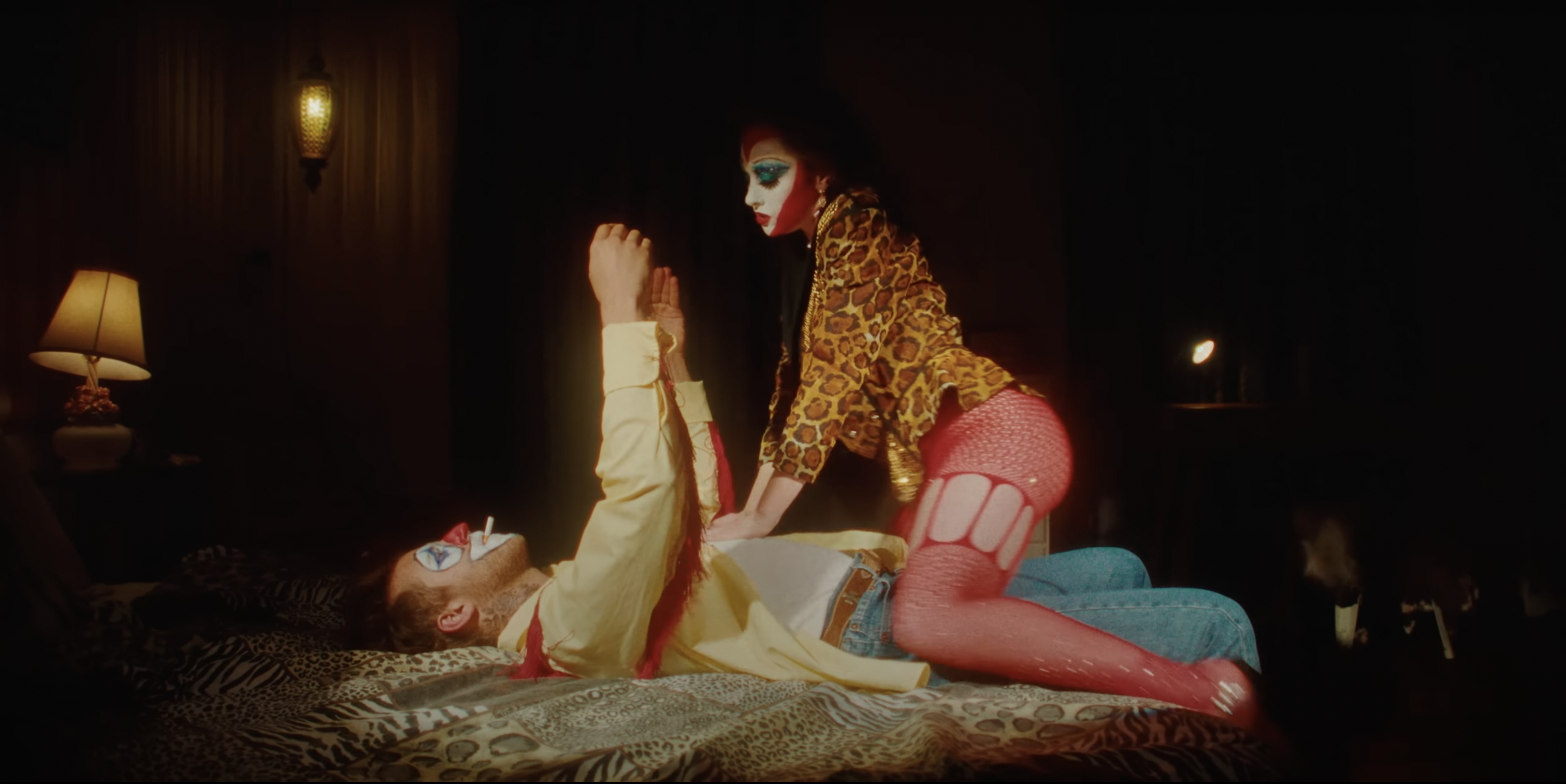
The video begins with Chappell packing her things, mascara running down her face after she broke up with her cheating boyfriend, Clownie. Her body language in this first scene communicates that her potential is repressed by Clownie’s emotionally abusive nature. I notice how during the first verse, it is made very clear that this story is not about him. In fact, his face is not shown throughout the first minute and twenty seconds of the video. As the first verse builds into the chorus, Chappell transforms from sitting timidly on a street curb to embodying power, confidence, and control. Her transformation into her drag persona represents a shift in embodiment, from a place of trauma to a place of dominance. For the majority of the video, aside from the first minute or so, Clownie is notably docile, in a trance-like state controlled by Chappell Roan. This dynamic in music videos, where one party has total control and the other serves as decoration, traditionally mirrors gendered expectations of embodiment. “My Kink is Karma” subverts this dynamic by explicitly depicting how this level of control looks when the roles are reversed.

Chappell Roan and Clownie: A woman with red curly hair, clown makeup, cheetah print blazer and red fishnets straddling a man in clown makeup, yellow shirt, and blue jeans on a cheetah print bed. The room is dimly lit with a spotlight on Chappell Roan and Clownie.

According to Iris Marion Young’s piece “Throwing Like a Girl” (1980), feminine bodies are taught to occupy less space and use less bodily power compared to masculine bodies. When someone is socialized as a girl for example, they are taught to throw a ball without engaging the entire body; this results in a throw less powerful than someone who is socialized as a man, who is traditionally taught to maximize their physical strength. This dynamic can be seen in the first part of the video. Chappell’s posture is submissive and defeated while Clownie is throwing her things to the curb in a fit of rage.

Chappell Roan: A woman with red curly hair with tear-streaked makeup, white tank top and cheetah print shorts, and white cowboy boots sitting on the curb smoking a cigarette. She is surrounded by disorganized piles of her belongings.

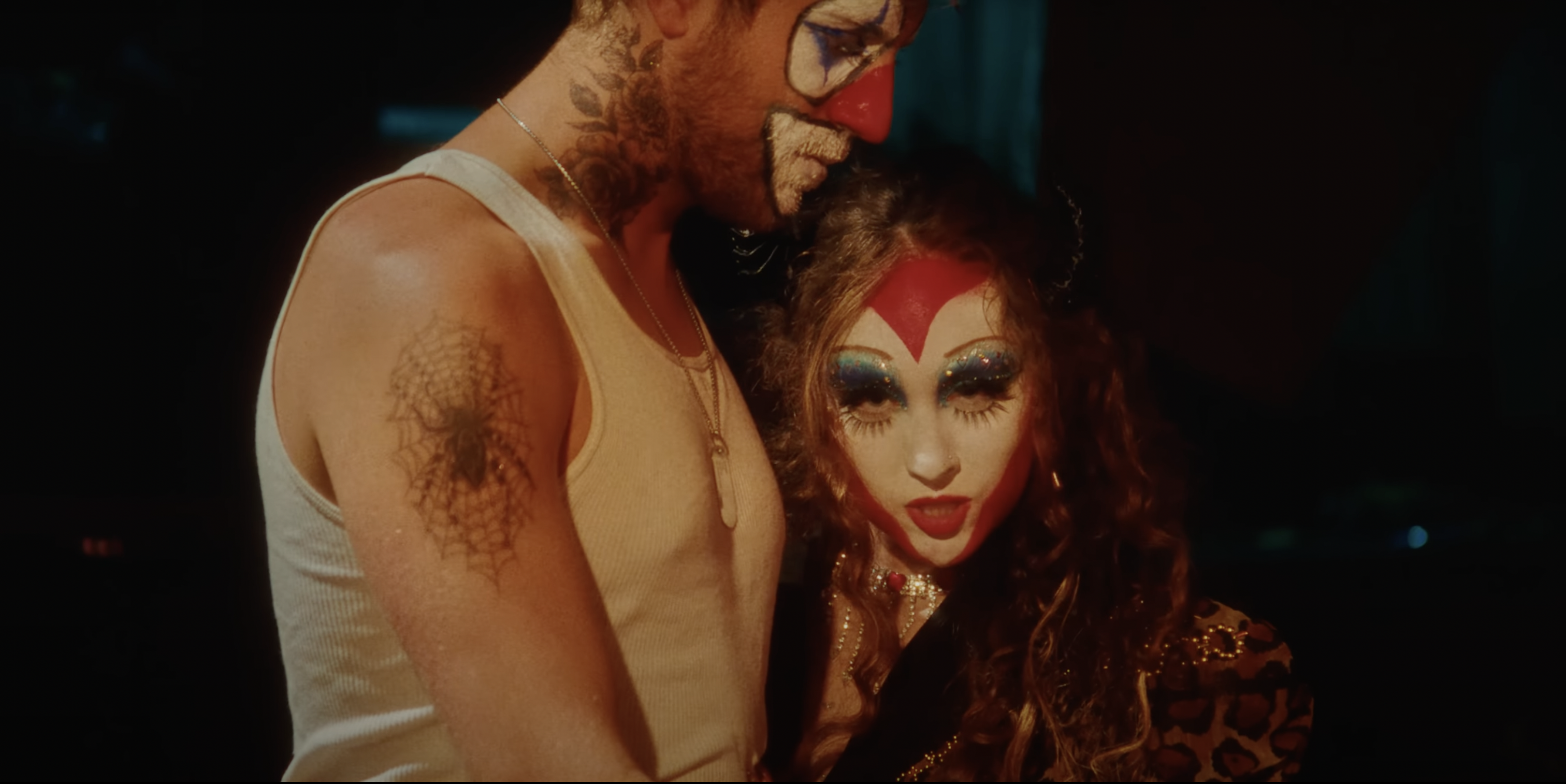
During the rest of the music video, Chappell Roan breaks every rule of gendered embodiment. She looks directly into the camera while Clownie exists in his submissive state of hypnosis. He does not react when she pushes him down onto the bed, or when she throws his jacket into the fire. He does nothing when Chappell smashes his face into the cake, or when she pins him to the heart-shaped target. Clownie is not there to take up space like men typically do in music videos, but to receive the karma that Chappell exacts. His embodiment is completely in Chappell Roan’s hands.

Chappell and Clownie: A woman with red curly hair, a cheetah print blazer and heart-shaped clown makeup is staring into the camera, while a man in clown makeup and a white undershirt is staring down blankly.

Although I’m sure there is an argument to be made that reversing the roles of gendered embodiment is problematic because it still privileges one socialized group over another, I find Chappell’s subversion of feminine embodiment extremely compelling. Her video inspired me to revisit the ways that I practice embodiment through art. The next time I am on the stage in my heels (it’s where I belong 🎶), I will think of Chappell Roan’s subversive embodiment.

Sources:

Roan, Chappell. “My Kink is Karma”. YouTube. May 13th, 2022. https://www.youtube.com/watch?v=ePsqyPMIg6I

Young, Iris M. “Throwing Like a Girl: A Phenomenology of Feminine Body Comportment Motility and Spatiality.” Human Studies, vol 3, 137-156. 1980.

QUEERIES: My Love for Eli Clare’s Exile and Pride and Why You Should Go Ahead and Read It, Okay?

I haven’t connected to any other class’s readings as I have connected with Eli Clare’s Exile & Pride. I’m trying to figure out why, and I still don’t rightly know, but I needed to share.

It seems obvious to say, “Well, I like the subject matter,” but really. I do. And it is all very different but so intrinsically connected, that I feel bad that I ever doubted the meshing of these worlds into one book. The environment, queerness, and disability (to narrow it down to a main triad) are all sides of the same coin. The environment–the one he have created and the one that has always been–often dictates disability. Disability provokes a queer understanding of identity. Being queer in different environments–rural and urban–is like being a polar bear or a house cat,  a bird or a lost lizard in a sewer. The criticism that Clare invokes when talking about these topics is also critical of race and ethnicity and of privilege and gender. Who was the first to claim land as an inexhaustible resource? Who dictates the gender and sexual norms? Who creates the urban space that perpetuates disability? Clare touches on all of these linked together identities and sites, and it feels so right. I learned so much from Clare’s writing, but I also picked up his sense of criticism; that calm, assertive, compassionate voice that questions why and kicks out with fervor. Clare’s criticism is beatifically formed and so god damn smart, but it’s not the only thing that keeps me in the book.
Continue reading →

~Read Me Queer Bby~

As I scroll through the endless stream of photos on the internet – mainly my tumblr – I can’t help but be overwhelmed by how many adorable queer folks there are.  With amazing haircuts, clothing, artwork, music, everything.  Babes all on the internet with super cute selfies, what more could one want?

Only as I as I spend more time seeing these images, I become aware of a question that always seems to be lingering in the back of my mind when it comes to my sexuality.

Am I queer enough?

Continue reading →

The Phallic Titty Manifesto: Queer Sex and the Naming of Parts

Transitioning is often seen through a medical lens, marked by physical changes to the body including hormone replacement therapy and sex reassignment surgery. While transitioning clearly demonstrates the fluidity of gender, the body, and how gender and the body interact and are perceived, the locations of sex on the body are often viewed as static. For someone to have fully transitioned, their gender and biological sex would seemingly “match.” I am in support of people doing whatever it is they need to do to feel good about their gender and I am in no way against this type of transitioning. However, what I believe is problematic is how this is typically seen as the default for trans* people. Not all trans* people transition or transition in this particular way.

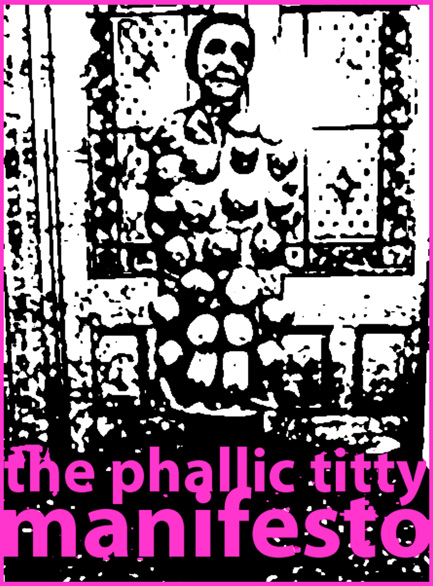
The Phallic Titty Manifesto, a zine by a friend Jackie Wang

discusses the ambiguity of flesh, tits as dicks and dicks as clits, erotic lactation, Judith Butler, pregnant bodies, Louise Bourgeois, the lesbian phallus, unmaking and remaking bodies, expanding erogenous zones, and queer sex.

Through a queer lens, sex is no longer isolated to biological parts associated with our sex at birth or if they are their weight no longer holds. In this sense, there is a radical capability to transition or transgresses gender norms while still seemingly embodying the sex you were assigned at birth.

This makes me think of the usage of terms “female-bodied” and “male-bodied.” I have typically heard them used in the context of referring to trans*, genderqueer, and non-gender conforming folks. While someone will refer to someone with “they/their” pronouns in one breath, they will use “female-bodied” or “male-bodied” to refer to them in another. While I think this is subjective, dependent on the specific person and how they like to be referred to, I think this is extremely interesting. From this example, it is clear how deeply embedded sex and gender are in physical bodies. I think at times terms like these can (unintentionally) reinscribe the gender binary, in which some folks clearly do not identify with. If someone is trans*, why wouldn’t they be trans*-bodied (or however they would like to be referred)? Do you think it is inherently impossible to view the body, specifically sex on the body as fluid?