The Mortifying Ordeal of Being Known

**This post contains the usage of the f-slur as it’s a term I’ve found encompasses me to a certain capacity. If this offends you, please feel free to keep scrolling**

I think there’s a point when people give up on you. And that sounds more melodramatic than I intend, but there’s truth to it. So often we talk about trans people from a place of unlearning and relearning gendered roles in society, but what about those that were never taught at all? An argument can be made that most gendered thoughts and behaviors come from the unconscious – what is reproduced in the world around us – and I don’t discredit that. But how does the world teach gender to a child whose gender is unintelligible, a lost cause? A father can only teach his “son” so much. The most formal gender schooling I received was years of sports, before he realized I was a lost cause. An incredibly awkward sex talk, before he realized I was a lost cause. Scoldings for playing my mother’s heels, before he realized I was a lost cause. Treated like a fag and lived as a closeted transsexual: the gift of visibility is one I would not force on anyone. 

 Some people have the capability to be straight-passing, cis-passing, white-passing, but in truth I’ve never tasted that luxury. I wasn’t always an outcast, though there were times when it certainly felt like I was, but I was always visible. Like a lighthouse on the shore directing all eyes on me the moment I walked into a room. I do not have the luxury of blending into the shadows or disappearing into a crowd, so I learned to lean into it.

 Visibility is a blessing and a curse. It drives away those who would cast malice behind my back but encourages those who would to my face. But the pressures of constantly being seen take a toll. Eyes glued to you no matter where you go, the way you talk, the way you walk, the way you carry yourself cut open and dissected for the world to see. In my case, to be seen is to be known. You’re turned inside out with your most delicate vulnerabilities on display. But in that comes community. Whether it’s an innocuous smile across the room from someone just like you, or unknowingly giving a stranger the confidence to start living, to be seen is to exist outside of yourself. To be seen is to contain multitudes. To be seen is heavy, but it is never a burden one must shoulder alone.

My Kink is Subversive Sapphic Music Videos- How Chappell Roan subverts gendered rules of embodiment in “My Kink is Karma”

My Kink is Subversive Sapphic Music Videos- How Chappell Roan subverts gendered rules of embodiment in “My Kink is Karma”

It’s 2023. I have just shut my computer after a grueling day of classes and homework, all to turn my attention to yet another blue-lit screen. As I catapult myself into my bed, I open YouTube in search of the Bob Ross marathon live-stream that I can always count on being my first suggested video. As the app opens, instead of Bob Ross’ comforting face, I am greeted by a smirking woman with curly red hair, glittery clown makeup, and devil horns. Her name is Chappell Roan. As a drag queen myself, I was instantly intrigued. I click on the video, named “My Kink is Karma”, and watch intently.

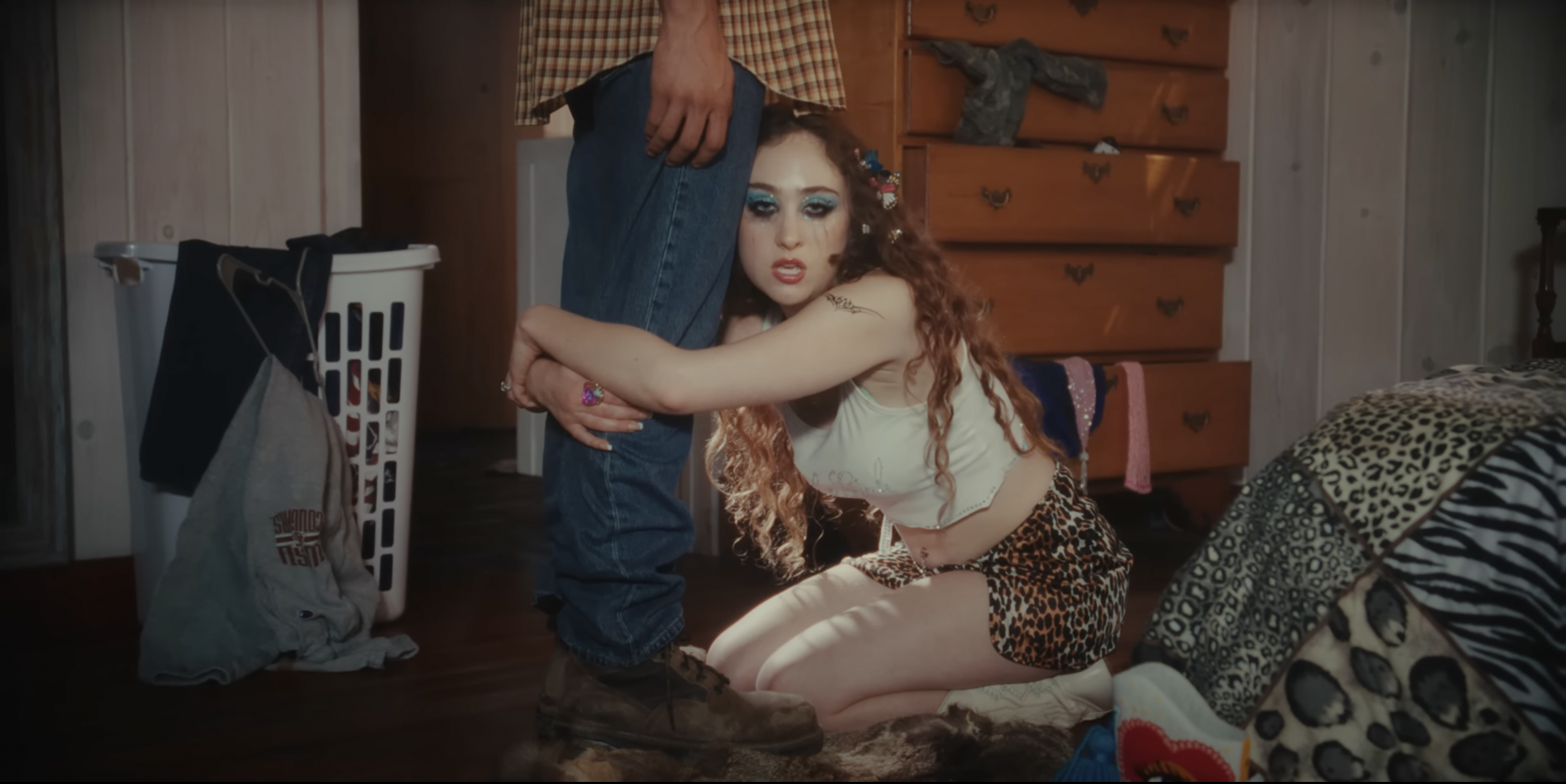
Chappell Roan and Clownie: Woman with red curly hair, white tank top, and cheetah print shorts kneeling on the ground hugging the legs of a man in blue jeans and a yellow flannel. She is in a messy and disorganized bedroom.

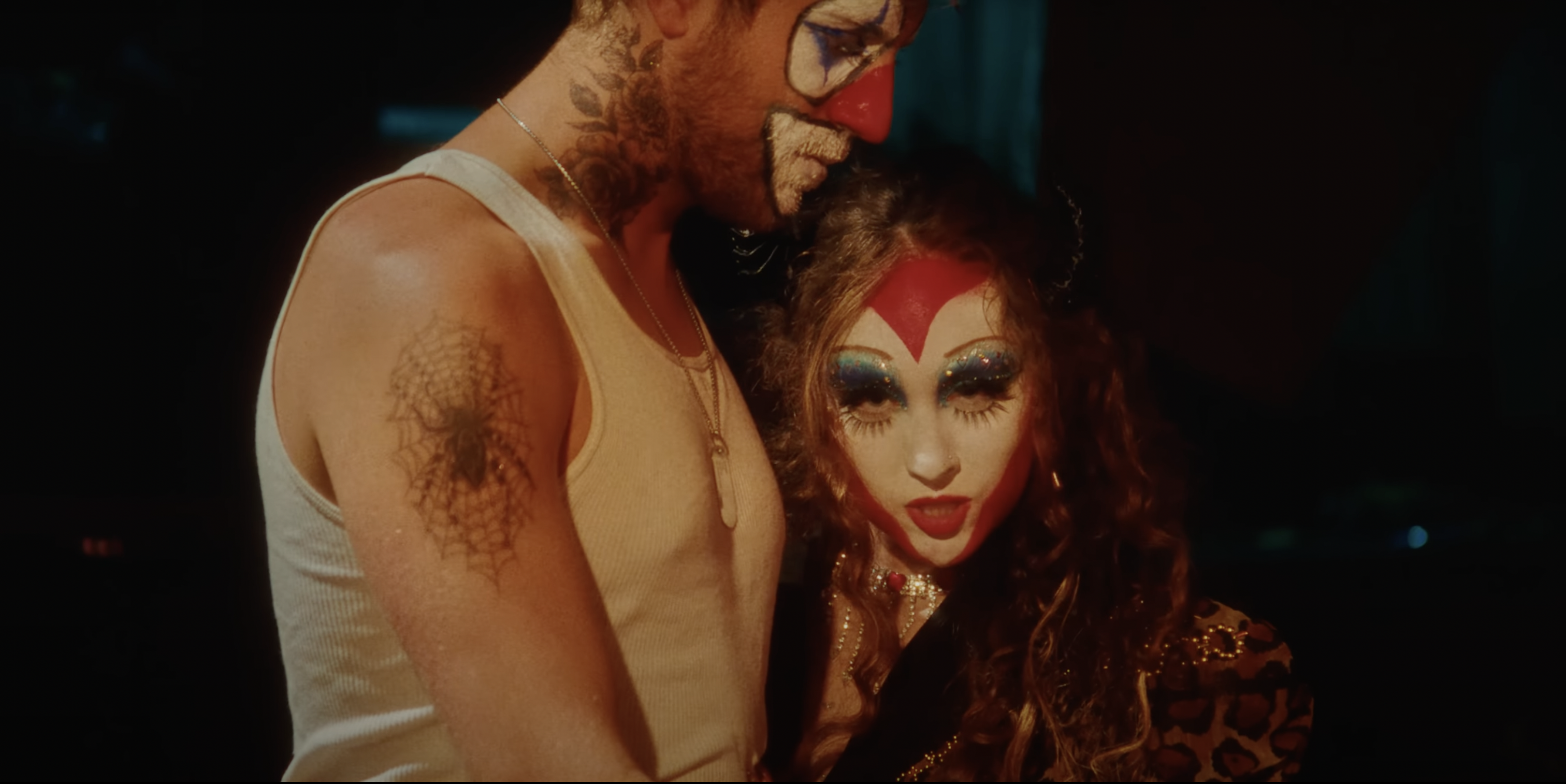
The video begins with Chappell packing her things, mascara running down her face after she broke up with her cheating boyfriend, Clownie. Her body language in this first scene communicates that her potential is repressed by Clownie’s emotionally abusive nature. I notice how during the first verse, it is made very clear that this story is not about him. In fact, his face is not shown throughout the first minute and twenty seconds of the video. As the first verse builds into the chorus, Chappell transforms from sitting timidly on a street curb to embodying power, confidence, and control. Her transformation into her drag persona represents a shift in embodiment, from a place of trauma to a place of dominance. For the majority of the video, aside from the first minute or so, Clownie is notably docile, in a trance-like state controlled by Chappell Roan. This dynamic in music videos, where one party has total control and the other serves as decoration, traditionally mirrors gendered expectations of embodiment. “My Kink is Karma” subverts this dynamic by explicitly depicting how this level of control looks when the roles are reversed.

Chappell Roan and Clownie: A woman with red curly hair, clown makeup, cheetah print blazer and red fishnets straddling a man in clown makeup, yellow shirt, and blue jeans on a cheetah print bed. The room is dimly lit with a spotlight on Chappell Roan and Clownie.

According to Iris Marion Young’s piece “Throwing Like a Girl” (1980), feminine bodies are taught to occupy less space and use less bodily power compared to masculine bodies. When someone is socialized as a girl for example, they are taught to throw a ball without engaging the entire body; this results in a throw less powerful than someone who is socialized as a man, who is traditionally taught to maximize their physical strength. This dynamic can be seen in the first part of the video. Chappell’s posture is submissive and defeated while Clownie is throwing her things to the curb in a fit of rage.

Chappell Roan: A woman with red curly hair with tear-streaked makeup, white tank top and cheetah print shorts, and white cowboy boots sitting on the curb smoking a cigarette. She is surrounded by disorganized piles of her belongings.

During the rest of the music video, Chappell Roan breaks every rule of gendered embodiment. She looks directly into the camera while Clownie exists in his submissive state of hypnosis. He does not react when she pushes him down onto the bed, or when she throws his jacket into the fire. He does nothing when Chappell smashes his face into the cake, or when she pins him to the heart-shaped target. Clownie is not there to take up space like men typically do in music videos, but to receive the karma that Chappell exacts. His embodiment is completely in Chappell Roan’s hands.

Chappell and Clownie: A woman with red curly hair, a cheetah print blazer and heart-shaped clown makeup is staring into the camera, while a man in clown makeup and a white undershirt is staring down blankly.

Although I’m sure there is an argument to be made that reversing the roles of gendered embodiment is problematic because it still privileges one socialized group over another, I find Chappell’s subversion of feminine embodiment extremely compelling. Her video inspired me to revisit the ways that I practice embodiment through art. The next time I am on the stage in my heels (it’s where I belong 🎶), I will think of Chappell Roan’s subversive embodiment.

Sources:

Roan, Chappell. “My Kink is Karma”. YouTube. May 13th, 2022. https://www.youtube.com/watch?v=ePsqyPMIg6I

Young, Iris M. “Throwing Like a Girl: A Phenomenology of Feminine Body Comportment Motility and Spatiality.” Human Studies, vol 3, 137-156. 1980.

“I Shouldn’t Have Slapped Him.”

In “Throwing Like a Girl,” Young conceptualizes the idea of “inhibited intentionality,” in which the capability and movement of bodies are limited based on gendered ideations. In other words, gendered notions teach us about how we are to move our bodies, with girls being told to not move so freely and boys being told the opposite. With this, I am reminded of a story from my mom’s childhood.

As she recalls this story, my mom once slapped one of her younger brothers in the face due to him making her overwhelmingly upset. Based on other stories that she has told, I figured that this was a common occurrence. My mom is the oldest of five, with two younger brothers and two younger sisters. She always laughed as she remembered the instances in which she got into physical fights with her younger sisters; yet, for some reason, this story with her brother was not as funny. 

“I felt bad because I had felt like I made him feel like less of a man.” 

“He was only a teenager, and I felt like I attacked his masculinity.”

As she recalls this instance, she expresses remorse and regret. She had no problem fighting her younger sisters, but when she physically slapped her brother, she thought she had crossed a line as a woman. Not because she was in the wrong, but because she felt she had taken up too much space. She moved in a way that should have been restricted because she now had committed the “crime” of stepping beyond the restraint of gendered movement. 

As Young states, “feminine bodily existence is an inhibited intentionality, which simultaneously reaches toward a projected end with an “I can” and withholds its full bodily commitment to that end in a self-imposed “I cannot.” In the case of my mom, she had stepped outside on these ideations and realized that she “could.” Yet, because of the expectations set for women and their bodies, my mom felt the self-inflicted reaction that she “shouldn’t.” In other words, once she realized that she “could,” her first thought afterward was that she “shouldn’t have.” And ever since, she still feels the same way. Instead of withholding her movement, resulting in a self-imposed “I can’t,” my mom fully committed and resulted in a self-imposed “I shouldn’t have.” In this sense, it becomes clear the ways in which we are socialized to not only police other bodies but also our own. Once we learn what we “can” or “can’t,” we try our best to maintain those limits. However, if we go beyond them, we do our best to compensate by replacing the ”I can’t” with an “I shouldn’t have.” 

Subway Shirts

I recently saw an Instagram reel from @arlenezhxo where she shows her original outfit and then adorns this oversized shirt with Kermit the Frog wearing a Santa hat over it. With the text on the screen saying, “shoutout to my subway shirt” and the caption saying, “what’s ur subway shirt?” Here it is: https://www.instagram.com/reel/C_wOd2SyAHV/?hl=en 

The idea behind a Subway shirt is to conceal your body and stop or reduce harassment from people who ride the Subway. This is not the first Instagram reelI have seen about the Subway shirt (I do not have TikTok). It brings up the idea of not wanting your body to be perceived. 

This can be understood through Featherstone’s critique of consumer culture and the focus on the body. Featherstone (1990) highlights that the consumerist obsession with leisure and consumption, especially regarding the body, is often seen as empowering by granting individuals greater freedom to express themselves through fashion and appearance. However, this constant focus on appearance also leads to a form of “ideological manipulation,” wherein the body becomes the primary site of self-worth and identity. The pressure to present oneself in a specific way reinforces conformity to consumerist ideals, which may limit true freedom and alternative ways of being in the world.

In this case, the “Subway shirt” can be seen as a reaction to that manipulation. It symbolizes a rejection of the consumer-driven pressure to always make one’s body available for public consumption and appraisal. The oversized shirt is worn not for leisure or self-expression but as a tool of protection, concealing the body to avoid unwanted attention. This aligns with Featherstone’s view that while consumer culture promises freedom and individualism, it can also act as a means of control, encouraging individuals to conform to certain norms and aesthetics. In this case, the “Subway shirt” might represent a deliberate disengagement from this consumerist gaze, offering a temporary escape from the endless cycle of bodily visibility and scrutiny.

Reference

Featherstone, M. (1990). PERSPECTIVES ON CONSUMER CULTURE. Sociology, 24(1), 5–22. http://www.jstor.org/stable/42854622

Breaking Free to Move Wild

I’ll admit it—I’ve heard “you throw like a girl” more times than I care to count. And every time I hear it, it hurts my pride at least. So it always made me want to prove them wrong. But then I came across “Throwing Like a Girl” by feminist philosopher Iris Marion Young, and it completely changed how I thought about that phrase. Young doesn’t just talk about throwing a ball; she dives deep into how society shapes the way women use their bodies. According to Young, the reason girls tend to throw without using their full bodies isn’t because they can’t—it’s because they’ve been conditioned to hold back. This social conditioning fosters self-doubt and a fear of judgment, leading to self-consciousness and unhealthy comparisons. In order to see this, we need to challenge these societal norms and encourage women to embrace their physicality and confidence. In defining this confidence it means embracing yourself, taking risks, and being bold about who you are. It’s about recognizing that your worth is not defined by how others see you, but by how you see yourself.”She writes, “Girls do not bring their whole bodies into motion… they tend to remain relatively immobile except for their arms” (p. 142). 

This really resonates with me. It’s not just about throwing; it’s evident in how we sit, walk, and carry ourselves. There’s this unspoken rule that women should take up less space, move carefully, and be less bold. We’re told not to be too smart or show too much emotion, and we constantly worry about our outfits being too revealing or not revealing enough. These expectations limit our authenticity and confidence. Recognizing these societal pressures is the first step toward embracing our true selves and challenging those constraints. Young argues that this isn’t about biology. It’s not that girls are naturally less powerful in their movements; it’s that society tells us, from a young age, that we should be. She states, “We reduce women’s condition simply to unintelligibility if we ‘explain’ it by appealing to some natural and ahistorical feminine essence” (p. 138). This highlights the danger of oversimplifying women’s experiences. It makes me reflect on how often society tries to define women through fixed, supposedly “natural” traits, ignoring the complex social and historical influences that shape our identities.

Reading this passage made me think about how I carry myself. I’ve always been told to sit neatly, cross my legs, and keep my arms tight. But why? Boys don’t get the same message. They’re taught to sprawl, take up space, and own their physical presence.  Young’s essay made me see that these differences are deeply rooted in the expectations placed on us. It’s not just about how we throw—it’s about how we’ve been taught to exist in the world. And maybe it’s time we start throwing like we mean it and being seen as we truly are and not what people see us as. 

My Transmasc Experience with Discontinuous Unity

I was socialized as a girl and had to learn to undo the thinking and processes that held me back from being myself as since I was taught to fit in the role of “girl” from a young age. I was a performer in ballet and Irish Dance, and praised as a good one at that by both adults and my peers. Simultaneously, I became an expert at performing my assigned gender. That’s what my life was, dance and being a girl and a daughter and a niece and a sister– and femme. I didn’t know any different. I didn’t see myself as being able to be any different. I only did, said, dressed, and convinced myself to feel like a “girl” would. I had played so far into being a “girl” that I completely disconnected with my body and lost myself. I never considered who I wanted to be. The modality of femininity, ‘Discontinuous Unity,’ observed by Iris Mariam Young in “Throwing Like a Girl” perfectly describes how I felt in my adolescence with femininity. I felt like I was constantly in a spotlight– viewed by a crowd I couldn’t see, critiqued for not pointing my feet enough, and convinced my body must play the role of “girl” correctly.

It was years until I realized that I had been struggling with internal homophobia and transphobia. It was okay for others to be LGBTQ+, but not for myself? The convincing wasn’t good enough though, because as the world around me crumbled with my first sense of self-realization, I saw that nonbinary lesbian inside of me. It took me 16 years to understand that I wasn’t straight, and another 3 to realize I wasn’t a part of the gender binary. Those last 3 years were the toughest. Validating myself was one of the hardest things I’ve done and continue to do daily. It feels so crazy looking back and sometimes it feels so unequivocally dumb that I couldn’t find myself and still doubt myself, but this is what happened to me and I’m still trying to accept it. I see a sense of femininity still lingering in the jewelry I wear, my short hair that I can’t ever seem to like even when it’s an inch from my head, and the mannerisms I can’t seem to shake. I hope to use these parts of me to empower myself rather than promote disunity of my mind and body. This has been my personal journey from “Discontinuous Unity” to “Ambiguous Transcendence,” where I can freely be myself regardless of others’ views of me.

TLDR; Society pushed me into a role without my consent that led me to disassociate and play pretend as a straight girl until I learned I had free will.

The Paradox of Visibility: A Phenomenological Exploration.

Memories and Past Experiences:

Conclusion:

-SantanaA :/

Reflecting on the Philosophy of Consciousness in the Context of Embodiment

The concept of consciousness and individuality has always been of great interest to me. The idea that every individual is experiencing something utterly unique in every moment goes beyond what I believe we can adequately perceive or understand as humans; it is like the concept of infinity. In a way, we’ll never know if everyone around us experiences things consciously or exists in the way we do, because when it comes down to it, our world is how we perceive it on an entirely individual level. I have thought that it is interesting to approach the subject of the human experience in an objective way, because this seems like a paradox to me. The idea of the “human experience” is directly linked to our humanity and therefore identity, so I wonder then how it can be examined in an objective way when the idea of experience is entirely subjective in it’s own right. 

If we assume that an “experience” is a conscious thing, and then that our consciousness is shaped by our identity and individuality, then experience by nature cannot be examined objectively. Because we ourselves are conscious beings we cannot strip ourselves of subjectivity because it is exactly that that makes us who we are and constructs our very thought. We are, in a way, burdened by our consciousness and thought, but then again this is in essence our humanity. Therefore if we dismiss this notion of objective examination and embrace our consciousness and the effect of our identity, we can discover new ways to address experience and accept this examination as a subjective thing.

Sexy to Someone (Is All I Really Want)

Content Warning: Mentions of nudity, genitals, and explicitly sexual content

My room is a mess.

Clothes are strewn haphazardly across the floor, my navy-blue comforter crumpled from where I have twisted it in and around my fingers from stress. In front of my mirror sits a make-up bag, unzipped and spilling products; mascara, blush, and eyeliner prepped and ready to highlight the “right” features of my face. Before that, though, I have to choose an outfit. And by God is it a puzzle, and I am merely piecing the corners together.

Crop-tops, skirts, lingerie, fishnets- there’s too much to choose from, and too many checkboxes to write off. Is my cleavage showing? Are my eyes wide and innocent, and can I peek up through my lashes with the mascara I’ll be putting on? If I turn around, do the bottoms of my butt cheeks show in the teasing way I want it to?

Modest clothes are always left behind in the closet. I wring my lip in worry, staring at the baggy jeans I have, before shutting the drawers again and turning back to the low-rise shorts that barely cover anything. A green floral lacy bra peeks out of the hoodie I throw on to avoid stares. In the end, I am forcing myself to hype myself up with courage, taking a deep breath and leaving my room to go and meet him.

Him has referred to too many people for my liking. People who leave too soon, for reasons unbeknownst to me. And in most of these cases, I’ve come back feeling like a shell of myself. My muscles are sore, I have bags under my eyes, and there’s this pit in my stomach that grows with each occurrence. It gnaws at me whenever I opt to wear a pretty white tank top and a brown miniskirt because he asked me to. It sits, heavy and festering, when I subconsciously raise the pitch in my voice to appear kinder, softer, more lovely, because he’d get hard to it. And it feeds on my insecurities, when I push myself more onto him, onto this image of me basking in the golden sunlight, with nothing on but my femininity. All for him.

If I showed up in sweatpants and a black compression shirt like the guys at the gym do, would they still want me? If, instead of a miniskirt and a lacy bra, I showed up in boxers and a binding sports bra, would they still kiss me as if I was the last person on Earth? What about if I had a dick? Would they be disgusted when they pulled down my pants and saw something else other than folds? When they ask to take off my top, what if instead of breasts they saw the smooth skin of my chest? Would it change anything?

I would grapple, and still struggle, with these thoughts constantly. As a gender-fluid person who is assigned female at birth, every time someone took me to bed, I couldn’t help but wonder if the presentation of my femininity was what drew people in. More importantly, I couldn’t help but wonder about the consequences that would result in me presenting anything other than feminine.

I hid these questions in pigtails and false eyelashes and lip gloss. I tried not to think about showing up to a date with him in cargo pants and an oversized graphic tee, with my hair falling into my eyes because its unkempt. He would not like that. I knew that from experience. He might feel weird about being seen with someone so non-feminine. Or even worse, feel threatened at my masculine presentation. And you know, as I would sit in his lap and let him run his hands through my hair, he would tell me that whatever was his, was mine. I didn’t know that sentiment also pertained to his view of my body shaping my view of my body. That his love for femininity would become my love for pleasing him.

Those days are recent. Passed and done and over with, but recent nonetheless. I still am coming to terms with regarding my body as a loved one I take care of, instead of property to rent and dispose of at someone’s leisure. And one day, I will find someone who understands what it means to be attracted to a person rather than a body. That there is more to me than my curves: there is also the messiness of my hair when I wake up, and the low register of my voice when I’m ordering coffee. No longer is my body theirs. The purposeful wall of separation I’ve created between my body and I will turn into a simple breath of air one day, and I am excited to experience it.

Sexy to Someone – Clairo

Learning to be a man after being raised a girl

For as long as I can remember, every summer my large extended family migrates upstate to north country New York to spend time with each other at my grandmother’s house on Lake Champlain. The house itself is falling apart, and every year the men of the family take it upon themselves to fix up a new part of the cabin in order to occupy themselves while the women spend time shopping and cooking enough for twenty five people, while the kids spend the day exploring the area and playing in the lake.

Growing up, aside from playing mermaids at the beach and following my older cousins around, I was expected to help sweep the sandy house every day, set up the grown ups and kids tables for dinner, and to clean up afterwards while the adults got themselves something to drink. While my parents tried to get the boys of the household to do the same, they tended to get away with doing less than the girls of the family, using the excuse that they had spent the day helping (or watching, as some of my cousins argued) their dads with that year’s construction project. Nonetheless, that’s how summers were organized for my family, and as I grew older, cut my hair shorter, and started wearing more masculine clothes, I got into the swing of helping inside the house while my brother helped outside of it.

[Image: Lake Champlain as seen from a cove, a sailboat and island are seen off the coast, with mountains on the other side of the lake seen off in the distance]

The summer I was 20 years old, my family once more made the trek upstate. This summer was particularly notable because I hadn’t been able to make it the past few years, meaning this was the first time I spent my summer in New York after socially and medically transitioning. I was expecting to spend my first day back following my cousins around and gossiping before heading back to the house to help my mom and aunts cook dinner. But before I could run off, one of my uncles handed me an armful of plywood and told me to haul it over to my grandmother’s porch. I ended up spending the day with my uncles and cousins disassembling the porch while my grandma sat in her adirondack chair and filled out her crossword puzzle with the help of my mom. I didn’t mind, despite not knowing the details regarding how to disassemble a porch, this was my family’s way of accepting me as a man, and therefore expecting me to fulfill certain duties as a man.  

However, as the sun started to set, and my aunts began making food for the family, I was called into the kitchen to help out with dinner. I am not a confrontational man, and didn’t want to make a fuss, so despite my achy and bruised body, I made my way into the kitchen to help, while my uncles sat in the living room to talk, and my cousins ran off to the beach. I found it interesting that despite my family’s acceptance of me as a man, I was still expected to fulfill the responsibilities that came with being raised and socialized as a girl. 

While this is one of the more notable times I recognized this happening, it was far from the only time in my life I’d been expected to be a man, after having been raised a girl.