Lately I have noticed that there are so many double standards nowadays. Today I was at my friend’s flag football game and noticed that there was one female player on the opposing team. I was happy to see a female allowed to play with males in a sports game but got upset when I found out that the team gets more points when a female scores. It seems hypocritical to allow a girl to play but then give us a handicap. Even when it comes discussing sports males automatically think that females do not know anything. However, in my group of friends my best girl friend knows more about football than some of my male friends. It seems that because men are always placing a certain stereotype on females, we in return do the same.
Uncategorized
The Adipositivity Project
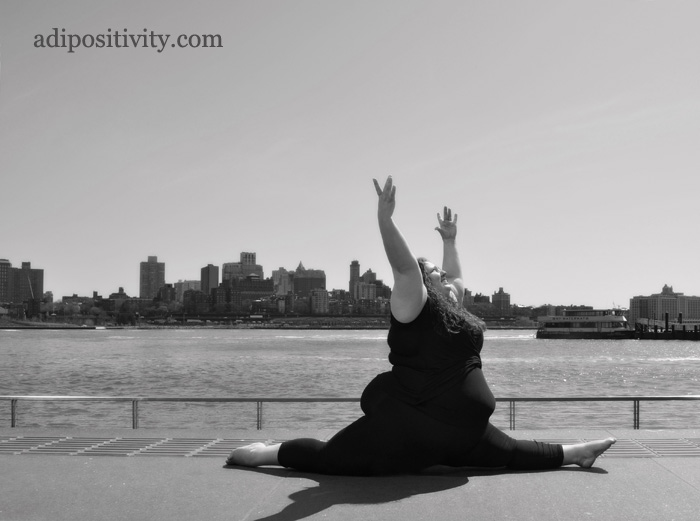
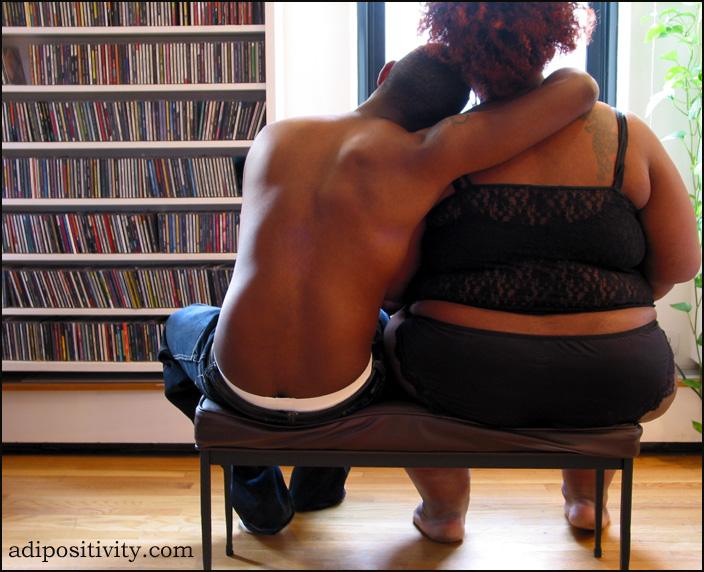
I’ve been aware of The Adipositivity Project for a number of years. Most people who float around Fat Acceptance circles online are aware of it, but when I’ve shown it to friends who aren’t aware of FA, it’s always surprised them. I thought, given the reading for our next class, this was at least visually on topic. I’m also always a fan of activism through art and you can’t say Substantia Jones’ photographs aren’t beautiful or radical. Many of the photographs are nudes, so beware if you decide to click through. I’ve pulled some of the more modest ones to show the intent of the images.
Adipose: Of or relating to fat.
Positivity: Characterized by or displaying acceptance or affirmation.
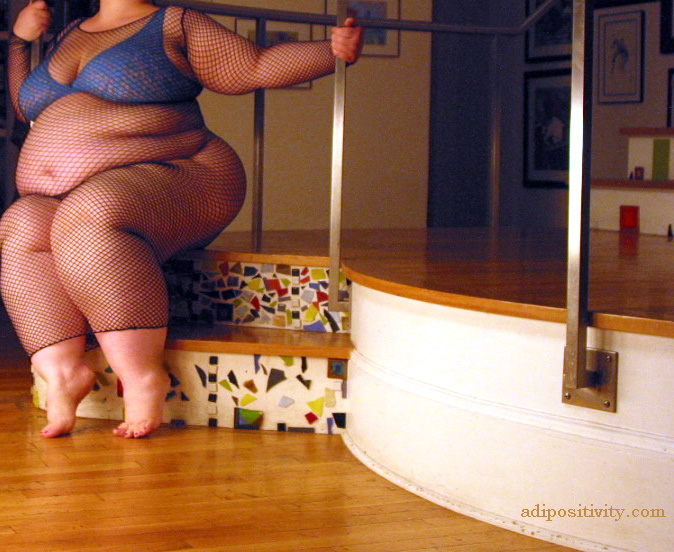
MISSION: The Adipositivity Project aims to promote size acceptance, not by listing the merits of big people, or detailing examples of excellence (these things are easily seen all around us), but rather, through a visual display of fat physicality. The sort that’s normally unseen.The hope is to widen definitions of physical beauty. Literally.
The photographs here are close details of the fat female form, without the inclusion of faces. One reason for this is to coax observers into imagining they’re looking at the fat women in their own lives, ideally then accepting them as having aesthetic appeal which, for better or worse, often translates into more complete forms of acceptance.
The women you see in these images are educators, executives, mothers, musicians, professionals, performers, artists, activists, clerks, and writers. They are perhaps even the women you’ve clucked at on the subway, rolled your eyes at in the market, or joked about with your friends.
This is what they look like with their clothes off.
Some are showing you their bodies proudly. Others timidly. And some quite reluctantly. But they all share a determination in altering commonly accepted notions of a narrow and specific beauty ideal.
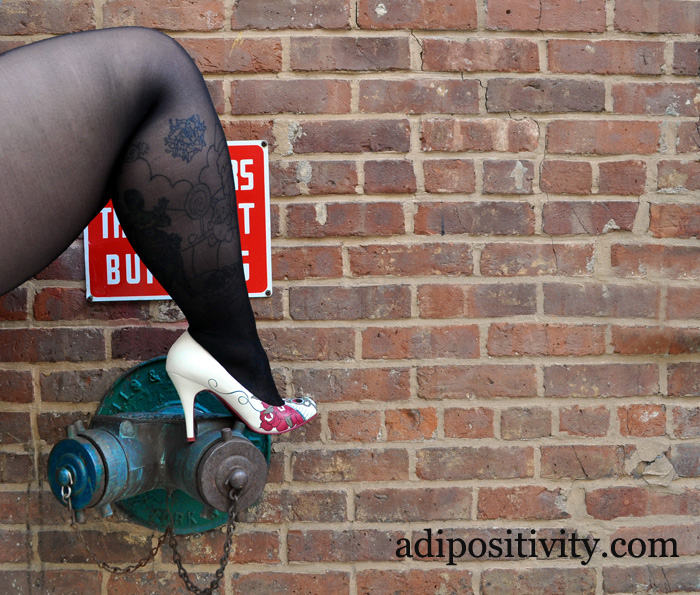
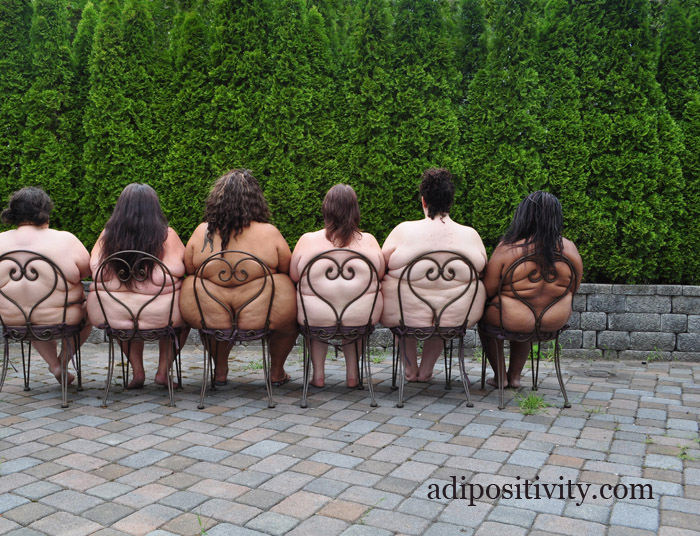
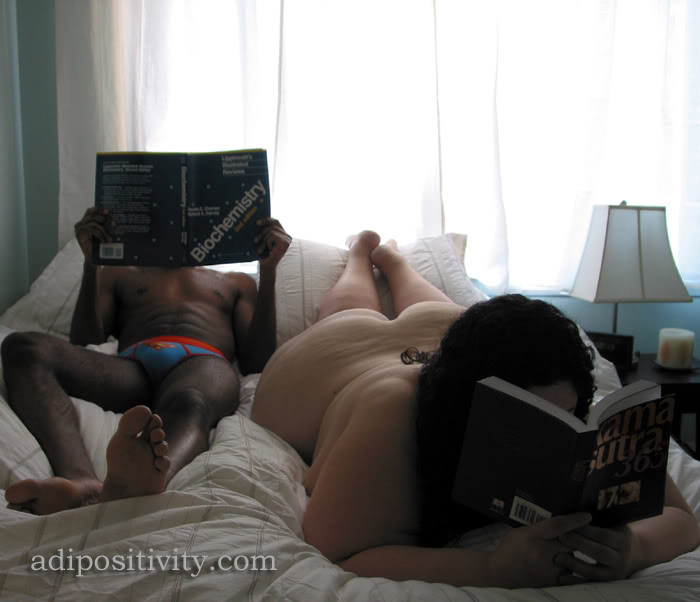
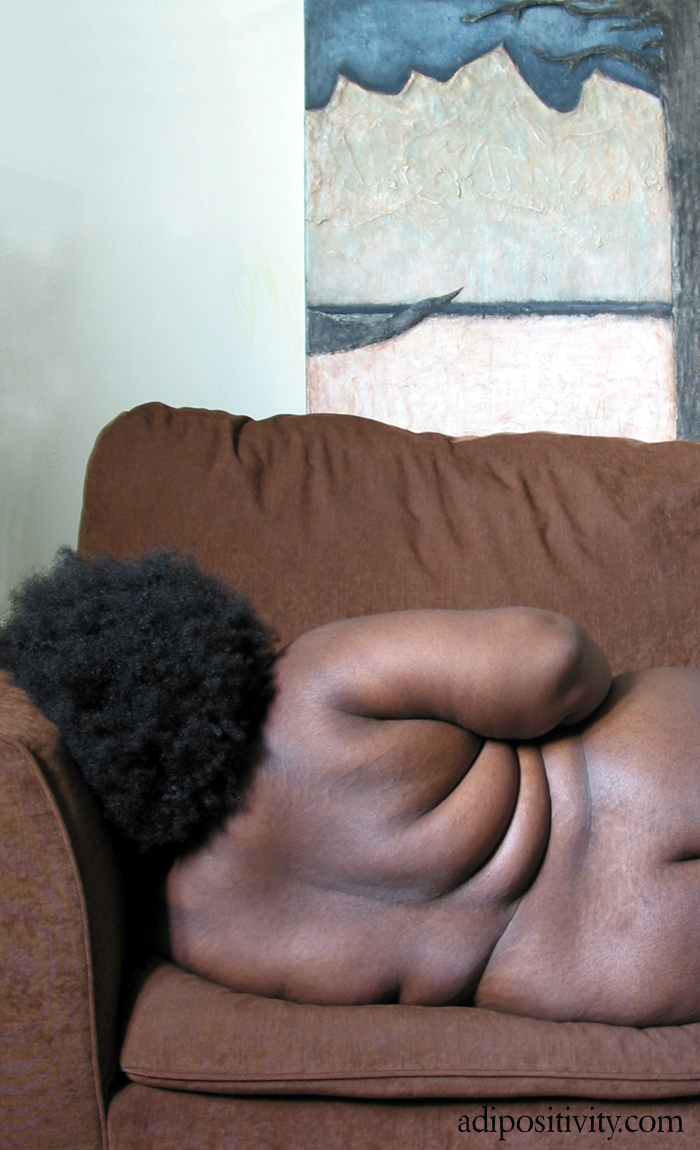
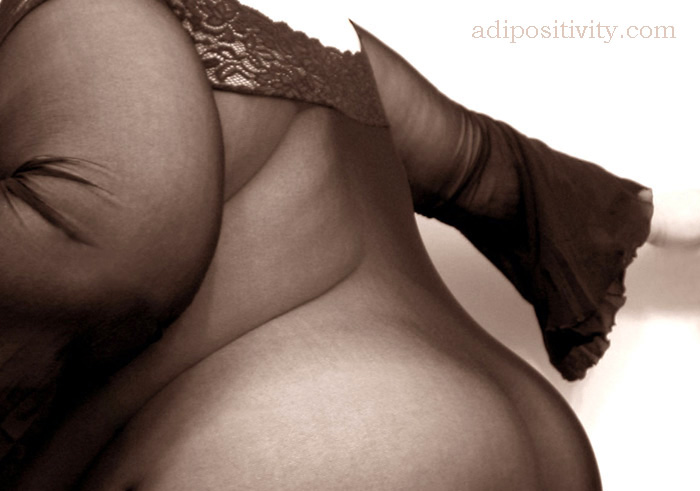
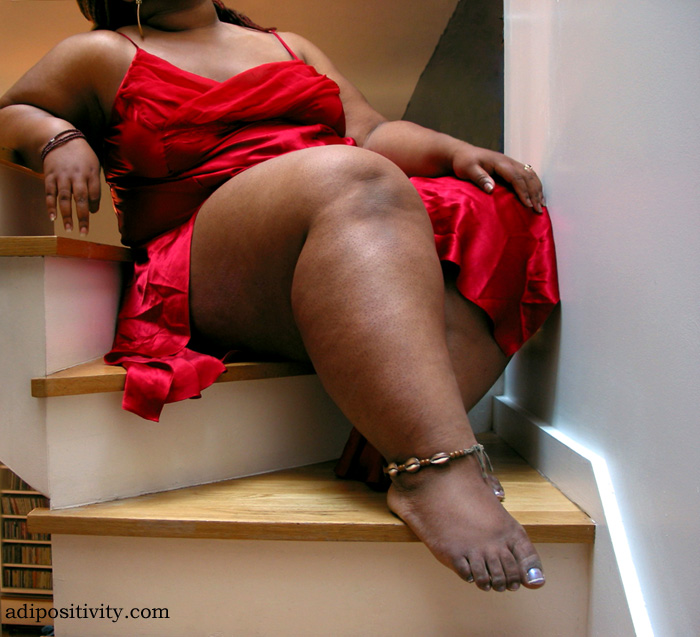
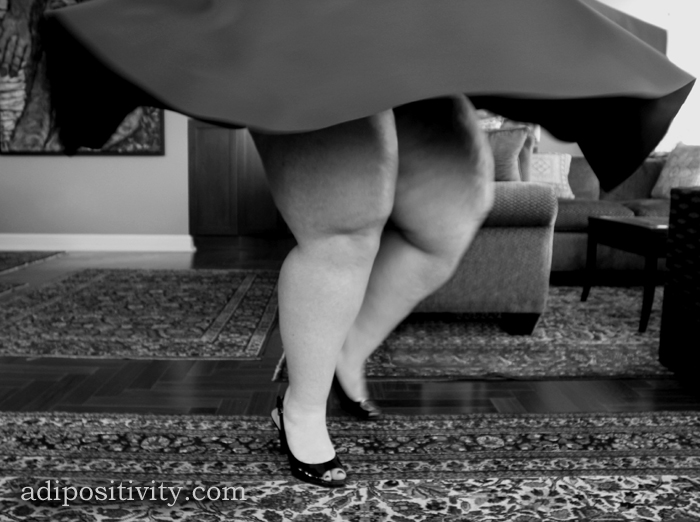
I love this project, especially considering the attempts by the media to include “real” bodies through the use of marketing like the Dove Campaign for Real Beauty and “plus size” (really a size 6-12) models, and how different these fat people look from those culturally approved fat bodies. These aren’t the media portrayed idea of what is “real” (and how problematic is that word in regards to any person?). These (mostly) women, 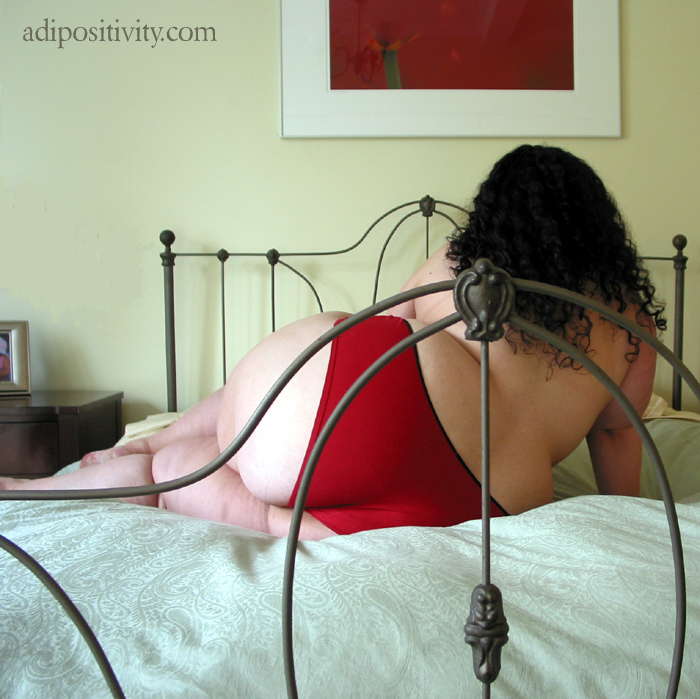 according to the BMI (another problematic method of judgment!), are obese, or more likely morbidly obese (sometimes called Death Fat in the FA community). Most of them probably weigh somewhere in the neighborhood of 200 or 300 or even 400 pounds – yet I don’t think they look like the stereotypical bed-ridden mordibly obese person most non-fats think of when they hear those numbers. Or maybe they do look like those ZOMG FAT people to you.
However you see them, these people are fat, but they have accepted the bodies they have and are living their lives in them.
October Baby
Recently my dad asked me if I would like to go out to dinner and a movie with him and I was touched! I thought it was sweet of him to want to spend some time together. Little did I know what I was in store for. When I asked my dad what movie he would like to go see he said there was a movie out that he had been wanting to see, so I just agreed not knowing what it was, thinking whatever it was it couldn’t be TOO bad, but I was completely wro ng.
ng.
When we got to the theatre he asked for two tickets to October Baby, I had never heard of it. My dad and I settled into our seats in the nearly empty theatre. As the movie began I could tell it was going to be sappy, melodramatic, and a real tear-jerker for those who could connect with the message of the film. I also quickly realized that it was a Christian Pro-Life film.
The film tells the fictitious story of a Christian girl in college who discovers after having health issues that she is the product of a failed abortion. She learns that her parents are not her biological parents and she was adopted. The main character has a difficult time coming to terms with this and goes on a road-trip with her quirky and hip friends to find her birth mother. She is able to find her birth mother after meeting a nurse who used to work at the abortion clinic and remembered the day of the failed abortion. The nurse tells horrific stories of what would go on at the clinic and there are many tears. When the main girl confronts her mother she denies being her mom and in the end the main character writes her a note letting her know that she has “let go” and has forgiven her. Also at the end, you see that the nurse who used to work at the clinic now works in the Labor and Delivery Unit in a hospital. A happy ending for all…
Just when I thought the torture was over, a video of an interview with the actress that played the birth mother started to play during the credits. So of course my dad wanted to stay to watch that. She basically said that she felt that this role was perfect for her because when she was younger she had an abortion and through playing this role she felt some closure. She also felt like she was doing her part to help other women from making the same “mistake” that she did.
By the end of this film I was furious. My dad is Christian and although I was raised Catholic I made my dad aware that I was not religious back in high school. The issue of religion (and politics) have created a large barrier in our relationship. So as the film ended and he asked me if I liked it, I was angered, how could he think I would enjoy this movie? Does he know me at all? I told him that I really hated it. He then called me a week later asking if I had thought about it and liked it anymore. I answered, “No, Dad. I still really hate it.”
What I found problematic with this film is the fact that it was basically instilling false fears into peoples minds about a sensitive subject that is already under attack politically. People were walking away from this film feeling validated in their viewpoints against abortion and women’s rights. Does my dad now think that failed abortions happen all the time? I am not trying to imply that this never happens, it does. But is it really something that needs to be embraced into the anti-choice movement? Also, I believe that if access to safer abortions were increased in the first place this would not be a problem to consider at all. This option of course was not considered in the film though. Instead, they simply vilified the birth mother and portrayed her as a vein,s elf-interested lawyer who has chosen to turn her back on her daughter. Even though the women who played the birth mother has gone through the experience of getting an abortion in real life and should understand the hard decision it can be, she chose to accept this portrayal.
Needless to say, before I ever accept another offer to go to the movies with my dad again, I will thoroughly research the film.
Here is the link for the film’s website. On there is the video of the actress discussing her abortion that played during the credits. The video is called “October Baby Stories: Shari” http://octoberbabymovie.net/#
Nudity in the airport
 Nudity is something everyone comes encounters on a daily basis. Whether it is in the shower or changing clothes the entire populace is naked at some time or another. Although individuals tend to see themselves nude regularly, under certain social situations nudity is considered as a taboo occurrence. However, some people strip their clothes to reveal their undergarments or naked bodies as a sign of protest.
Recently, on April 10, 2012 an unidentified woman was spotted naked in a Denver airport. Denver channel reports the woman was reported to be smoking in a non-smoking terminal, when the woman was asked to put out her cigarette she responded by taking off her clothes. There is differential discourse regarding the causation of this woman’s’ actions. Reports cannot definitively tell whether the woman stripped her clothes was a result of an airport employee asking her to put her cigarette or if she was protesting against Transportation security administration or TSA pat downs. Denver police claim that the woman was experiencing a nervous breakdown while she unclothed herself. The unidentified woman was not arrested but instead taken to a hospital for a mental evaluation. There has been other news coverage regarding individuals who stripped their clothing at an airport because they were protesting against TSA pat downs. For example, a fifty two year old woman in a wheelchair was reported stripping down to her black lingerie to get through security at Will Rogers World Airport in 2010. In addition, a college student who was protesting against TSA pat downs stripped down to a speedo in November of 2010. Nudity or almost nude bodies undoubtedly brings attention to a situation or cause. Nudity is a factor of life that everyone must encounter. The United States has sexualized the body to the point that we as a society feel embarrassed or uncomfortable when we view another’s nude body or when someone touches ours for an extended amount of time. Therefore, issues such as TSA pat down become problematic because many Americans believe in social situations the body should not be touched extensively or seen without clothes on.
Some people report that these pat downs are an invasive of privacy and feel very uncomfortable after the pat down was conducted. After September 11, airports have become aggressive in mitigating terrorist or suspicious activity that may potentially harm their passengers. Now the question I pose to all of you is do you believe airports is invading autonomy over people’s bodies even if it occurs for a brief period of time? More specifically, what would you do if you perceived an airport official to have touched you in a sensitive area longer than deemed necessary?
Martha Nussbaum Contra Judith Butler: Feminism and disability through two critical lenses
Judith Butler stirred up a bit of debate earlier in the course, relating to readability, obscurantism, and other relevant concerns, but also served to supplement the beginning of the class’s ongoing discussion of disability. I found this essay recently by Martha Nussbaum, an important and frequently quoted political and legal feminist philosopher, raising some very interesting criticisms of Butler’s method and conclusions. This also reminded me that Nussbaum was included in the same documentary of which Butler’s walk with Sunaura Taylor was a part, the very thought-provoking and beautifully composed “Examined Life.” What struck me about this mutual discovery/rediscovery was how similar Nussbaum’s piece in “Examined Life” was to Butler’s, considering her polemic objection to Butler’s work in the essay.
The thrust of Butler’s discussion with Sunaura Taylor was that, rather than society being composed of self-sufficient individual agents working for their own benefit in a public sphere of socio-economic exchange, with marginal disruptive aberrations on that structure in the form of disabled subjects, we are all dependent, and we exist in a network of interdependence and contingency. This served as a critique of individualistic programs of thought that continually attempt to entrench normative prejudices relating to ability, sexuality, and embodiment into society. Nussbaum makes a very similar argument. “The theorists of the social contract…assumed that the parties to [the social contract] really are roughly equal in physical and mental power,” she argues, continuing to criticize this Enlightenment individualistic position by not only asserting that it leaves out consideration of unequal capacities, particularly people with disabilities, but that “it’s all of us– when we’re little children, and when we age.” The ubiquity of interdependence and the importance of inclusive social structures runs through both philosophers’ contributions to “Examined Life.”
I was wondering a couple things as potential points of discussion. 1.) Where do Butler and Nussbaum’s arguments about disability and society diverge in these videos, if at all? Is it purely a difference in scope or method, or is there a real difference in position? and 2.) What arguments of Nussbaum’s, in her critical article on Butler, can be vindicated, and what, if any, arguments in Butler show Nussbaum’s criticism to be incorrect or insufficient?
Bald Barbies
Disclaimer: While I have never experienced baldness personally, drawing from the literature on disability and class discussions I felt an affinity with the topic. If I indirectly offend anyone I offer an apology in advance.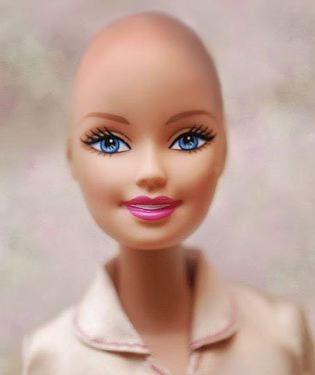
Recently I’ve noticed a lot of rabble on facebook about a topic I never thought would pop up in my newsfeed: Bald Barbie.
There’s a facebook group dedicated to pressuring Mattel to create the Bald Barbie for children who suffer from hair loss due to cancer as well as Alopecia, and Trichotillomania. Mattel has finally released a statement saying they will create Bald Barbie but it, “will be a friend of Barbie, which will include wigs, hats, scarves and other fashion accessories to provide girls with a traditional fashion play experience.”
Hm. So, the new doll cannot be labeled a “Barbie” and she still has to have fashion accessories which, in my interpretation, (and perhaps this is my raging feminist coming out) means people who have hair loss still have to cover up their scalp since baldness cannot be accepted as normal.
Not only will Mattel’s new doll not be a “Barbie”, she will also only be distributed to children’s hospital for reasons of “directly reaching girls who are most affected by hair loss”. But what about the children who are not in hospitals who have experienced hair loss? And how does a hospital reinforcing to the children that they’re still beautiful actually combat the main message that Mattel sends out to the general public on a day-to-day basis, i.e. beauty has a certain standard, and if you don’t have the hair and body for it, you will never be beautiful.
Could placing the doll on the shelves of a toy store create too much of a sense of normalcy towards hair loss?
From the past course discussions on disability, and the invisibility and inaccessibility that many disabled people have expressed they have experienced; I don’t think that Bald Barbie does much to enhance the lives of children who have experienced baldness.
By only distributing these dolls to hospitals Mattel is stating that baldness is still a disability and is associated only with illness. Mattel could release Bald Barbie in mainstream stores and allow Bald Barbie to be viewed right next to a Barbie with hair but then what message would Mattel be sending to the children that experience baldness? Beauty standards can actually deviate from what Mattel portrays them to be?
If Bald Barbie were to be considered equal and sold in the mainstream market right next to a Barbie with hair I think children who experience hair loss could actually feel acceptance and beauty towards their baldness, especially when Barbie is such an icon for female children for femininity and glamour.
I think Mattel’s creation and distribution of Bald Barbie is just another way to emphasize disability rather than accept it.
Design improved by (dis)ability
So we’ve talked quite a bit about how architecture and spaces treat (dis)ability as an afterthought, defining a norm and making often weak attempts to accommodate those who do not fit inside the normative box. But this doesn’t always have to be the case. There are some really smart designers who have flipped this script- collaborating with people of different abilities in order to come up with design that is beneficial to everyone.
Take for example the OXO Good Grips line of kitchen utensils. We’ve all seen  them- peelers with really thick handles, unusually shaped can openers. Cool looking, but not the norm in utensil design. It turns out, this entire line was designed in consultation with arthritis sufferers, in order to create kitchen tools that they could easily and comfortably use at a reasonable price. Now, OXO Good Grips is one of the best selling brands of kitchen utensils around the world. A simple thought- making an easier to use potato peeler- leads to better design.
But what about architecture? How can it be impacted by collaboration across abilities? At DC’s Gallaudet University, which specializes in educating those with hearing impairments, new buildings are showing innovative design meant to help the deaf that could end up in your new office building or classroom. Walking and talking is one of the cornerstone experiences of college life- but this becomes a bit trickier when you’re speaking a language that is visually based. Buildings offer numerous obstacles to these conversations- narrow hallways, doors that have to be opened. Gallaudet is creating buildings with wider hallways and wider sliding doors to better accommodate students’ social life. Eye strain, again a common college problem exacerbated by needing to use your eyes to take in every second of classroom interaction, is dealt with by thinking of light sources and room color. Each innovation is driven by thinking of (dis)ability first, and each one something that could be valuable to the world at large.
Is this a next stage in industrial design? Instead of trying to make a product comply to Americans with Disabilities Act standards, should we instead focus on making products more inclusive from the start? It’s a bit of a rhetorical question, sure, but the real question is, why aren’t more people thinking this way?
The Girl With The Dragon Tattoo (WARNING! i tried my best not to spoil anything but….you never know soooo proceed with caution)
Just recently I viewed the movie “the girl with the dragon tattoo”. Though I had never read the book, rave reviews had me really excited to see the film. Ill do my best not to spoil anything for those who still plan on seeing it or those who have not read the book, however there were a few things that definitely stuck out to me.
For one thing, I took notice of how the main character was viewed and treated as a result of her appearance. I would love to say I was shocked, but it is very representative of what goes on everyday in our society. The main character seemed to be a rebel from her piercings and tattoos down to the way that she chose to dress. Because of this, certain people with whom she worked closely with doubted her ability to complete intricate tasks successfully, though she would prove throughout the movie that she was clearly the best for the job.
At times, the movie reminded me of a class discussion that we had towards the beginning of the semester when we talked about embodiment and how mental abilities are separate yet go hand in hand with what is embodied in physical form. The main character in the movie, who was a warden of the state, was deemed incompetent and as a result was not in charge of everyday things like her own finances for example. It was interesting to me how certain authorities that she had to report to, acted as this so called “mental incompetence” viewed her body. I think this often times happens during this day and age which leads to serious things such as violence as well as sexual assault.
The Great Wall of Vagina
Artist Jamie McCartney is trying to start a sexual revolution… but not the kind we usually think of.

He is attempting through art to change female body perceptions and show us that every woman’s vulvas are normal. McCartney is a life cast artist; he spent five years collecting casts of volunteers’ vulva mounds and has turned the result into The Great Wall of Vagina.
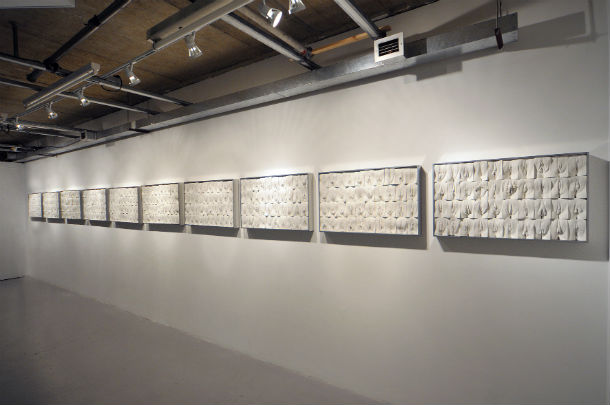
The work includes 400 casts, as accurate as photographs, displayed in ten wall panels. They range in age from 18 to 76 and include mothers and daughters, identical twins, transgendered men and women, women pre and post natal, and another one pre and post labiaplasty. It is impressive and at times overwhelming, but by reducing the body part to a simple white plaster cast, he removes the sexualization we would typically attach to such a display. His use of spectacle shows us how absolutely diverse each and every woman’s vulva is – on the website it mentions how each one is as unique as a face. And they are!

“For many women their genital appearance is a source of anxiety and I was in a unique position to do something about that.” - Jamie McCartney
There are several things I find interesting about this art project. First, by bombarding us with 400 vulvas in a small space, he reduces the body to a single part, from a view many of us have never seen. And while we ARE viewing the diversity and differences in vulvas, it also manages to emphasize the similarities. We see the similarities in our differences.
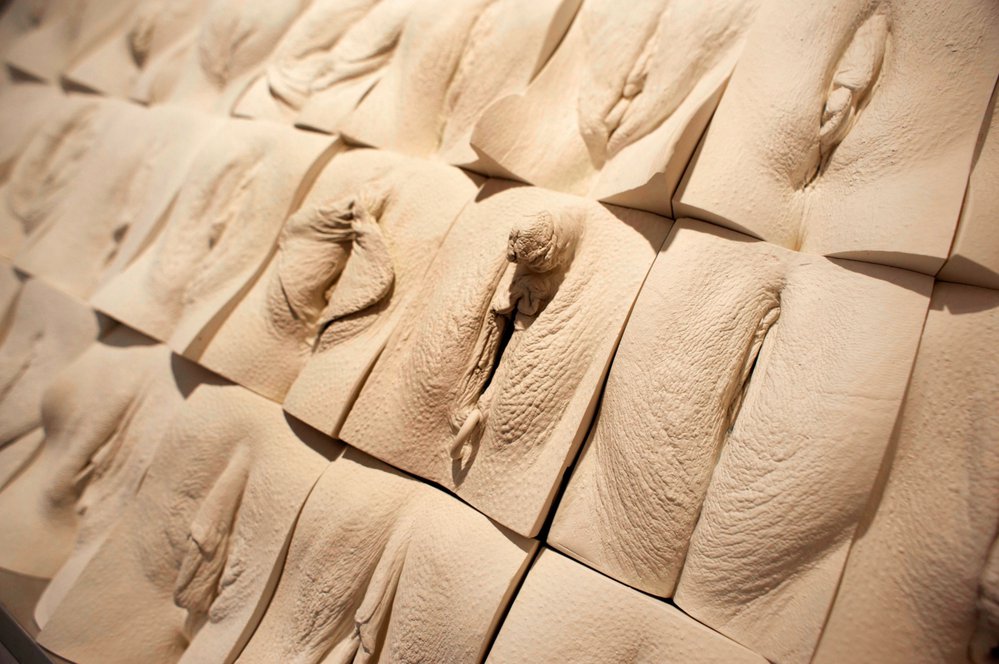
And second, if women are shocked and surprised at the diversity shown here – why is that? Is it simply because most heterosexual women haven’t seen other women’s open vulvas? Or is it the “pornification” of our modern culture? If labiaplasties are on the rise, do you think an exhibit like this would help stop that trend? Do you think hetereosexual men and lesbians are surprised by this diversity?
So, would you go see the show? And if you are the owner of a vulva, are you looking for one that looks like yours?

“It’s time our society grew up around these issues and I’m certain that art has a role to play.” - Jamie McCartney
Hijabs and Hoodies
After we discussed the horrific and tragic murder of Trayvon Martin in class today, this article in particular caught my attention:
Shaima Alawadi, a resident of San Diego, California, was found beaten unconscious in her home last Wednesday and died of her wounds this past Saturday. A note was found saying, “Go back to your own country. You’re a terrorist”.
Shaima was a stay at home mother with five children.
http://www.reuters.com/article/2012/03/28/us-california-iraqi-memorial-idUSBRE82R01N20120328.
This happened less than a week ago.
There was mention in class of how certain ideas in society become normalized, for better or for worse. In Trayvon and Shaima’s case there is no question these ideas create a poisonous environment.
But in both cases there was a similarity: clothing.
Trayvon was wearing a hoodie; which according to sources across the spectrum, most notably Geraldo Rivera, made him a target for suspicion. Last I checked wearing a hooded sweatshirt left no one with the ability to label someone as “suspicious” and cause cruel loss of life to another.
Shaima also had an article of clothing that marked her; a hijab. For those who are unfamiliar with a hijab, it is a head covering traditionally worn by Muslim women for reasons of modesty. Yet by wearing a hijab Shaima marked herself as “other”.
I find myself wondering if we can draw parallels between Shaima’s and Trayvon’s murders. They were both marginalized members of society, Trayvon was black and Shaima was an Iraqi-American immigrant. Both were wearing articles of clothing that are innocuous (although a hijab may stand out for those unfamiliar with the garb) but these clothes became threatening to those with prejudices and stereotypes.
I think we, as a Western society, are not past our cultural and racial biases when two murders are committed within a month of each other on the basis of race and ethnicity, with the flimsy excuses of clothing as reasoning. (By the way, I’m not ignoring that there are far, far too many of these crimes that go purposely unnoticed or are unreported).
In response to this hate crime there has been an out pour on social media and I found a group on facebook that seemed particularly fitting: http://www.facebook.com/pages/One-Million-Hijabs-for-Shaima-Alawadi/137306256397032.
When women are told, “you were asking for it”, if they are raped and happened to be wearing a miniskirt, when young black men are shot for wearing hoodies, and a woman is beaten to death in California for wearing a hijab because it “makes her a terrorist”, I have to wonder about the emphasis placed on clothing and the body-the cycle of violence around the clothing people wear for religious or personal reasons and why people use these articles of clothing as excuses for committing atrocities.
I find myself sick at heart with the violence, the hate, the prejudice, and the inbred bias. I send loving and peaceful wishes to the members of Trayvon Martin and Shaima Alawadi’s families.
 Unruly Bodies