Deaf Fest

As I was watching Crip Camp (2020) for this class, I was reminded of one of my favorite childhood memories. My mom was a special educator for the Deaf and Hard-of-Hearing for around 25 years. She used to teach in the city schools of Brooklyn, and began working in Baltimore City when my family moved from New York to Maryland. My mom was like a second mother to her students. She would often bring hot food to her students around the holidays, crowd-source school supplies, teach her students Latin-dancing, and even would have some of her students over to her house when they were having a rough time at home. I treasured the days that I was able to come visit the classroom and her students. It always made me smile to see how my mom so deeply cared about her kids.

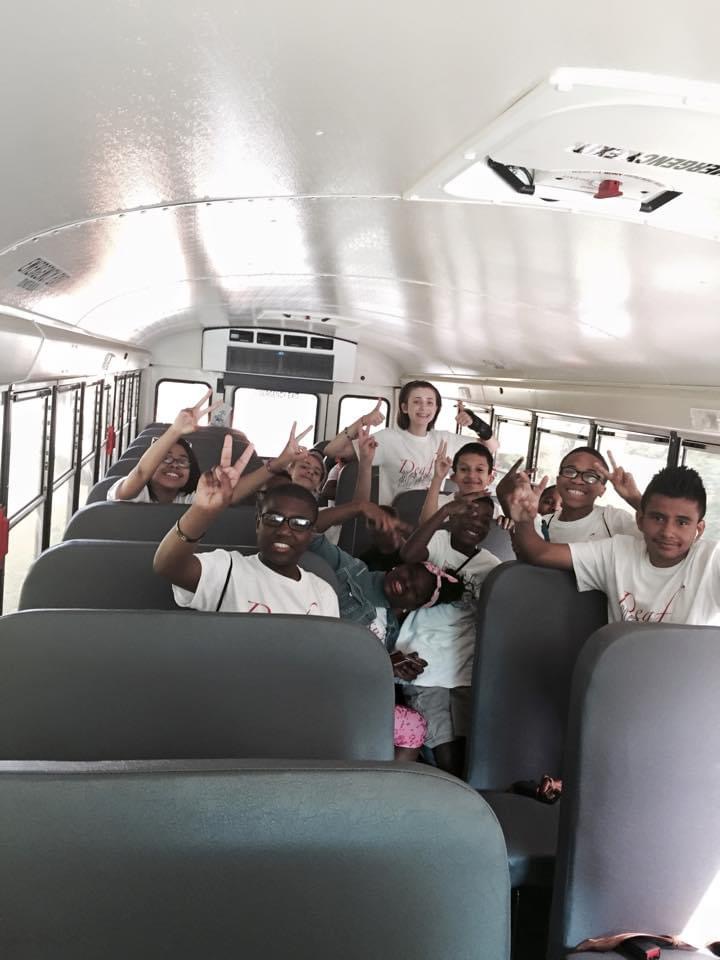
Group of smiling children on a school bus, wearing matching white t-shirts that say "Deaf Fest" in red text. All of the children are holding peace signs up with their hands while smiling at the camera.

One of the things my mom and the other teachers did for the Deaf and Hard-of-Hearing students every year was Deaf Fest. One sunny day at the beach every year, complete with matching t-shirts designed by my mom, grilled hotdogs, hamburgers, pavilion snacks, arts & crafts, and games. The bus ride to the beach was loud and cheerful, and every student was so excited for the festivities to come. The students gave me my sign name during Deaf Fest one year- the letter “S” combined with the sign for “dance”, because I was always dancing around the classroom when I came to visit them. On the bus and in the pavilion, my mom’s students would help me learn sign language by signing to me. Even though I was very young during these years, I could feel the powerful sense of community Deaf Fest brought.

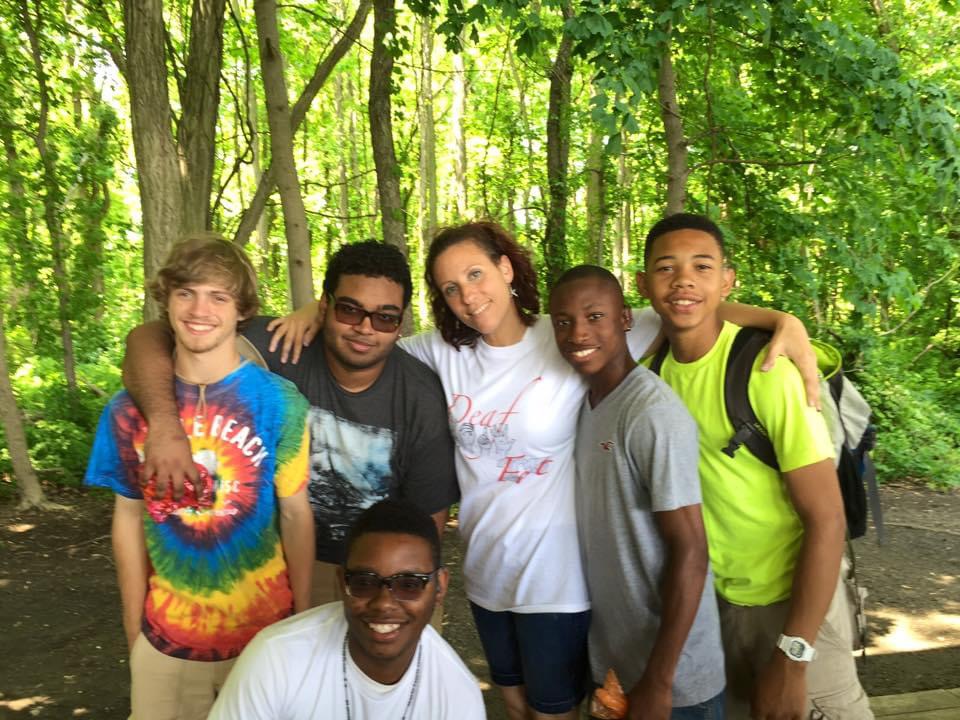
A group of students smiling for a picture with their teacher outdoors. The background is bright green with trees and greenery, with the sun peaking out of the trees.

Although Deaf Fest only happened one day at the end of the school year, I was reminded of the happy memories it brought as I was watching Crip Camp. Nostalgic images of Deaf Fest floated through my mind while I witnessed the ways in which Camp Jened members were seen and supported during camp. I also saw resemblance in my memories of the days spent in my mom’s classroom, how the school system rendered these kids invisible to the hearing world. In my college years, I find myself eternally grateful for being able to experience the joy that Deaf Fest brought to my mom’s students, and I hope that I have the privilege of experiencing that level of community again.

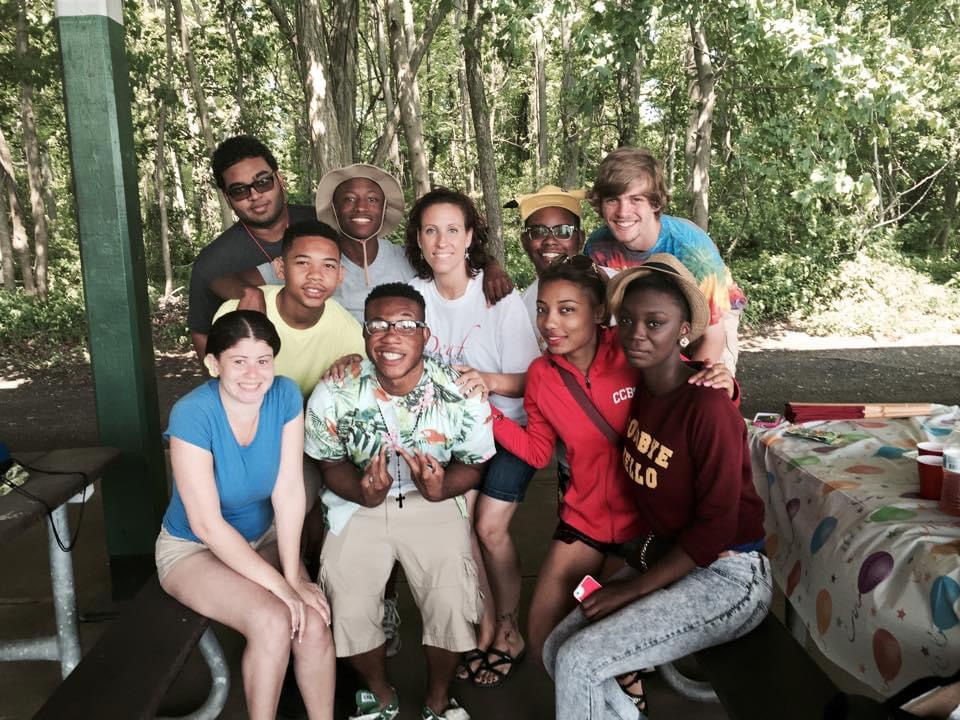
a group of students, some sitting and some standing, posing for a picture with their teacher under a pavilion on a bright and sunny day.

I Love My Fat, Trans Body

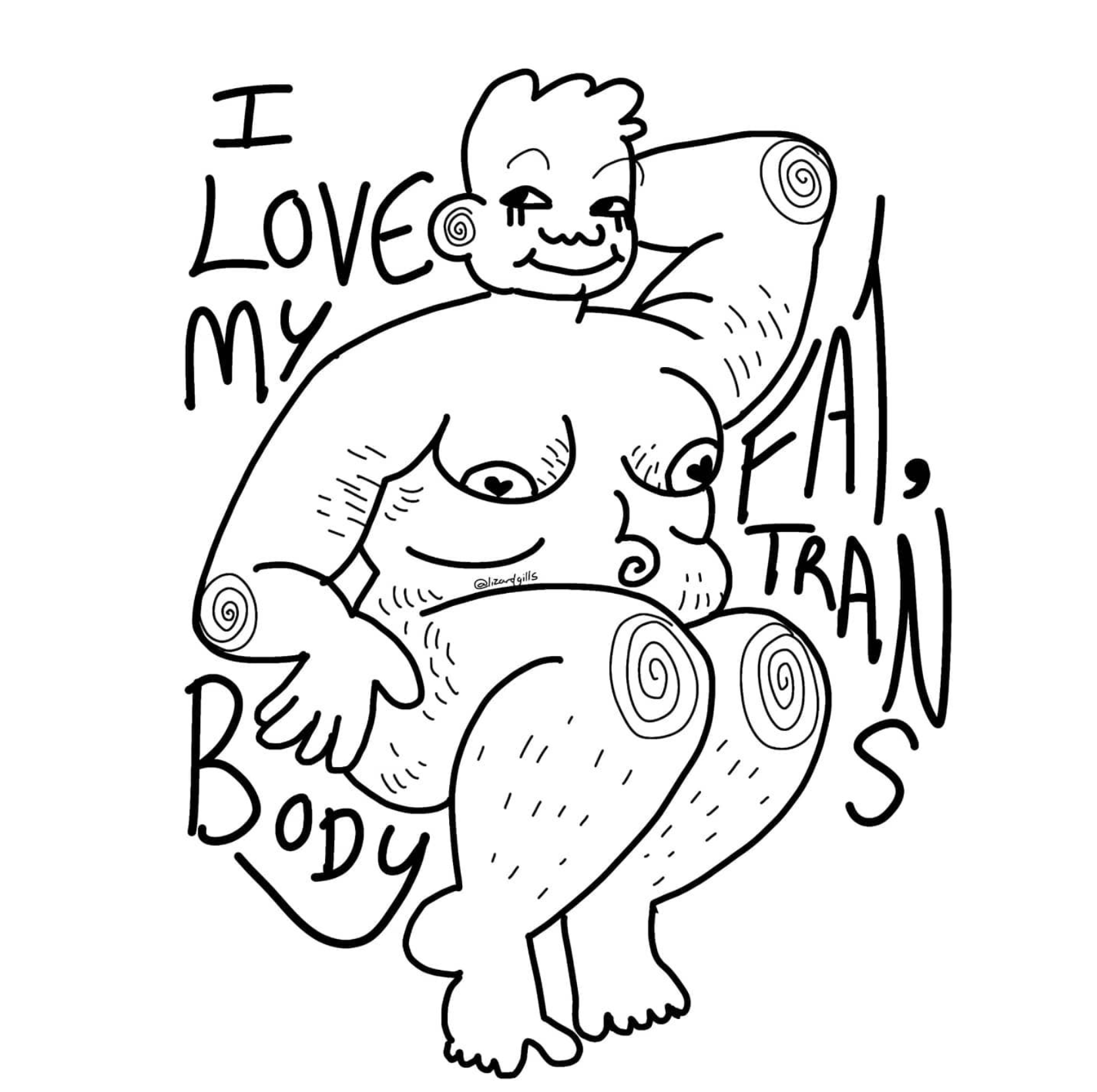
A picture I drew in 2021.

When I think about my transness, one thing that I believe is inherently intertwined with that aspect of my identity is my fatness. I find there to be power in the body. But the combination of being trans and fat, particularly due to the lack of representation of fat bodies in trans spaces, is something that has always bothered me.

Read more: I Love My Fat, Trans Body

It’s one reason I really enjoyed this article (https://medium.com/@sbearbergman/please-come-and-be-fat-cc04ed4d8772) that I found online some years ago. It really spoke to me as someone who struggled to pursue top surgery due to being fat. I had to pay out of pocket for this life changing surgery because the only surgeon in the state that accepted my insurance had a BMI limit; which, if you did not know, BMI is an outdated practice – a BMI limit for top surgery instead shows a lack of effort on the surgeon’s part to learn to work with fat patients, a problem which would be solved with more representation – more patients, more outreach, more effort.

Top surgery was monumental in my journey to loving my body. It saddens me so incredibly much to hear other fat trans folks talking about the lack of representation in our community, because I’ve also seen how much we get talked over by our thin counterparts. Even within the trans community, the lack of representation of fat bodies has lead to many thin trans individuals not understanding the unique struggles that come with being a fat trans person.

I love my fat, trans body, and I want everyone with the same experience to be able to say that.

A Nightmare in Healthcare

Before reading I just want to put a warning that my emotions were high during this post and I hope I don’t offend anyone who is going into healthcare or have family in healthcare.

As a little kid you are taught the basics; police officers arrest the criminals, firefighters put out the fire, dentists clean your teeth, teachers teach and lastly a doctor “helps” you with a stomach ache or something.

Well this can be true and untrue at the same time considering that we have this huge issue of doctors refusing treatment that occurs in the healthcare system since the 18th century. Sadly this is a recurring nightmare for POC because it continues to be a problem that POC don’t receive the same fair treatment as a non-colored person in the healthcare system. 20-30% are more likely to experience negative healthcare outcomes due to racial bias, now this percentage is continuing to be documented as research continues so this number could be higher or lower. But after hearing Lovejoy’s story about how she went misdiagnosed because she had something that only “white people” can have is sad and the fact that she had to endure the pain that she did because of that.

Now you’re probably thinking what does this got to do with me well I’ll tell you. Now I didn’t experience this first hand but I saw with my own eyes happen to my mother in 2019. My mom at the time had kidney stones that bothered her that entire year. She went in for multiple tests while it was still at its early stage of development and I think you can guess that of course the doctor’s found nothing wrong at the time. During that entire year of back and forth hospital trips they couldn’t seem to figure out what could be wrong with her (all they had to do was check her blood) and when they did start finally doing that after months my mom had endured severe bruising on her arm and it swelled up because they spent a whole 15 minutes poking her with IV because they couldn’t find her vein on my brown skinned and veins showing at all times mother. When they finally found the issue by switching through different hospitals and instated her in the hospital I had to hear the news from her doctor that she was even lucky to be still alive since she went so long being untreated.

The fact that I almost lost my mother to a system that you’re taught will help when you’re ill is frightening to see as a young black woman. Those memories of my mother being treated unjustly and watching and hearing her be in pain for months and feeling hopeless because there was nothing that professionals can do for her something I will never forget. I was 16 when this happened and now I’m 21 still in fear of what could happen to me if I were to fall ill and have to go to the hospital.

The Potential of Body Neutrality

This reminded me of what we have discussed in class regarding how society prioritizes weight and what bodies look like. In our everyday lives, there is constant expectation of what our bodies are “supposed to be,” what type of body is deemed “healthy” or not, and what bodies are “moral” or “immoral.” Especially with social media, people’s bodies are only placed on a pedestal where hundreds and thousands of people look, judge, and comment. Over time, it becomes distressing because it can be extremely dehumanizing to constantly be aware of others’ entitlement to comment on your body and interpret it, whether those remarks are positive or negative. In this sense, as society focuses on weight and the body, you are left to feel as though you are no longer human with a personality, character, or morals, but rather just a body defined by weight.

With this, I can’t help but wonder: How can we change these expectations and concepts that invade how we view and think about weight and bodies?

I think of the body-neutrality movement that we touched upon in class discussions. Body neutrality embraces the practice of simply accepting your body for what it is rather than constantly trying to have a positive or loving mindset. There is no positivity or negativity tied to bodies, but rather just an acknowledgement of their existence as they are. I find that this has the potential to make a change in how the world views and thinks about bodies and weight, as recognizing and accepting bodies as they are disadvantages ideas of “good” and “bad.” While this cannot be done overnight, there needs to be a change in how we think about weight. Ultimately, there could be a great benefit in embracing movement such as body neutrality and understanding and accepting weight and bodies as they are, rather than attatching them to notions of positivity or negativity. 

GAD and Emotional Labor — A Full-Time Job

Earlier today, I had to go grocery shopping. I was missing a few things around my apartment, and naturally had to make a quick stop at the Giant near campus to grab a couple of things. The trip itself didn’t take more than 30 minutes, and despite the crowds in the store, I had no issue finding and purchasing everything I needed.

By the time I returned to my apartment, my heart rate was averaging 120, I was covered in stress sweat, and I felt like my brain was scrambled eggs, just like the one “Your Brain on Drugs” ad — except my brain was just on tons of stress hormones.

Continue reading →

Social Darwinism, Work, Education, Poverty, and death.

One of the things that I never understood about the way that our life in this country is structured is how miserable your supposed to be while engaging with it. There is so much misery involved in the everyday lives of human beings, especially those that live in poverty. this excess stress from always being in a state of precarity and being underpaid to take care of basic necessities. For impoverished college students, the cost of schooling and the menial work of trying to ensure that your institution grants you the correct amount of money to be able to cover tuition cost (and potentially room and board). For impoverished workers, there is always a threat to your employment that more likely than not doesn’t pay enough to survive. In an economy, where degrees are paradoxically more necessary than ever and historically undervalued, rent prices are going up exponentially, and school is more unnattainable for the working class since the 60s, we are expected to do school and work, and self management of the body all at full time. In these state of affairs, I wouldn’t be surprised if the ruling class is simply trying to get the poor citizens of america to just what they’ve wanted them to do forever: to die. The system that we are working within today is one that drives a working laboring body so far to the point of desiring death, and then punishing the unwilling participants for saying the desire outloud. their desires for the working body not to die does not come from care for the working body, but from the need to utilize the working body. the wealthy have already revealed to us years ago that they actually do not care about the well being of the poor. From the various austerity pollitics coming out of the Reagan era that created a profit incentive from credit and debt to as far back as victorian attitudes surrounding social welfare, the ruling classes have always made it clear that they do not believe that the poor actually deserve to live. Social Darwinism has been a long lingering school of thought among the wealthy, the idea that the economically strongest individuals should survive and those who fall short should die off. This is not only limited to financial success, but also ability, temperment, and perceived morality that many on the right is genetically inherited (essentially economic eugenics). However, If all of the working and lower class individuals just died, they wouldn’t be as economically “fit” as they are, as their wealth depends on the labor provided by the working class. If the stress and anxiety gets to a working class person to the point of them wanting to take their own life, the various institutions (educations, work, and family) will work to try and convince them to not take their own life, which may involve serious caring conversation or serious medicalization. I find it very funny that as much as the wealthy seems to not want the poor to be able to survive, they depend on their lives continuing in order for them to stay as comfortable as they are (sorry about this being a lot, i’m going through some stuff at the moment. I’m Okay, this post is just something i’ve been thinking about for a long time).

Autistic Masking & Trans Passing — The Venn Diagram is a Circle

Autistic people are a lot more likely than the neurotypical population to identify as transgender — something I personally chalk up to us having a keener eye for social norms that make no sense (the gender binary being no exception). As an autistic trans person who has to deal with the social repercussions of both these parts of myself, I have noticed how society is built not only to prioritize cisgender neurotypical people, but to actively shun those who don’t fit in either category in very similar ways.

Continue reading →

Work and Worth: A Journey

As a college student, I’m constantly juggling classes, assignments, and part-time jobs, and I often feel like I’m being pulled in a million directions. It’s exhausting, and I sometimes find it hard to keep up with everything. Beyond my studies, I want to be there for my friends and family, but it often feels like I’m barely keeping my head above water. Lately, I’ve been thinking a lot about how work and health are connected, especially as I prepare to step into the workforce. The transition to independence is daunting, and one of the biggest challenges I face is figuring out how to take care of myself amid all the chaos. Unfortunately, essential topics like nutrition, stress management, and work-life balance are rarely taught, leaving me to navigate them on my own.Reflecting on the history of labor in the United States, I realize that the fight for workers rights has been long and difficult. Over the years, labor movements have battled for fair wages, reasonable hours, and safer working conditions, paving the way for healthier workplaces today. But after reading “Made by the Work: A Century of Laboring Bodies in the United States” by Ed Slavishak, my perspective on the human cost of labor has shifted profoundly. Slavishak dives deep into the harrowing experiences of early 20th-century workers. It’s hard to fathom that laborers in steel mills and coal mines faced daily dangers and grueling conditions, with their bodies treated like mere tools for productivity. One statistic that struck me was that over 25,000 workers died every year from workplace accidents. That number is staggering and heartbreaking. It hits close to home for me because it makes me think about how easy it is to overlook the sacrifices of those who came before us, who were seen as expendable and pushed to their physical limits until they broke.

Sitting in my cozy dorm room, surrounded by textbooks and my laptop, I feel a mix of privilege and guilt. I belong to a generation that, for the most part, doesn’t have to face such dire conditions. It’s easy to take that for granted, especially when I’m so consumed with my own struggles. While my working environment is much safer, I can’t help but feel frustrated by how companies historically handled safety or neglected it entirely. They placed the burden of safety on workers, insisting that “the best safety device was a careful worker” (p. 152). That mindset is infuriating because it shifts the blame onto the very people who had little control over their situations.As Slavishak points out, corporate safety campaigns “shifted responsibility to avoid the costs of updating machinery or improving ventilation” (p. 152). This is maddening. It reminds me of the pressures I face in college. I often feel that I’m expected to power through exhaustion or even illness just to meet deadlines. I think about how many workers today might still feel that same pressure to sacrifice their well-being for the sake of productivity.Learning about unions and workers’ compensation laws has given me a profound respect for those who fought for workers’ rights. They understood that workers deserved to be valued for more than just their output, advocating for crucial things like life insurance and compensation for injuries. Slavishak notes how the insurance department of the Amalgamated Association of Iron, Steel, and Tin Workers directly asked its members, “What are your chances of living twenty more years? Can you afford to tempt fate?” (p. 153). That question resonates with me. It makes me think about the importance of community and looking out for one another in college. We’re not just isolated individuals scrambling to succeed; we’re part of a network that can uplift and advocate for one another. As I navigate my college journey and prepare for the future, I’m reminded that the fight for dignity in the workplace is far from over. It’s not just about securing a job; it’s about creating a work culture that values us as whole people, not just for our productivity. Reflecting on the struggles of past workers fills me with a sense of responsibility to carry their lessons into my own life. Balancing everything can feel overwhelming at times, but I know that by supporting each other, we can work toward a future where every worker is treated with respect not just for their labor, but for their humanity.

N.A.D – No Apparent Distress

TW: Abortion, Pregnancy Loss, Ectopic Pregnancy

June 2022 – After being on the birth control implant, Nexplanon, for 7 years I decided to have the implant removed. I wanted to give my body a break and be able to regulate my hormones and cycles naturally. I could not take the constant anxiety attacks and overall poor mental health caused by the high dose of continuous hormones being released into my body. Once removed, I never felt so clear headed or so relaxed. It felt as if a storm of clouds around my head just dissipated and my cycle returned to normal. I felt as though I had a new outlook on my body and the way it is supposed to be. 

July 2022 – It is mid July and I am driving down 95 heading to Baltimore. I feel a strange tingling and pulling sensation in my lower abdomen. I have never felt this before, it was such an unusual feeling that I made sure to take a mental note. Subconsciously, I already knew. A week passes, my cycle never comes. One evening, enjoying time with my partner at the kitchen counter; I casually slip into the conversation, “I think I’m pregnant.” He looks at me, totally unfazed, “I think you are too.” he says. The next morning, the test is positive. Neither of us are at a stage of life to raise a child. Only two other people are made aware of the situation, his sister and my best friend. The abortion is scheduled for mid August.

August 2022 – It is the evening before the procedure. I am terrified but I have planned to stay at my partner’s house where he and his sister can help me recover in secret. We order food and enjoy the evening as usual, there is nothing out of the ordinary. Throughout the day I had some light brownish spotting, not uncommon for a pregnancy. Right before bed I decided to pee one last time. This time there was one small drop of bright red blood in the brown. This does get my attention but I shrug it off. 

I jolt awake at almost 2:00 am on the dot in unbelievable pain. I stumble to the bathroom in the darkness and I flip the light on. I am hemorrhaging blood and the pain is indescribable. Instinctively I know something is very wrong. At this point the pain is so bad I crawl back to the bedroom to wake my partner.  He stirs, I say, “Something is really wrong, wake your sister. We have to go to the ER.” He goes to get his sister, a veteran shock trauma nurse and chief of hospital operations. I am barely conscious on the floor, bleeding, sweating, and in extreme pain. She says, “I think you may be having a miscarriage.”. I respond, “What if it is ectopic?”. I have never been pregnant before but I knew this was something much more dire. 

After struggling to even be able to stand, my partner and I finally arrive at the ER at 3:00 am. He is basically carrying me through the door, hospital security quickly gets me a wheelchair and I begin to violently vomit at the check in desk. I explain to them I am pregnant and something is seriously wrong. I am taken to a treatment room for IV fluids, my veins were so shallow the nurses could not hit a vein. I begin drifting in and out of consciousness as the nurses are stabbing me over and over and shouting at me to stay awake. Once the IV is placed I am left alone in a chair off to the side. I begged for somewhere to just lie down, even the floor, as sitting straight up was extremely painful. Denied. The IV bag is empty, back to the wheelchair in the hallway. 

8 hours of what felt like being stabbed over and over by a dull serrated knife pass. The minutes felt like years. Pain meds, denied. At 11:00 am, I am given a room with a bed, it would be another hour before pain meds. Finally, relief. An internal ultrasound is performed, the results inconclusive. The doctor comes in to discuss the results, the results are inconclusive and discusses the possibility of an ectopic or a miscarriage with a fallopian cyst. There is too much “sludge” in my uterus to be sure. She pushes to send me home with mifepristone and misoprostol. I refuse, I am not leaving this hospital without surgical intervention. A second ultrasound is performed with a specialist. Results, inconclusive and exploratory surgery is recommended; the surgery is scheduled for 5:00 pm. 

14 hours since check in and I am on my way up to the OR. I am terrified and crying. Everything goes black. I wake up and I am told the surgery was successful. However, I am told that my tube was extremely close to rupturing and had it been any longer it could have been fatal. Discharge: 7:00 pm, 16 hours since check in. My partner drives us home, he never left. The beginning of recovery starts. 

March 2023 – I log into MyChart, the hospital database which includes medical records. Just out of curiosity I decide to read the medical documentation from my ER visit and surgery. There, on my intake notes under patient condition, reads in all caps “N.A.D”, no apparent distress. I am horrified. 

Women in medical settings already have their symptoms dismissed or minimized, pregnant women especially. Our symptoms are written off as “just being a woman” or pregnant women being labeled as “dramatic” or “overreacting”. What could have happened if N.A.D had not been placed on my chart? Could I have gotten the help I needed sooner? Would I have had to suffer for as long as I did with a critical condition? To this day, I still have not mentally recovered from this experience. For pregnant women in the ER, vomiting, loss of consciousness, hemorrhaging, loss of full mobility, and extreme lethargy are considered N.A.D. This is the sad reality for many women who seek medical care. Even when you are on the verge of dying you are considered to be in no apparent distress.