What The Hell Are You On About?

I have always been made brutally aware of how I look and how much space I take up. From an early age, I would be taunted for my widened belly, dark skin, and braided hair, but always praised for my silence, attention, and “proper” speaking. Within that, I was taught to internalize these statements, and I unfortunately projected them. It was what I thought was right and wrong, and in being a child, I wanted nothing more than to be virtuous. So that’s what I did, I told myself loud was wrong, small was right, and obedience is everything. That internalized hatred festered within me so much that just my reflection could bring me to tears. As life went on, I learned to expect to be deemed stupid, incapable, and a waste of space. I learned to make myself smaller, hunching my shoulders, not eating in front of people, never looking anyone in the eye, you know, the whole shabang. It wasn’t until 13, the first time i realized that all I have is myself in the world, so why spend so much time hating it?  Why was I made to think these things? Who fed these ideas to me? No other than the people who wanted me to remain docile. They knew that if I unlocked my mind and started thinking I could be more, I would be more. Nothing is worse than a woman, let alone a black woman, with a voice. No one wants people to expose how there are still confederates in the white house and Nazis running the polls, never. So what do they do instead? Pump the media full of slim bodies, obedient wives, and diet pills, give people A LOT of small issues to deal with, so we forget the big ones. Much like how Charlie Kirk gets shot and all of a sudden everyone forgets about Epstein, one small assertion to distract from the life-changing facts. As a matter of fact, I didn’t take up ENOUGH space, and I was TOO silent. So while you are busy judging people on their looks, or hair, or whether or not they lost the 3 pounds they were supposed to, while our nation is literally on fire, I ask you:  What The Hell Are You On About?

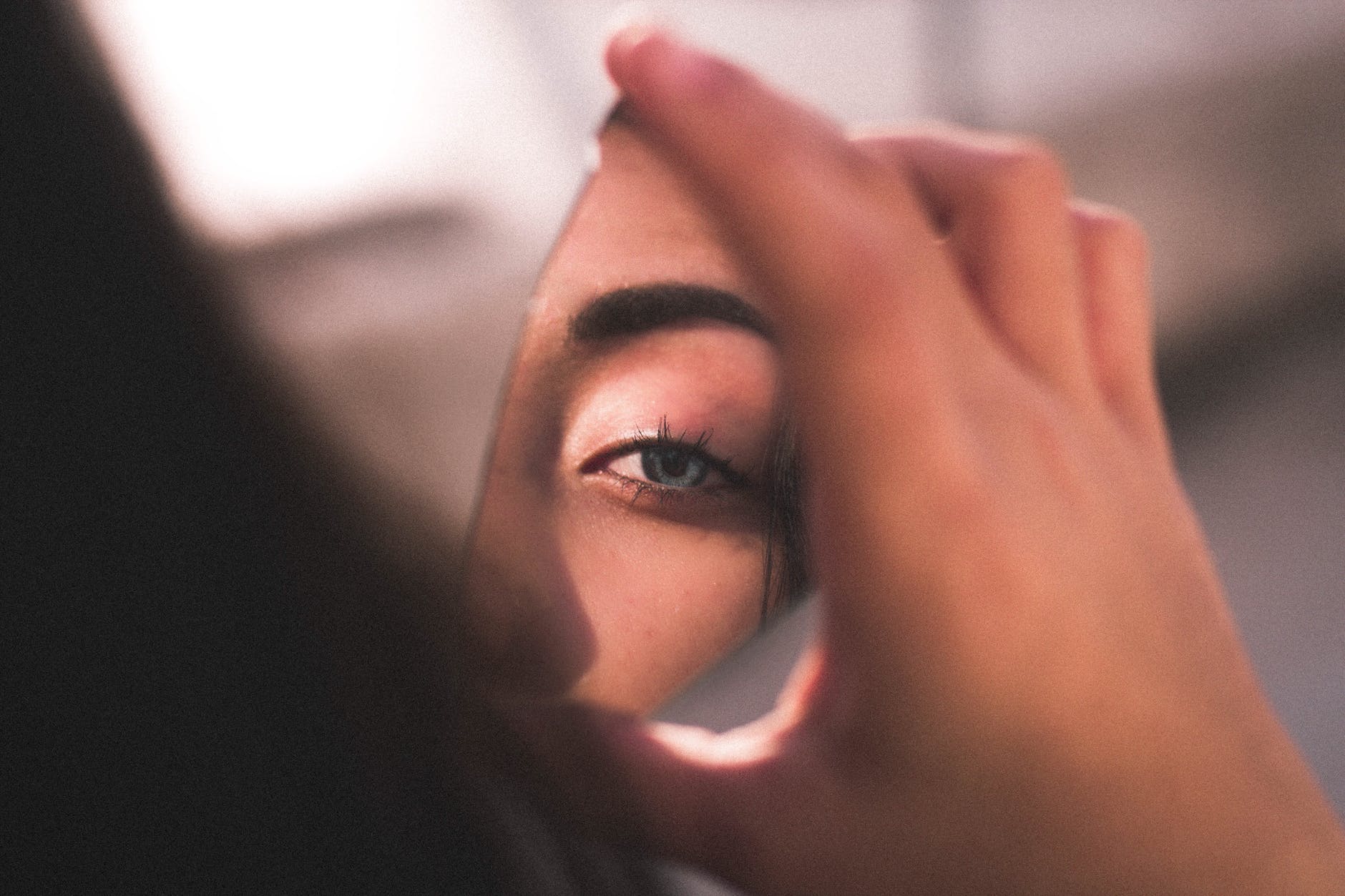
woman looking at her sad eye in a broken mirror
Photo by Ismael Sanchez on Pexels.com

an open letter to my reflection

To my reflection,

Our relationship has been rocky for the past 22 years, to say the least. Some days, I see you and I smile. I stop and admire the little things about you. Sometimes that admiration stays, feeling like how a breeze feels on a warm summer day. Sometimes is not all the time. Most days, I see you and I want to cry. The little things I once admired have since disappeared, and the comforting breeze on that warm sunny day has turned into the searing gusts that cut my skin and leave me raw. These days are much more frequent. More often than not, when I pass you as I leave for the day, making eye contact with you is impossible. I avert my eyes to avoid the death by a thousand cuts that I know will ensue if I stay with you for too long.

I don’t know what its like to be comfortable with you. To be happy with you. To be secure with you. You have caused me endless tears, endless confusion, endless dread. What is it like to look in the mirror and feel completely and fully affirmed by you? Has anyone ever felt that? Or am I chasing a mirage, a confidence that will never truly be achieved by someone with a human brain and human body?

I hope that one day you and I will make amends. Maybe one day the gusts will turn into breezes, and my cuts will heal.

Until then,

S.

pussy (n.) 1. Nice name for a cat

  1. Slang for women’s genitals
  2. Cowardly

Credit to Urban Dictionary for the lovely definitions.

Being born with a body that possesses a vagina has always been…well, there isn’t one word I’d use to describe it. It can be joyful at times, and a burden the next. It can hold me back from feeling immense happiness, and it can also make me feel on top of the world. I never thought I’d have complicated feelings about my vagina, but now as someone who is taking testosterone and seeing the effects it has on this important body part of mine: I can’t help but feel constantly conflicted. Don’t get me wrong, I am in no way saying I want phalloplasty. I, frankly, would prefer if no surgery had to happen within/outside/around my vagina. But I still can’t help but feel this weight of it pulling me back from fully being myself, and fully feeling happy.

Read more: pussy (n.) 1. Nice name for a cat

And why is that? I mean, the short answer is dysphoria. But OK, try a different path: even if I was cisgender, would I still feel conflicted in having a vagina? Could I join the cisgender women in arms and discuss how owning a vagina makes me the most badass, powerful woman on Earth? I mean, maybe. The reclamation of the vagina as an empowering symbol has its appeal to me currently: I’m a man with a vagina, suck on that Republicans! But still, that concept of my genitalia never meeting the “norm” for a cisgender man will always feel as though it’s holding me back. And yes, I know, the “norms” were created by folks who wanted a mass genocide of the Black, Brown, queer, disabled, and all things deemed “other” – so knowing this, why do I still feel the need to appease this massive dictator of a concept?

One answer could be: it’s just easier to submit to society. Another could be that I’m just starting to unlearn these things as the “norm”, so falling into “old habits of thinking” is prone to happen. And, perhaps, the third answer is just that it is also the “norm” for transgender men to feel dysphoria surrounding their genitals, to feel as though they are “lesser”. And maybe that’s the norm that I find myself stuck in: I have to be depressed about my vagina, because I’m trans and society says I have to feel sad about being trans. By actively going against this, and creating joy out of the otherwise dysphoric – it begins to open up a world of new possibilities. The thing that once felt as though it was holding me back, now holds significant power – just as it does for others.

Trans Doubt and Acceptance (9/25)


TW: dysphoria

I am trans… or am I??? Part of me knows that I undeniably am. I have had dysphoria for years, although I did not know what dysphoria was or even what being transgender meant. But even still, that tiny voice in the back of my mind likes to sow seeds of doubt in my thoughts. Maybe it’s denial, internalized transphobia, fear, or some other mix of emotions.

Continue reading

You Must Be This Tall to Ride

Content Warning: Height dysphoria, transphobia

I recently joined the millions of users on Tinder, a social networking app that allows for mutually interested individuals to communicate if they are within a predetermined distance. Tinder functions simply. Users are presented one-by-one with other profiles—which include up to six photos, age, distance, and a brief text description—and are given two options: swipe left to “dislike” and thereby remove the profile as a potential match, or swipe right to “like.” If both users have mutually swiped right, the application allows for text communication between the two profiles to occur.

While the app can be used to find friends, Tinder is most frequently used as a dating services app. As I have swiped through profiles and read their short descriptions over the past few weeks, I have picked up on certain trends in the information users present to potential romantic and/or sexual partners. One of the most frequent descriptors used is height, revealing what many view as an important physical factor. This mark of importance ranges from implicit, such as simply listing one’s height, to extremely explicit, in which I’ve seen a profile’s description read, “Do not swipe right if you are under 5’10”.”

A recent national study showed that 48.9% of the heterosexual women surveyed wanted to only date men taller than them (Yancey & Emerson 62). Height preference was important to the heterosexual men surveyed as well, but not as important, with 1.3% wanting to only date women taller than them and 13.5% wanting to only date women shorter than them.

Height is clearly an important characteristic when it comes to choosing a partner, yet there has been some debate as to whether this is due to biological tendencies (evolutionary perspective) or social expectations. Ultimately, these gendered-height expectations are rooted in patriarchy. The women surveyed in the study often listed protection and security as reasons to why they prefer taller men (Yancey & Emerson 62). Others stated that a taller man made them feel more “feminine.” The men surveyed in the study who set upper limits for height were “not considering physical or sexual difficulties but societal expectations” (Yancey & Emerson 66). These men did not explicitly speak on traditional gender roles, but they did convey a desire to avoid possible stigma. Men were “reinforcing societal expectations with their higher height limit just as women reinforced those expectations with their lower height limit” (Yancey & Emerson 66).

Like many gender norms, height expectations have the harshest impact on the transgender community. Height dysphoria, an invasive dissatisfaction and discomfort with one’s height, is a frequently seen dilemma among online transgender support forums. Height is very difficult to amend, and because it is wrongfully associated with masculinity and femininity, transgender individuals suffer greatly. Posts in these online forums express a sense of futility. While it can be achievable to possess societally-deemed masculine traits such as hair growth, muscular strength, and body parts, height is nearly impossible to change. Some responders recommend shoes with platforms or boosters. Others simply recommend an attitude adjustment.

This attitude adjustment should not be the responsibility of the trans community, but rather those who have the privilege to actively challenge gender norms free from danger, particularly white, cis, and heterosexual individuals. It is human and understandable to have height expectations, as patriarchy is deeply embedded and can be difficult to unearth, but I ask the reader to truly consider their own expectations and from where they have been created. Just as we work to untangle the mess of patriarchy in our coursework, conversation, and minds, we must also work to distance ourselves from harmful gendered-height expectations.

Works Cited

Yancey, George, and Michael O. Emerson. “Does Height Matter? An Examination Of Height

Preferences In Romantic Coupling.” Journal Of Family Issues 37.1 (2016): 53. Publisher

Provided Full Text Searching File. Web. 29 Sept. 2016.