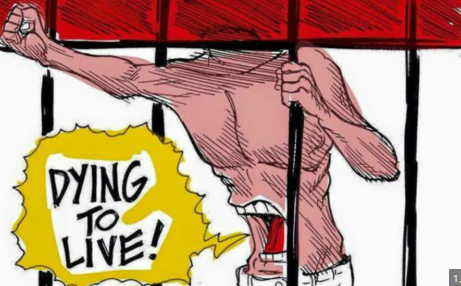
“The Strike” the documentary about the 2013 California Hunger Strikes, I found to be a very captivating and intriguing watch in class. I personally didn’t know about the strikes until we watched the documentary, but I was personally baffled that this was even able to happen to these men in solitary confinement. Watching the documentary, though, I realized a startling truth… most men in society, in many ways, experience a quieter, emotional version of solitary confinement. The men in “The Strike” were put under horrendous conditions by the California prisons; eventually, when word got around that a planned hunger strike was going to take place, it was easy for many to get behind, really, because when you take away someone’s social interaction and time outside and force them to live the same day over and over again, you’re forced to take action on the only thing you have left, the body. For the men, their bodies were the only thing they had control over, so they found a way to rebel by starving themselves for the betterment of their conditions.
While the conditions aren’t the same by any means, men walking free face a similar imprisonment placed on them by the greater society at large. Even though it’s no longer the 1900s anymore, the stigma of men having to be stronger, masculine figures who do not express emotion and provide for the women and children is very much still alive and well. It’s a quieter, more invisible form of imprisonment; boys can’t cry, can’t ask for help, and don’t talk about what hurts because at the end of the day, even if they do talk about what hurts and cry, they show weakness and failure to be a pillar of strength in society’s eyes. And like the men in “The Strike” the only agency they do have is that of their own bodies, throwing that pent-up emotion in the gym, building muscle, cleaving away the pain of their psyche by tearing the muscle fibers keeping them whole. Becoming what society wants, a strong man who doesn’t show weakness, is what true strength is to society.
The reason I’m able to describe how it is, how these invisible bars keep men inside, is because I am one of those men; a subconscious reason of why I started going to the gym is because I was skinny as a twig in middle school, and I was made fun of for my poor posture and the fact that you could see my rib cage with my shirt off. I couldn’t really vent any of these feelings to anyone; my dad is a stoic person who himself doesn’t really express a lot, unless he’s drunk off his rocker. And my mom, who is the complete opposite of my dad, can’t really understand me, even when I try to convey my anger. I just had to shut up and forget. That was in my early development years, and so into middle and high school, I never really talked much. I had friends, but I was known as a quiet kid. It wasn’t until high school that I started taking serious issue with how I looked and how others viewed me. I wanted them to see me as a strong, dependable person, so I started working out. Not choosing to, but was suffering in silence; this was also the time I realized that I hated myself. I distinctly remember telling my friends that I hated myself, after years of never really talking about how I felt. This was how one friend responded to me, “No, you don’t hate yourself.” After this point, I lost faith in trusting others with how I felt when I started putting all that pain and feeling into running and lifting weights. This is how I’ve been living for years now, not really thinking that anyone could or would want to hear what I truly felt. It’s been put into my head, “Men can’t cry,” and I think a lot of other men would resonate with this feeling or story of myself.
Roughly 75% of deaths by suicide in America, Canada, and the UK are by men, and after years of pent-up emotion, the final state a man has to go to rebel is by taking his own life. I myself have faced thoughts of suicide, but never planned for it; it’s only been up until a few months ago that I was able to confide in really close friends about these past feelings. Nothing really gets me to talk much about a certain topic or subject, but I champion and proudly stand for the mental health of men everywhere, to please go and find help, and to realize that it is ok to cry in this painfully messed-up world. While I’ll probably never go through the trials and tribulations of the men in the California hunger strikes, I can connect to the feeling of rebelling against your own body to make a statement to others and having agency over the one thing you can never lose: your body.