A New Type of Ideology

Plastic surgery has become an increasingingly common practice in western and affluent societies. Spending hundreds to thousands of dollars can alter the appearance of humans in dramatic ways. The advancements in science and medical procedures have allowed plastic surgery to be portrayed as having moderate to minimal risks for patient. In addition, over the years people tend to regard medical surgery as having fewer complications than the previous years. Despite the superb medical improvements   the possibility of danger to the patient and liability of the doctor/hospital are still very significant.  Anesthesia awareness is rare but it is possible for anyone to experience this traumatic ordeal. This occurrence poses a threat to anyone who undergoes plastic surgery or any other type of medical procedure involving anesthesia.

Anesthesia awareness occurs when a patient wakes up during surgery.  The individual’s body is in a state of stagnation but their mind is still cognizant. The patient’s body is under the influence of powerful anesthesia medications but the mind is attentive to its surroundings and the procedure being performed. Although this state occurs at the administration of the drug, anesthesia induces a separation between mind and body. The Cartesian dualism ideology alleges that the mind and body are separate entities and anesthesia awareness depicts this notion. The body is heavily sedated by anesthesia; therefore, the body is constrained by the physical science of medicine but the mind remains cognitive and free from the effects of the drug.

After further examination of the Cartesian ideology, a new theory should emerge encompassing aspects of both the Holistic and Cartesian dogma. The Cartesian phenomenon brings forth fundamental questions regarding the essence of the human body. Is the mind and body interlinked with one another or, are these two separate entities independent from one another? During the course of our class, Unruly Bodies, I have struggled with this vital question. Answering this question is problematic because there are several events that would be categorized as Holistic Embodiment, a strong alliance between the self and the body. One such example of holistic embodiment is self-esteem being linked to our physical appearance.  Anesthesia awareness is one example of Cartesian Dualism. I believe both ideologies are correct and should co -exist for different scenarios the body can be placed in and experience.  Perhaps a new ideology should be studied in mainstream literature which would include principles from both of these ideologies.


Why Cant a Female Basketball player just play like a female

I was reading this article on Brittany Griner the female basketball player that plays for Baylor University Basketball team and who is the fourth women in basketball history to dunk. the only interesting thing about her is that when she dunks she dunks hard (like a male). even though she looks like a female many people in the world consider her to be a male that looks like a female only because the way she dunks no other female dunker  has never been done  before.

There were only three other women who have ever dunks before and they are Candace Parker, Sylvia Fowles, and Lisa Leslie. Brittany Griner makes it five and the best female Dunker the world has ever seen. what I don’t understand is why is it so hard to believe that she is just very athletic why can’t she just be a very athletic female and not a female that plays like a male or maybe a male in a female body.

the article discusses that she may have more testosterone than a ordinarly female but that is not uncommon so we can’t blame her and bash her for the gifts that God gave her to succeed all we can do it credit her for working on her craft and being the best female player she is.

As an athlete I somewhat understand what she goes through, because women are considered more manly because they play sports and the one’s that are really good are really stereotyped to play like a male because they are good and maybe resemble a males game but why can’t it just be a female playing like a female, because now a days females play more and more athletic and aggressive

  1. <div style=”display: none;”><img src=”//pixel.quantserve.com/pixel/p-18-mFEk4J448M.gif?labels=%2Clanguage.en%2Ctype.wpcom%2Cwp.loggedin” height=”1″ width=”1″ alt=”” /></div> 

<p><img src=”http://b.scorecardresearch.com/p?cj=1c1=2&c2=7518284&#8243; alt=”” style=”display:none” width=”1″ height=”1″ /></p>

Bows and Arrows vs. Vampire Fangs

If you’re a nerd like me and spent this past Thursday night eagerly waiting for The Hunger Games midnight premier, you might recognize the name Katniss Everdeen. Katniss is the heroine of the wildly popular Hunger Games series by Suzanne Collins. If you haven’t had the opportunity to read these books yet I highly recommend checking them out at your local library.

Recently, I’ve noticed a lot of media comparing Stephanie Meyer’s Twilight with Suzanne Collin’s The Hunger Games, or more specifically, Katniss vs. Bella.

I did a little research and I found this article: http://www.washingtonpost.com/lifestyle/style/in-katniss-of-hunger-games-a-lasting-heroine/2012/03/20/gIQAXvVbUS_story.html

The main point of the article is Katniss is not a new character, her physical and emotional strength are not new concepts to female heroines. However, many of the “sheroes” depicted in present day teen fiction, such as Bella Swan, are the exact opposite of the force that is Katniss Everdeen. Bella doesn’t push herself forward, and fight. Bella’s route is different, but her choices are her own. I am not a Twilight fan in any sense of the word but this article had a fascinating insight: there is room for both sheroes. Katniss needs to exist alongside Bella, both are representational of different aspects of feminism and the choices it allows women to have.

I appreciated the article for having the insight to point out characters like Katniss, who defy the norm, have existed in literature for ages. Has anyone besides me read Little Women? Jo and Katniss would have been best friends.

Ultimately I have to agree with the Washington Post article; Jo, from Little Women is remembered as is Alana from  Tamora Pierce novels, and I don’t think anyone will ever forget the brilliant Hermione Granger from Harry Potter. These women, along with Katniss Everdeen, are powerful, dynamic creatures who put their complete selves into a struggle against all odds.

So I offer up the question, of all the female characters in modern day literature, whom do you think will be remembered?  Will our daughters read about Bella Swan while Katniss fades quietly into the background and is eventually forgotten? Or will it be characters like Bella, who passively accept their surroundings, who will eventually be forgotten?

Orgasm During Birth…What?!?!

http://youtu.be/8EQ_-irO50w

Image

So I came across this video when someone posted it on Facebook a few months ago. The video is a clip of a newscast about women who have experienced orgasms during child birth. The idea of experiencing pleasure during a process that has been portrayed to be the most painful thing a woman can go through is strange and confusing to me. How can birth be so painful to some women, but pleasurable to the point of an orgasm to other women?
    My first reaction was that I was sort of grossed out when I thought about the idea of my own mother having an orgasm while she birthed me. My mother actually had an awful experience with labor, she was given too many drugs accidentally, causing her to lose all feeling in her body. If my mom and other pregnant women could have better experiences I am all for it. About 99% of births in the U.S. are not in a hospital, yet we rank 28th in the world in infant mortality. The hospital setting is no more safe than home births. So why not have a birthing plan that allows you to be in the comfort of your own home, and possibly give you an orgasm? Of course, pregnancies with complications need to be more monitored and may possibly require a hospital birth.
    Ultimately, these are personal decisions that need to be made by each pregnant woman for herself. I still think it is a bit strange to get pleasure from the baby leaving the birth canal, but that is just my opinion.

Sharing the Experience? The Menstruation Machine.

Image

To the phenotypical male, menstruation will always be a mystery that we will never experience.  Or is it?

Growing up as a boy, the only information I received about menstruation was by eavesdropping on girls whispering to each other, or the odd incomprehensible schoolyard insults about PMS.  Television provided images of pads (with wings!) that women were supposed to wear in order to catch an unnaturally blue liquid, but no indication of where those pads went, or what that odd liquid actually was. Sitcoms taught men to just stay out of the way during “that time of the month,” lest all hell break loose.  It wasn’t until many years later, when I screwed up my courage and started to ask questions of my partner, that I was able to come to understand what happened.  Sort of. I mean, I could be sympathetic, but how can one be empathetic of a bodily process you can never experience?

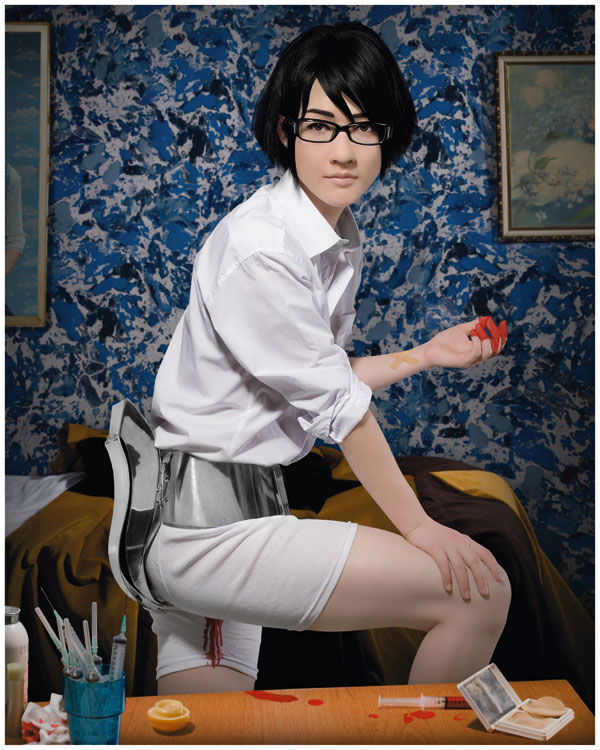
Performance artist Sputniko! (aka Hiromi Ozaki) seems to have developed a solution of sorts to this conundrum.  The Menstruation Machine, a gleaming chrome device that straps to the abdomen, is meant to simulate menstruation for those who would not otherwise experience it.  Prior to putting it on, a vial inside the machine is filled with the wearer’s own blood.  Once on, the strap around the abdomen simulates cramps, and the vial inside slowly drips blood into the wearer’s underwear.  Sputniko! created a music video of Takashi, a drag performer, wearing the machine out on the town and experiencing cramps and bleeding:

On the surface, this seems like a really interesting opportunity for someone who doesn’t menstruate (whatever their gender identity) to experience what goes on during this part of the menstrual cycle.  But in the end, it is just a simulation, and like all simulations, it can be stopped.  And it has limitations- it does not simulate the anxiety of a late period, or account for variations in severity over time.

Obviously, Sputniko! created this as an art piece to stimulate discussion.  Can such a machine be used to bring about empathy in those who don’t menstruate? Or would it create a sort of false empathy because the experience of menstruation is a fully embodied, ongoing experience? I find myself sort of in-between these two stances. What do you think?

crap I have a left hand

Being right handed is the best. Why we even have a a left hand is a mystery to me? Of course I am being sarcastic but in most cultures being right handed is preferred. I mean preferred to the point that I have seen children get scolded for using their left hand instead of their right. My older cousin should be a lefty but her father decided that he would beat every impulse to right with her left hand. Today she can write with either hand. So why the preference? Here are some fun facts about left handed people;

  • see more easily under water
  •  excel in tennis, baseball, fencing and swimming
  • generally more intelligent, better looking, imaginative, and more talented
  • children having basic problems using the wrong tools so most often times considered slow. (Maybe if we make more left handed tools it wouldn’t take them forever to figure out how to use a right handed scissors.)
  • They seem to make exceptional leaders, inventors, artists, musicians and murderers!
  • more eloquent

Even with these generally good aspects that come from being left handed we are pushed to be right handed. There is a particular Nigerian food called Eba or Pounded Yam and uses one hand to eat it. Well one time I saw one family friend sitting in the corner and eating her food. I asked her why she was basically was hiding in the corner. And she replied that she was eating her food with her left hand. It was strange to me that she felt weird eating in front of people because she was using her left hand. When you type you use both hands to do so (well unless you are my mom then you use on finger) but were did this preference for right had come from? What are some things that you do better with your left hand then you right?

Skittles and Iced Tea

The murder of 17 year old Trayvon Martin is gathering a large amount of attention in social media. Of course, his murder and the freedom of his murderer are main topics, but there is another cause for concern. What was so suspicious about Trayvon? Why was his black, male body in a hoodie so scary that it caused one to commit murder? More importantly, why does this man, so frightened of black men, continue to walk free?

I believe the whole problem ties back to the Western view of black masculinity. Black men are seen as violent, angry animals. I find this especially interesting since our current president is literally African-American. Why is so much fear directed toward black men? America has historically subverted the black man into being an inferior animal. I guess people really do hate what they do not understand. Sadly enough, Trayvon came to learn this while getting some Skittles and iced tea for his little brother. Unfortunately, Trayvon’s case is not the only one. Sean Bell was murdered the day before his wedding, leaving his fiance and son behind. Bell was also an unarmed black man. His case is different in that he was shot numerous times and by the police.

Can we truly call ourselves “post-racism” when the bodies of black men lay blood soaked and dying simply for being black and “suspicious”? We call ourselves color blind, when all we see is color. A few weeks ago Kony 2012 was viral, and America was so concerned about black bodies in Africa. Since tragedy struck home, though, America has been pretty quiet. I am personally devastated by the case of Trayvon Martin.

Bleach is for clothes, not faces (but apparently not to everyone)

I remember hearing about skin lightening over a year ago. I recall being surprised that such a practice even existed, but in retrospect, perhaps I should not have been. The media seems to purport an overwhelming amount of imagery that caters to those with white/light skin (but that’s a topic that may be for another blog post).

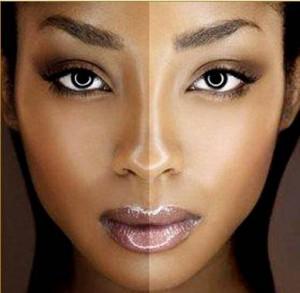
Skin bleaching uses chemicals or natural products to lighten skin, and is common in communities of colour. Thus, it is apparent why the practice is problematic: it erases the very aspect of color from people of color.

Interestingly enough, a model who works in Mumbai stated, “obviously what you don’t have is what you want. The Western world, they go in for tans. They want to get a little brown touch to themselves. They think that’s hot…so, what we think over here, since we are brown-skinned people, white is hot.” So, does skin bleaching merely exemplify that people can never be satisfied with their bodies, and that they will always engage in different forms of embodiment in order to change their natural states?

Or, is there a more grim truth?

Lightening the skin can actually be traced back to colonization, when white skin was often preferred. Furthermore, it has been said by psychologists in an article that consumer demand (I assume they are referring to demand for skin bleaching, as the aforementioned article revolves around the topic) can be traced to perceptions that lighter skinned or white people are more sexually desirable, etc. The aforementioned insights appear to indicate that there is a standard of beauty that is playing out here, one that holds that white skin as favorable. Thus, it seems as though skin bleaching is a product of racism.

While thinking about skin bleaching, a few questions came to mind. What if people were to dye their bodies a color that no one was born with (i.e. purple)? What may reactions to that body modification be? Would the modification be considered a product of racism, as it involves a divergence from natural skin color? Also, are there any other forms of body modification that are a product of racism?

“Boobs Don’t Work That Way”

Has anyone come across this tumblr? I really like it.

“Okay, so we want two sexy women on the front cover. Both with tops that don’t cover much and you know what? Maybe one of them is pants-less. Yeah! And have them pose in a really sexy way. Woah, woah woah! What is that? Did you just draw nipples? That’s too far man. Children read these things."

“Boobs Don’t Work That Way” is a “blog about tits and the impossible things artists make them do,” according to the homepage. And it delivers! Each of the 22 pages features numerous renderings of women and their breasts, or I should say, their impossible breasts. Because let’s face it, friends, Real Breasts Don’t Work This Way.

Conversations about our breast-obsessed culture are not new or radical. We know we love breasts, and it doesn’t take a lot of looking around to be reminded of this fact. Breasts are all over the place! On billboards, commercials, movies, magazines, and oh yes, on many of the women we encounter every day. For a lot of us in women’s bodies, we’ve experienced having a conversation with a man and noticing his eyes conversing with our breasts, rather than our faces. I noticed this for the first time when I was about thirteen.

What “Boobs Don’t Work That Way” does that I love is expose some of the absurdity of our breast obsession. Artistic depictions of women’s breasts are often realistic, but this tumblr gives us a cache of the ones that are NOT. And it is refreshing to see someone make fun of these pictures! I mean, they’re so ridiculous! If I were an alien from another world, what would I think if I saw all these pictures? Would I think women have globes of flesh attached to their chests, devoid of nipples? Would I think these globes are perfectly round and humongous compared to their waists? Would I think these globes were detachable? Some of these breasts look like they’re about to fall right off the women who possess them.

And what is particularly interesting about that point what it brings to mind about embodiment. Women who have breasts experience their breasts are part of their bodies, as part of their embodied selves. Women bring their breasts everywhere with them (maybe if they had a choice, they wouldn’t?). Yet pictures like this one obscure this reality. These breasts are for display and affect, and give no indication that they are experienced for any reason other than to tantalize the viewer.

Get Naked to Fight Negative Body Image!

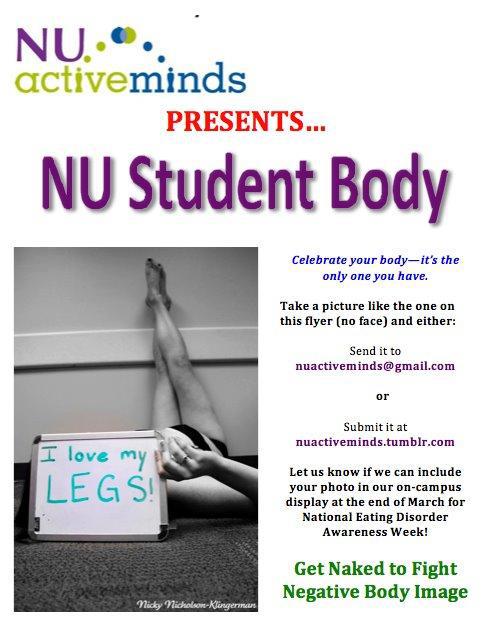
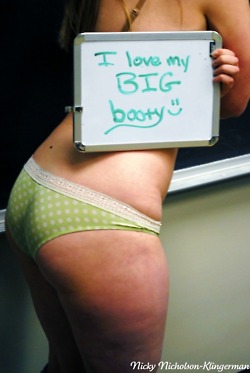
My sister, Lisa, goes to Northwestern University and put the poster to the right on her facebook page. I glanced at it, and immediately loved the idea. A student organization “Active Minds” is asking average students at the University to submit pictures of themselves with their clothing off (without showing anything inappropriate) and without showing their faces to put a cute slogan on a whiteboard or paper and say something positive about that part of their body. I asked her if there were more pictures like the one in this poster. She said yes, go HERE. So I did.

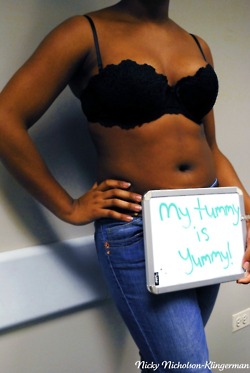
The pictures on this blog are the ones I found on that website. I loved the clever ways people wrote about their bodies and that everyone seems comfortable in their own skin. In a way, it reminds me of the POST SECRET website where people anonymously send in secrets about themselves they’ve never told anyone, and they are viewable publicly on the internet. But unlike PostSecret, this community is just college kids and they’re saying that instead of giving in to the public perception of how bodies “should” be, this is simply the way they are and they’re proud of that and they’re willing to put it in a public place.

I can’t wait to see the kinds of pictures people post, and am also curious to see if anyone will send in a picture of a scar they’re proud of, or if people will send in pictures of their tattoos or piercings like what we’ve discussed in class. I am going to continue to follow this project even after I post this blog and I encourage you to do the same.

The goal of this project by Northwestern University’s “Active Minds” is that they will have lots of pictures of average people who like their bodies the way they are and they will be displayed at the university for National Eating Disorder Awareness Week at the end of March. I couldn’t be happier with this idea.

As a child, I was a ballet dancer, and I was severely underweight. But I thought I looked great because the standard in that environment was, and is, that you are not supposed to have excessive body weight, even in areas like your hips and breasts where you should be gaining weight at puberty. I was exposed to eating disorders at a very young age and know several people who have suffered and nearly died from them.I really like the idea that they’re promoting eating disorder awareness and simultaneously promoting a positive body image. In fact, I like the idea so much I want to start something like this at UMBC. So my question is, if I did, would you join me, and do you think other people would join in?