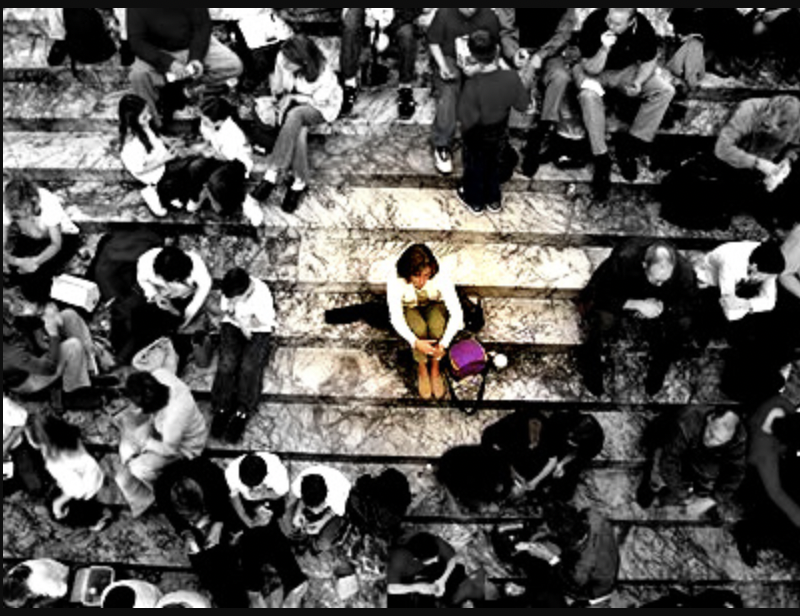
Excuse me, is this space taken?

Much of my academic day is spent in observation of the environment I am in. While I am capable of diligently taking notes and tuning into the main themes and key points of the class, my brain is also taking notes of the people sitting around me, the mannerisms and postures of the professors in front of me, and the general feeling I get from being in this world. More often than not I wonder: do I belong here? 

Why do I feel this? 

Believing one has the capacity to freely take up whatever space they occupy is a luxury, a privilege, seemingly designated only to those who have not spent their entire lives hearing that they take up too much space. I donʻt even think they were necessarily encouraged to exist in this way as much as there was the absence of actively being discouraged to do so. I marvel at what that must be like to not feel the internal burning shame that revs up my pulse and creates a subtle dizziness in my head anytime I open my mouth in class. My entire childhood surges forward in those moments and my nervous system is immediately dysregulated in anticipation of being made to feel like nothing I have to say ever matters. 

Itʻs silly, I know. 

Of course what I say matters. Of course I have contributions to make to important conversations. Of course Iʻm allowed to take up space, especially in a college classroom where ideas are meant to be exchanged and explored. Iʻm a human being with a beating heart and a curious mind, like most here. But could somebody please tell that to my central nervous system? It always seems to forget this in moments when I need to remember it most. 

This is my reality. It is my phenomenological experience. What are the enabling conditions that allow for this? Well certainly my childhood is a large component – how I was taught to behave as a child, how I was taught to view myself, and how I was taught to move through the world. But beyond the formative programming and environment that laid the foundations for my current configuration, I have found that Academia as a whole, systematically infused with patriarchal and racist ideologies, plays a part. 

There is a competitive expectation here, that if you do not speak fast enough, cleverly enough, articulately enough, then you are exposed for who you are not – intellectually superior. That to showcase intelligence automatically assumes others want to hear what you have to say. That if you are a member of the prioritized categories of social being – in particular, white and male – then the gravitas of what you speak is appreciated before you even speak it. This pressurized environment all the more draws out the deep-seeded fears and insecurities surrounding my internal question of intellectual capacity. Can I take the wellspring of thought and insight contained within and adequately give it voice so as to give myself the appearance of competitive intelligence? Can I do this all the while fighting against the belief that the space I am taking up does not belong to me? 

To this, I have no answer. Only a sense of “I guess weʻll see” and the burning desire to crawl into bed and get lost in the latest reality dating TV series, where I can freely exposit to my laptop why I think everyone is an idiot.  
Getting Older is a Real Bitch

I sometimes miss how disconnected I was from my body when I was younger. Though not a monolith, I think most adolescents feel some degree of invincibility when it comes to how their bodies move throughout the world. The carefree attitude of “nothing is going to hurt/stop me or slow me down” is one that accompanies a life lacking experience (and might have something to do with an underdeveloped frontal lobe). But I think it’s a necessary part of the growth process that allows us to have lived experiences with a certain degree of fearlessness that encourages us to explore the world. 

The older I get, however, the more my body’s limitations prevent me from living as fully as I’d hope. For one thing, sleep doesn’t come as easily as it once did. As a child, I’d often fall asleep in random places whenever I got tired. As a teenager, I’d sleep for 12 hours at a time. No insomnia, no nightmares, no getting up twice to pee. Now it takes pharmaceuticals and magnesium and turning off screens in order to clear my brain long enough to fall asleep. Wash, rinse, repeat.

In 2018, I started to experience intense pain in my shoulder, swelling and pain in my fingers and toes, and debilitating fatigue. The pain would come and go and I would sometimes go weeks feeling totally fine, so I ignored it for a while. I’ve been tired since I had my first child in 2000, so fatigue has never been a good barometer for my health. After the shoulder pain woke me up in the middle of the night, I made an appointment to see my doctor the next day. Many, many blood tests later, I was diagnosed with two autoimmune diseases – one of which is called rheumatoid arthritis. There is no cure for RA, and the causes are unknown. Left untreated or if my body does not respond to the medications, the disease can cause organ failure and severe deformation of hands and feet and other parts of the body. My life, and by extension my body, was forever changed with that diagnosis. Every decision I make is now governed by how it is going to affect my disease. Food that I eat, alcohol that I consume, stress that I experience – all of these things can cause a flare of the disease. 

I’ve learned to manage my symptoms with the help of medicine and doctors, but it will never not be a part of me. I am who I am today as a result of the limitations of my body, and though it often frustrates me, it has shaped my resilience. I still would love to look at my young self and tell her to be more grateful for her sense of invisibility. Youth really is wasted on the young.

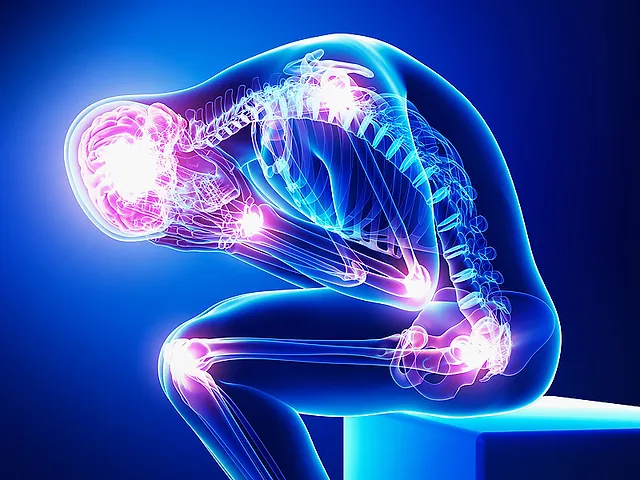
The image is of a human skeleton with visible pain sensors.

The Body Neutrality Bubble

Is it possible to adopt a body neutral mindset in the face of external structural notions about what the body should be?

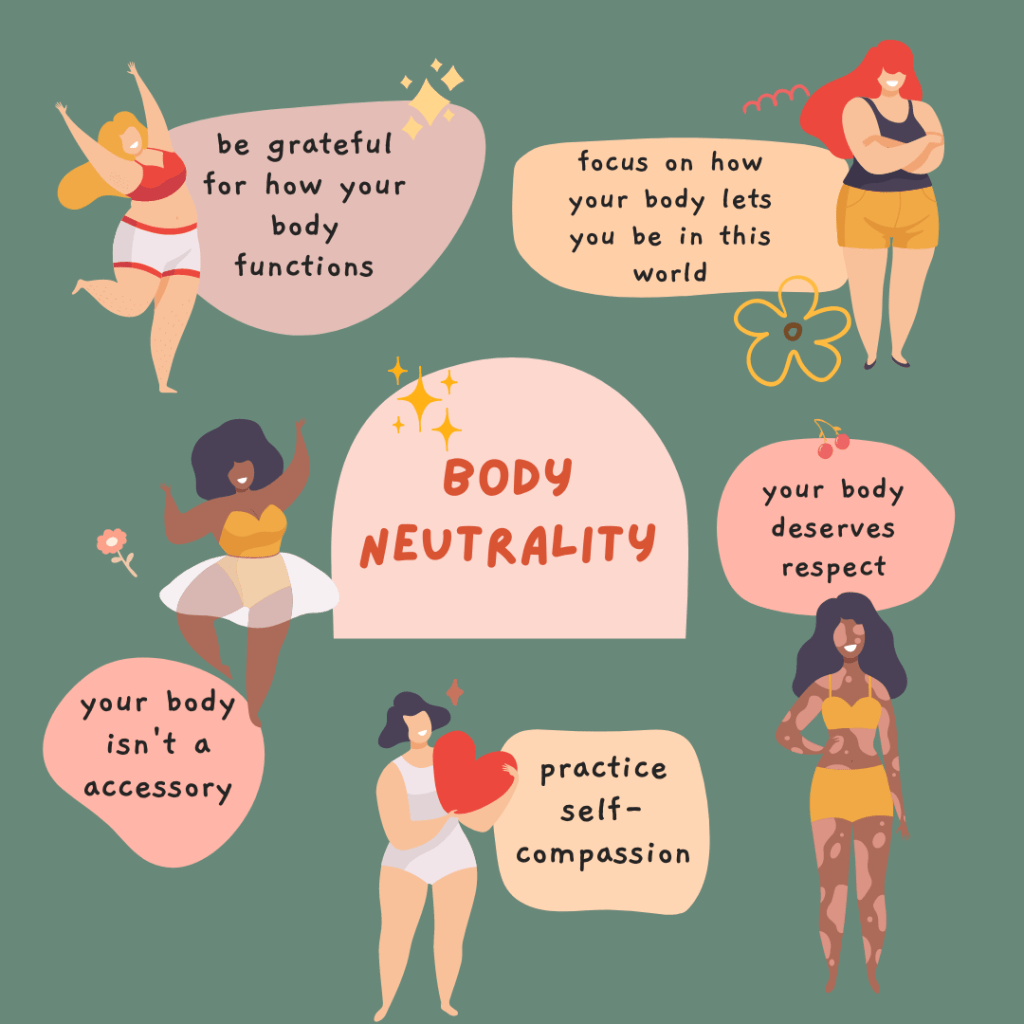
The image depicts a graphic from bewitching.net that has a green background and colorful splotches with text. The middle pink splotch says Body Neutrality. It is surrounded in a circle by 5 other splotches that say be grateful for how your body functions; focus on how your body lets you be in this world; your body deserves respect; practice self compassion; your body isn't an accessory. Each text has a different body next to it posing.

Image Description: The image depicts a graphic from bewitching.net that has a green background and colorful splotches with text. The middle pink splotch says Body Neutrality. It is surrounded in a circle by 5 other splotches that say be grateful for how your body functions; focus on how your body lets you be in this world; your body deserves respect; practice self compassion; your body isn’t an accessory. Each text has a different body next to it posing.

Body neutrality is a contemporary concept that describes the practice of adopting an objective, arguably more function-oriented mindset towards one’s physical self. Popularized in 2015 by Annie Poirier, body neutrality as a concept encourages individuals to view their bodies as physical vessels that allow them to experience and conduct through daily life. Some find it to be a stepping stone to body positivity, however in its fundamental ideology body neutrality is intended to promote a more peaceful relationship between the mind and body that does not focus on negative nor positive conceptualizations of the body, especially in those ways that can consume and strain the mind (i.e., significantly focusing on the size, shape, or color of the body). The concept of body neutrality is designed to operate in contrast to societal expectations that systemically operate to burden individuals to fit into physical and emotional molds in order to be legible as human beings and gain access to various spaces both physically and socially. It is critical to note that societal standards of physicality and being often disproportionately impact minority communities, who often may be denied access to other mechanisms of legibility such as personhood and femininity.

As the concept of body neutrality manifests as an individual effort—where one must rewire their thoughts to accept themselves in their current existence—it is critical to consider to what extent this mindset is sustainable. For sustainability seems unlikely in a world where one’s internal perspectives are competing with the perspectives ascribed to them by other social actors and the implications of structures more broadly (i.e., the spaces their physical and emotional selves may be accepted in or denied access to). It appears to be the case that the body neutral mindset can only exist in the individual bubble, as venturing out of those individual boundaries forces one to be confronted with realities of dominant thought about the superiority of thinness, smallness, whiteness, etc. that will inevitably, even momentarily, impact the way one views themselves and others. It can be said, then, that genuine bodily neutrality is an in-achievable pursuit in our current world where subjects are “locked in” their bodies unable to transcend to a space of being that allows them to shed their physical and spatial identities. While this perspective is less than optimistic, it does offer a more pragmatic contextualization of how societal influence is imperative in creating an environment where humans are categorized and then held to physical and emotional standards that are historically long-lasting and seemingly intrinsic, which hinder individual and population-specific liberation.

Expectations not met

~Throughout the entry there will be songs I listened to especially when I was younger to cope~

People’s idea of being black is a mystery I will never be able to understand. From a young age I have always been referred to as an “oreo” or hearing my peers comment that certain people despite not being black acted blacker than me. I always found it strange how there was a specific idea of being black. I was constantly told who I wasn’t and not who I could be.

Read more: Expectations not met

It made me feel hated and somewhat like an outcast because wherever I went I didn’t feel accepted. Even my mother would tell me how I should act as a black man but that only made me rebel even more. It made me hate who I was and I wanted to be different so badly that it caused others to denounce my blackness even more. I felt as though I couldn’t win with who I was. Of course throughout life I started to see how this affected my self-image and I have learned from that but the insecurities are still there. The saddest part is the image that people may imagine in their mind when they think of black people can come from television or media.

Many shows depict black people trerribly or the nuance of certain television shows is not understood by those that are young. Causing confusion and leading people to believe that black people act a certain way without explaining why some black people may act that way. The depictions of black people and their actions in these shows defined what it meant to act black for me. I would actively try to avoid those certain actions or make fun of those actions without understanding how they came to be. These things that black people get made fun of for such as improper grammar are effects of being enslaved for years. I was never able to understand these things as a kid and looking back at how ignorant I was genuinely causes me pain. These depictions still affect me today as I think “don’t act a certain way “to avoid any conflict. Of course now I’m very proud of who I am and how I look but the years of thinking that way is gonna take time to heal.

Girl? Boy? Both? Neither?

Am I really a girl? I sometimes feel like a boy? Am I trans or just nonbinary? Or do I just simply feel more masculine inside and uncomfortable associating it with my feminine appearance?

Since embracing my queerness and discovering different aspects of my sexuality and gender, I have learned more about myself and society as a whole. Despite my parents’ hopes, dreams, and attempts, I am undoubtedly a lesbian, albeit a very feminine one. I feel completely comfortable and confident in my femininity. I enjoy having long and glittery nails, voluminous lashes, and dedicating hours and considerable expense to perfecting my makeup. However, alongside this comfort in my femininity, I also experience confusion about my masculinity due to the societal constructs surrounding gender. Gender norms for both men and women are deeply ingrained in our culture, and everything we do seems to involve some recognition of someone’s gender. I continually struggle to find my place within these constructs.

For most of my childhood, I was constantly given the label of a “tomboy”. I can still hear my mom’s voice yelling at me for wearing slacks and a shirt to a nice restaurant instead of putting on a dress. I constantly fit that label until one day, I just didn’t anymore. I can’t recall why, but I know a big part of it was feeling out of place around my peers and other girls that I was surrounded by. I became so immersed in makeup, pink, nails, hair, and everything “girly”. I finally fit that label of a girl. I felt deserving of that description. I did come to fall in love with it, but as I’ve grown up, I have come to recognize that with it, I have completely disregarded the part of me that was fulfilled with masculinity. The part of me inside that felt hot in a button-down and slacks. The part of me that wanted my hair cut really short and a sleeve of tattoos.

So, while taking this class, among other philosophy and gender study classes, I have become more comfortable exploring that discomfort. Recognizing the systemic factors that play into my feelings about my gender and the self-expression of those feelings has opened my eyes. It allows me to not only slowly recognize and break away from the constructed “masculine” and “feminine” roles pushed among individuals within society but also recognizes that everyone has both. Everyone experiences them at different degrees and finds different ways, but everyone experiences both. And there is no need to fit oneself into one or the other. Not one box will fit at all times, and that is OKAY. Some people might recognize both sides and discover they are trans or non-binary. Others might just recognize that they conform to their assigned gender at birth best. Others (like myself) might just not know and still be trying to figure it out. No matter what the case is, it’s okay. By the end of it, does it TRULY matter since it is just a social construct? I don’t know, but it’s starting to really not seem like it in the grand scheme of things when taking society out of it.

Crocs: Come as You Are

Crocs: Come as You Are

I don’t think it was until the Covid-19 pandemic that I first gave RuPaul’s Drag Race a watch through (of course I had to start with season five, because Jinkx Monsoon is a literal legend). I remember hearing about how much drama there was, I’ve known a couple of the winners through the avenues of Twitter or Instagram, and I always thought that drag as a cultural phenomenon in the LGBTQ+ community was insanely unique in the way that it distorts the socially constructed concept of gender and makes fun of the social expectations of both men and women in their outward representations.

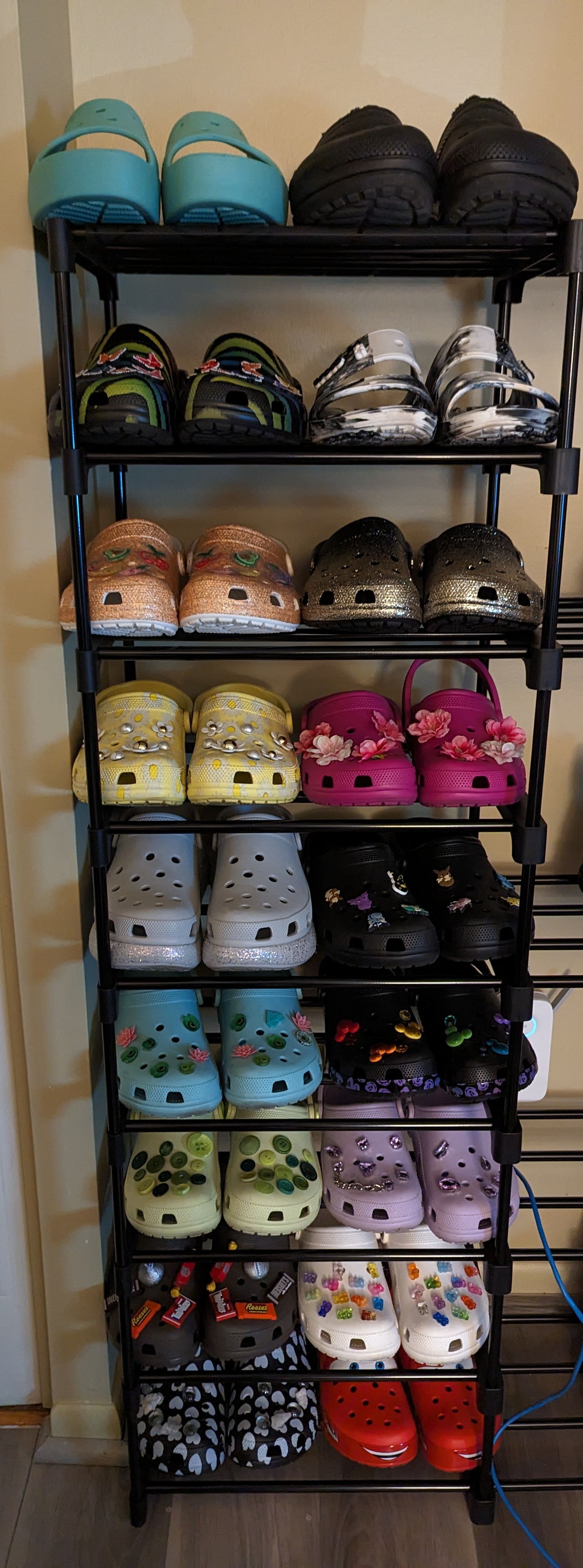
After I caught myself up with the American seasons of the franchise, I explored the ways that I feel and express myself outwardly, and while I don’t know makeup or walking in heels, that’s where the Crocs slogan, “Come as You Are,” emerged as my segway into my own form of drag that I continue to own to this day. I own over ten pairs of Crocs since I work at a shoe store, and I tailor every single pair to a color or style or concept. Just look at the image below:

18 pairs of Crocs arranged on a shoe tower, with different colors and accessories for each. Meant to supplement the reading.

Ranging from gummy bears on my white Crocs as a low-key form of gay Pride, fake cherry blossoms on my magenta Crocs, and green buttons scattered around on my lime Crocs, the way that I choose to decorate my Crocs with the best invention in the world, Jibbitz (that I only order custom ones of since they are cheaper) gives me the option and mobility of being me and allowing my creative side to flourish.

And I think that’s where I connect with phenomenology; when I wear Crocs with the pieces that I got to choose or make and I know no one else probably has, I feel independent. I feel happy. I feel energized and enriched. I see others look at my Crocs. I see others judge my Crocs. But I do not care. 

The feelings I feel and the experience of how I came to try on my first pair to owning over ten pairs is different than any other person’s experience with Crocs. Most people compliment them, and it only makes me happier because I put a lot of work and care into how they are presented with tailored outfits or shirts to match. It became my sense of style and how I express my ideas to the world around me, allowing others to see me in the context of fun or creative.

Drag is hard: wig glue, wigs, heels, corsets, dancing, singing, comedy, splits, dips, makeup, names, eyelashes, dresses, earrings, jewelry, custom outfits, and energy; but with me, my drag is in the Crocs of it all, and I hope everyone around me sees that.

Showers are underrated

Earlier this week in the shower, I was racking my brain on what I could possibly write for my blog that tied into themes of phenomenology. I had been looking for a topic for a while but I felt as though all of the topics I had brainstormed were not good enough then boom💥, it came to me. Honestly, it was kind of an Eureka moment. As mundane and repetitive as showering can be to some, I usually get enlightened with the best ideas when 100-degree water is sprinkled on me. Since showering is something I do every day (except on the rare occasion when I go camping), it is a mindless activity that I ABSOLUTELY love. Sue me, I’m a shower enthusiast.

A shower enthusiast

Daniel Zender


I stopped scrubbing my body and thought to myself, “How do I know how to shower?” I remember taking baths as a kid but who taught me how to ensure that I actually clean myself in the shower rather than just letting the water drip on me? There was a time during my pre-teen days when showering and homework were the two most tedious tasks that I could do and I would simply stand in hot water for 5 minutes and call it an “efficient shower”. I believe the answer to these questions is that I had multiple resources that informed me how to shower which I applied either consciously or unconsciously. This then led me to ask myself, “Do I have a specific routine in the shower that I utilize every time I shower, and if so what is it?”

This question prompted me to observe myself every time I stepped foot into a shower henceforth. It was a very surreal feeling as I was so used to showering without thinking much about the showering part. The quick answer is yes, I do have a routine that I follow aimlessly every time I shower without fail. It took a lot of concentration for me to pay attention to where I was gliding my loofah and how long I spent scrubbing each part of my body. I felt like a voyeur to my own flesh; paying too much attention to agonizing detail. I would be lying if I said that there weren’t some points of these various showers where I fell back into the groove of letting my body clean itself without my brain being truly present. I have to admit, that it takes an immense amount of brain power to observe experiences while still being or participating in them.


I find it hilarious how my “shower thoughts” manifested into thoughts about showers. I highly recommend this exercise to everyone as it shifted my understanding of self which is always important.

Oh, I Couldn’t Possibly Eat Another Bite

Ah, to be a woman.  Where do I even begin?  I read a text for class about embodiment and the author made the point that women’s bodies are a burden in that women have to put up with monthly menstrual cycles, hormones, pregnancy and labor, menopause and so on.  That doesn’t even address the societal issues women face just by being women.  Having periods and experiencing menopause can’t be helped.  From walking down the street to walking around a college campus, women constantly have to practice caution and must always be aware of our surroundings.  That in itself is another burden of being a woman.  Please, don’t get me wrong– I am glad and proud to be a woman, I’m just tired of living in constant fear of being sexually assaulted… again. 

In addition to the aforementioned biological burdens, I also feel my very body is itself a burden.  I hate my body.  For too long have I hated catching glimpses of myself in the mirror.  There is no such thing as thin enough.  So what do I do?  I refrain from eating.  If you don’t eat, you can’t gain weight, right?  Don’t eat all day so you can “deserve” dinner, exercise every single day, go for long walks, and when necessary, take laxatives when the number on the scale just won’t go down.  For a couple of years, I would stick my fingers down my throat but I wasn’t seeing the results I was hoping for.  So I started to deprive myself of soda and sweets; I couldn’t tell you the last time I drank a soda.  I always decline cake when offered but I do so in a very polite way so as not to offend.  I check myself in the mirror several times a day: before I eat, after I eat, when I’m exercising, before I shower.  I weigh myself twice a day, which I’m told is excessive.  Even when I’m not physically doing things or refraining from doing things for that matter, the thoughts are ever present.  Can I eat this and not hate myself tomorrow morning?  How many calories?  Don’t do it, you will end up angry at yourself.  This is what I say to myself all the time.  I often restrict myself to 500 calories a day.  It is mentally draining to constantly be nagging yourself, if I eat this, I can’t eat that.  When I get my period, I get bloated and gain weight and as a result, I cry and panic.

Why do I feel this way? Why do I do what I do?  I don’t know…most likely because I feel it’s the one thing in my life I can control.  That’s what the doctors say.  All women have the same struggles and frustrations of having to look at how women are portrayed in the media, how women are “supposed to look.”  We see it in magazines, on television, in films, we read about it in books.  This doesn’t help anyone.  Know that much of it is fake, photoshopped.  Alright, let me wrap this up.  In short, don’t starve yourself.  Don’t stick your fingers down your throat, you’ll only rupture your stomach doing that.  Healing from a disorder like this takes time and patience.   

Getting an official diagnosis gave me something to call it, which was a good thing I suppose.  There were times when I really thought I was going crazy, actually losing my mind.  I love to perform on stage in plays and musicals.  I always made sure to be as thin as I could before the curtain went up.  This of course meant laxatives and anything else that would do the trick.  I am ambivalent.  On one hand, I’d love to not obsess over food and weight every second of the day.  On the other hand, I want to be thin and I can never seem to attain it.  It’s never enough.  As an adult, the lowest I have weighed is 87 lbs.  I freak out and panic if my weight is over 93 lbs.  Like I said, it is a gradual healing process and it only works if you want it to and truth be told, I’m not sure if I’m ready.  

being perfect means I finally win, right?

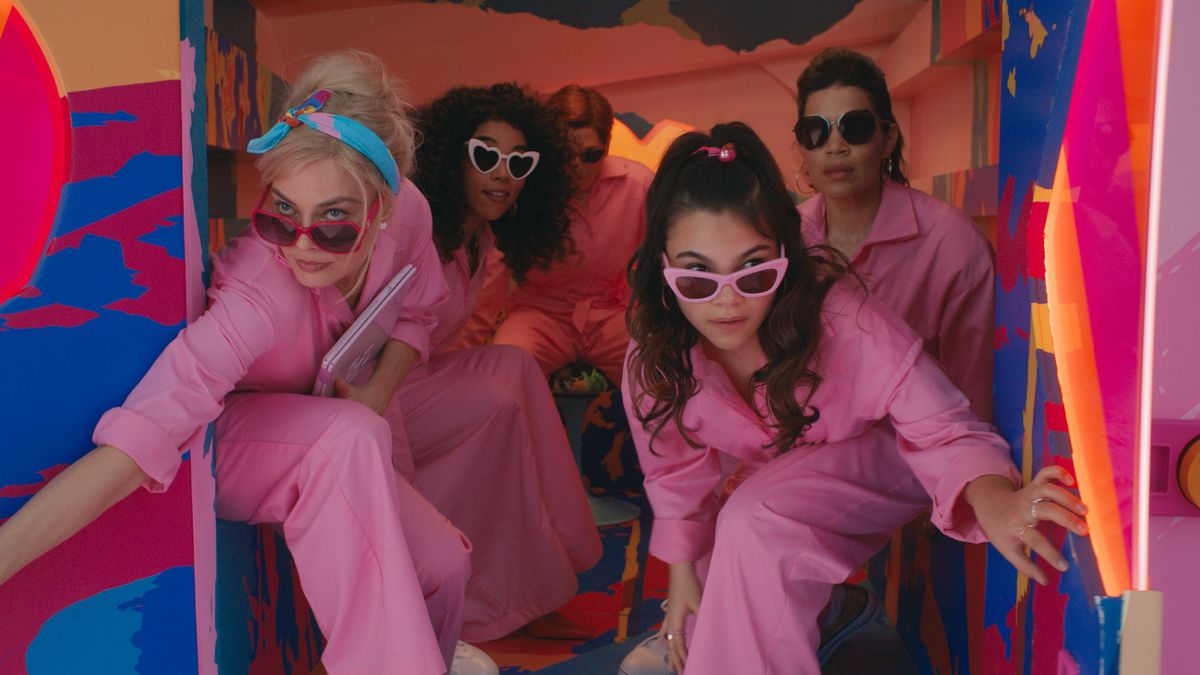
Scene from the 2023 Barbie movie. The Barbies are getting ready to un-brainwash the other Barbies by sharing how impossible it is to be a woman.

My body exists as an argument. My body is an inner discourse in my head and a theoretical object to be tossed around by politicians. My body may breathe and jump and eat and do all the most basic functions, but it will never have the luxury of existing simply. My eyes look away too quickly or they may gaze too long with a hidden intention or thought behind them. My heart flutters as I raise my hand and pounds as I try to fall asleep. Even on the cellular level, the macromolecules of my body tirelessly create my being with hidden complexity. My body bleeds and cries and sings and falls. It is always changing how it feels, not usually followed by a moment of peace. Peace is not well known to my body. Peace is only for the perfect or those at peace with the imperfect. My body is always running towards the perfect but the finish line keeps getting pushed further away. I am out of breath.

I am 20 years old and I feel like my body is paraded. I feel like it barely belongs to me. It is for the world to look at and think about. I belong inside of it and yet I cannot be content with it. I need to constantly be learning and aware of other bodies so that I may exist in the most perfect way, a combination of every best quality I can find.

I met my boyfriend when I was 16 years old. His parents judged the girls in the family who were too loud or talked too much. So, I was quiet and well behaved. They then told me they felt I was being disrespectful through my quiet, and so I spoke, but only at the correct time with the correct tone and the correct amount of information. They made fun of another family girlfriend who was anorexic and never ate, she was always complaining about headaches or some new health problem. So I made sure to eat in front of them and keep my health problems and complaints to myself. They made comments about women gaining weight and also told me they felt they knew nothing about me. So I made sure to eat the correct amount at the correct time and give a few tasteful complaints.

I entered high school at 14 years old. People loved the girls with quirks and imperfections. John Green taught me that the “just damaged enough” beautiful girls were the ones that every guy dreamed of. People thought I was intimidating. People couldn’t relate to me. I was putting on this perfect image; put together, mature, smart, always on time. People didn’t like that as much as I thought they would. I decided to show just enough imperfection to seem relatable, cool, funny. I let people in, just enough.

I entered my dark phase at 12 years old. Everyone hated the girls who yelled in the hallways, cried all day, posted their life story on social media. They were too big, too open, too much. Perfect people don’t act like that. I wanted to be full of secrets, a mystery. I wanted to be someone that people wanted to get to know, they wouldn’t just already know. I wanted everyone to wonder. The less they knew, the more likely it was that I could be perfect under it all.

When I was a child, I spent a lot of time at my friend’s houses. “We love having her over!” their parents exclaimed, “She’s such a great influence.” I probably wasn’t, but I sure knew how to make the parents happy. I said the perfect things to them and said them in the perfect way and ate what they made for dinner was a great friend to their child and never misbehaved and acted girly and innocent and the way a perfect little girl should be. I lived for that validation. I watched my friends get yelled at, hit and punished. I would never do something to warrant that.

When gender started to matter, having only older brothers was hard. Losing your siblings because boys and girls can’t be friends is hard. We weren’t allowed to like the same hobbies anymore. My brother wasn’t allowed to acknowledge that we had fun. I wasn’t supposed to watch him play video games and he wasn’t supposed to play dolls with me. His friends became meaner to me and my friends became shyer to him. I couldn’t play baseball and basketball outside with my brothers anymore when I became seen as a girl and not just a person. I was doing everything wrong and it wasn’t my sport to play anyways, apparently. I should just do ballet. I should just stay small and quiet and just be so different than my brothers. I am a girl, anyways.

As I grew up, I looked for my parents in every authority figure. Even when they were standing in front of me, I was looking for them. I found what gives praise: perfection. A large part of that perfection was being a girl and all of the things that means.

You know what it means to be a girl. It means you can’t win. It means you have to be perfect but you can’t actually ever be perfect. You need to be just imperfect enough but brace yourself to be judged for those imperfections. I never found happiness from it in all those years from trying so hard and my body feels like a war zone. I know all of this. I know perfection isn’t real and it’s unachievable and it’s useless to even try. Why can’t I escape it?

Do my actions make me a typical “man”?

Do my actions make me a typical “man”?

When I was reading Throwing like a Girl I couldn’t help but think about my childhood growing up and how I played. I am the youngest of 3, I have an older sister and brother. My parents always used to say that they treated us all the same just like every parent is supposed to but I guess if you are a person with siblings you can recognize some of those differences. For me it was always my mom telling me to be “more lady-like” I always hated when she said that she would either say that or tell me to be more like my sister. My sister is like the “perfect traditional” girl because she likes dresses, her favorite color is pink, she loves talking about whatever boy she’s talking to at the time. She played with dolls and loved getting her nails done but me on the other hand I’m completely different and my mother hates it. My brother on the other hand he’s more of the indoor type, he plays video-games, keeps to himself not really the one to be outside. So ever since I was born I just kind of fell into the roll of being the outdoor kid my dad loves it he once told me when I was little that I was like his real son but just girl version. I didn’t know how to respond to that, thinking about it now I still don’t.

My dad was always the one to encourage me to do more rough activities like the boys around me but my mom would put me back in the house every chance she got. I was the first girl to play on the all boys football team in middle-school (now the team is coed). I was the one to climb trees, ride dirt bikes, jump off the top of the rock wall just like all my male friends. There was a time when I was in elementary school that I actively told people that I was a boy because it just felt like everything I was doing wasn’t “lady-like” and I was always told that everything I did was for boys, but I genuinely like doing them so in order for me to do that I had to be a boy. This was the cause of a lot of arguments with my mom because as I got it older and I started to grow into my features she started making me wear dresses and skirts. She once told me that I was dressing like a lesbian, little does she know lol (she doesn’t, anyways…) I always had to stay indoors and do something relatively easy. I thought my dad would have my back but somewhere along the lines he started to agree with my mom and told me that girls wear dresses etc. I had to get my nails done, wear my hair “proper”, and just do womanly things according to my parents. But the more they told me to do that the more I did the opposite. I always wore pants or shorts, I let my hair be wild, I used to bite my nails down to the nub, I just did everything under the sun that I could think of as un-ladylike. But doing all this really caused me to be really confused about who I am, middle-school to high school me really went through it. lol

Now things are a lot calmer, I learned that I don’t have to go to the extreme opposite trying to prove to my parents who I am. I no longer bite my nails down to the nub but I do keep them short for multiple reasons. I dress how ever I feel like dressing that day my clothes and or actions don’t have a gender and I’m okay with that but I do prefer to dress more masculine. My parents are allowed to have whatever opinion they want about how they think I’m supposed to dress or act, it’s up to me if I want to listen or even follow what they say.