
Who am I?
I,
I’m my thoughts,
My dreams,
My aspirations.
I’m my name,
My looks,
My imagination.
That’s what I see,
When I stare,
Into my reflection.
My reflection,
Ripples in the river of life,
The shallow,
Shallow river of life.
To the world,
I am my reflection:
I am only what the world sees,
Only what the world decides I am.
My body is but a vessel;
Why must the world ignore me,
But acknowledge the vessel?!
Books, merely objects
Are still judged
By only their covers,
So who am I to demand
They not judge me
By only what they can see.
The inside of a book
Is where the value lies
But most people don’t bother;
It’s easier to judge
From the outside
My body is a part of me,
It embodies my soul
My personality,
But it is not all I am.
I am not my scars,
My disability,
I am me,
A completely separate entity.
I, Me,
Not just what you see
activism
My Mom (& her BMI)
Keto,
Maybe that’ll help
Paleo,
Couldn’t hurt to try
So many failed attempts
To lower her BMI
How can I tell her,
That a number
It doesn’t define her!
The scale, the scale
What does it say?
FAT, it says
But in numbers,
It judges.
Why must we care
What a metal box
Has to say?!
Why do we care
About the numbers
At the end of the day?!
The world says
Those numbers matter
The world says
Those numbers decide
They have more say
Than we do,
In our own lives
It shatters my heart
The look on her face
As we snack on chocolates
While she eats ice chips
Sugar-free,
Fat-free,
And low-carb
That’s her life
My BMI,
That number
It’s way too high
UGH
How can I tell her
That number is futile
Tell me now,
Does the BMI know
Of the babies
You’ve born?!
Does the BMI know
Of the PPD
You’ve overthrown?!
A number cannot measure beauty
So why,
Why does it bring tears to your eyes?
A number cannot measure beauty
So why,
Why must the matter
Overwhelm your mind?
I tell you you’re perfect;
But my words
They are fruitless,
It is only numbers
That get through to you,
The same numbers,
That judge you
Perception VS Reality
If Life is a marathon,
Not a sprint,
How come then,
Everyone is going,
So, so fast
But I,
I’m already behind,
And while everyone else,
Is having a great day,
I toil away
My legs,
Slabs beneath me,
Holding me up,
But barely,
My lungs,
Burning with every inhale,
About to burst,
But I cannot stop,
I have to keep going,
To get to the top,
I can’t ever,
Ever stop,
I want to pause
Catch my breath,
But that’s not possible,
Because the world won’t stop,
And the non-existing finish line…
Uncrossable
I see them,
In the distance,
So far,
Way ahead of me,
Doing better,
Crushing this war,
Me, however,
A nonstarter,
I struggle to keep up,
Everyone is running,
Sprinting,
Me, however,
A slow trot,
Kinda like,
A tortoise a lot,
In a world full of hares,
Speeding by,
We both mosey about
I turn my head,
I see the hares by me,
Wait!
I’m not so far behind?
I’m actually,
Doing kinda fine?
My eyes,
My mind,
They…
They deceive me?
Why?!
How can they not show me reality,
When it’s right in front of me
I turn, Timidly,
I ask,
The hare next to me,
How its going,
To try and uncover,
The secret of her,
Great stride,
And to my surprise,
“I’M SO FAR BEHIND,”
She bursts,
Impossible.
My mind told me I’M the worst!
Turns out,
I’m not alone,
In my pain, and,
This hare,
Is not a hare,
Just a person,
And I,
I’m not a tortoise
So, I uncover,
Life isn’t a sprint,
Or a marathon,
I figure,
It’s a heckin’ triathlon,
Ongoing and never-ending
And I,
I’m not the only one,
Who struggles,
Because the hares aren’t hares,
And my eyes,
My eyes lie:
I’m doing just fine,
Jogging,
In my own time
Reproductive bodies and Disabilities in Different Cultures
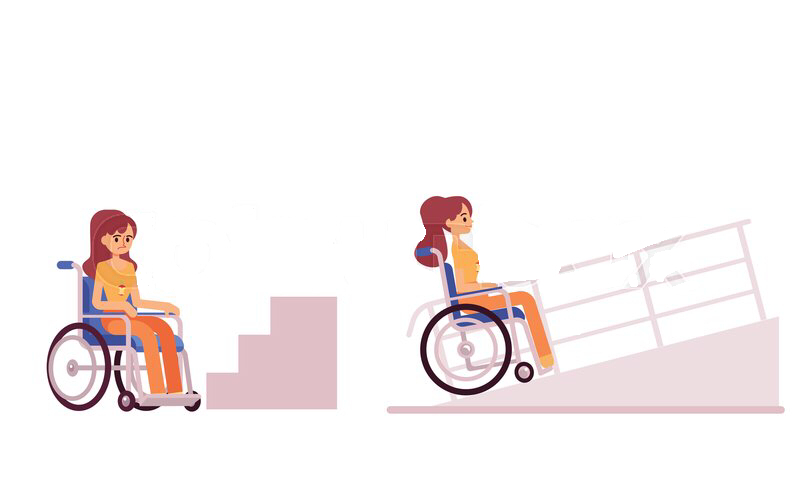
According to many cultures around the world, It is a woman’s “duty” to reproduce. In fact, many people believe that our sole purpose here on earth is to pop out kids and try to populate this planet. This view doesn’t even consider if the woman – who has to carry and deliver the baby – even wants kids in the first place. And If a woman chooses not to be a mother, she is not doing her “duty.” Like duty by said who? God? Not everyone believes in an eternal being with infinite power. It’s even concerning how some people wholly ignore how much work goes into having a child; all the sacrifices and attention to detail that a woman needs to have in order to deliver a healthy baby. I remember having a friend from Dubai who told me that the culture there in Dubai is very patriarchal, and it is the men who do most of the decision-making in the family. The woman is just his “wife.” His job is to look after the woman and her kids, and her job is to do housework and take care of the kids. This kind of thinking is a very traditional way to view gender roles. It is how cavemen view gender roles, where the men are tasked with hunting, and the women are to pick berries and take care of children. However, we can all agree that this view is outdated and it views women as if they are physically disabled, thus an “almighty” man is needed in all families to guide them and fill in the gaps that woman is unable to fill.
Drawing some examples from Baynton’s Disability and the Justification of Inequality in American History and the film Aftershock, women have been viewed as being physically disabled, at least that’s how Baynton wants us to understand them. He argues that a patriarchal society – like the one we have in America – views women as weaker, emotional, irrational, and thus inferior to men. This reasoning can explain why women are paid less than men despite taking on similar positions. This belief that women are irrational is the reason why women in some areas of the middle east are not allowed to drive or in some cases pick their lovers. This is a social disability that needs intervention because it can be crippling to the advancement and well-being of a lot of women in patriarchal societies.
Upward Spiraling Out of My Body Dysmorphia
trigger warnings: body dysmorphia, suicide, mentions of disordered eating, illness
If you remember what your body looks like, I think you’re one of the lucky ones. If you don’t, then I’m not so glad this is what we have in common. Coming from an older West Indian family, my body was always a discussion. No matter how many soccer practices I showed up to, salads I ate, nor how well I did in P.E. class, whenever an aunt approached me it was always “You’ve gotten bigger!” Even throughout my adulthood my body has gotten bigger. I know I’m big, but I wish they knew that I didn’t need to be reminded every second of my life.
I think it’s important to note that I wasn’t always fat, but I still struggled with food and dieting at a young age. Having to deal with cholesterol issues during elementary school was the start of my long, relentless relationship with food. I remember sitting in the doctor’s office with my uncle, his eyes glazed over, listening to every word my pediatrician said. My relationship with food not only originates in this moment, but also with my family’s history of heart disease, diabetes, and many other debilitating diseases. By the time I reached high school, my uncle had a coronary angioplasty, stent insertion, triple bypass heart surgery, and several other surgeries for various kinds of cancer. He never wanted me to suffer like he did.
For as long as I can remember, my uncle micro-managed everything that graced my plate. There were even times we fought at the dinner table so he could see whatever takeout I’d brought home. The stress of bringing home any form of food that he would scrutinize started to transfer into other aspects of my life. In middle school I discovered how uncomfortable it made me feel to eat in public spaces. In high school I even went as far as to become the library aide so I could escape the daunting task of consuming food in the adolescent-filled cafeteria and tried my best to retreat back to the library every lunch break. The library was my safe haven, a place of structure for the moments where I felt the most vulnerable. This is still a habit I have today, I always look for security.
It wasn’t until my senior year of high school that I started my first romantic relationship. He was beautiful, smart, and even had a piercing on one ear that was the jackpot of my teenage girl fantasies. Being with him was the first time someone told me I was pretty. For someone that had only dreamed of having a boyfriend, that meant the world to me. I naively thought that feeling would last forever. As the pandemic raged on, and quarantine forced us into our isolated nests, there became an evident strain on our relationship. Still, we continued to stay with each other. I never noticed when his demeanor changed or that I couldn’t fit into half of my jeans anymore, or even that I was getting bigger than him. I made a huge mistake. You know that horrible mistake people make when they get lost in a relationship because they already have constant bodily validation? Yeah, that one. I gained the “happy weight”, I let myself go. People hate happy weight because being fat makes you feel empty and alone after a relationship. Nobody thinks that you’re attractive anymore and it feels like now there’s this huge responsibility that you have to get back to when you were skinnier. I fucked up.
Coming out of that relationship I became extremely depressed. I moved back in with my family, back to a space I never felt secure in. Endless nights spent scrolling through Tinder, a space where your body is always being perceived, felt completely invalidating. I was a completely different person. And I didn’t feel that way because I had loved and learned valuable lessons about navigating relationships, but it was because I was fat. Everytime I looked into the mirror, a devil appeared on my shoulder pointing out every flaw on my now monstrous body. It’s like my ego had turned against me.
I didn’t want to live in my body anymore. I thought I was nothing without the comfort of another person telling me I was good enough. I can’t say that I never feel that way today, but I’ve worked on it. I’m not about to go on a spiel about how much it matters to love yourself, nor about how self-love is a journey and not a destination… but would love really be worth it if it meant that I had to be skinny, athletic, or fit any of the aesthetic qualities guys on dating apps wanted? Probably not. But I want to be better, because I know that the moments in between these feelings of doubt and despair are much more important than these superficial views of my body. Though, how I never saw myself changing is still a phenomena to me.
In the end, I’m still trying to upward spiral out of this feeling called body dysmorphia.
Excerpts from my investigation into disability on campus
The following is a series of excerpts for an article that I wrote for The Retriever that was published on Wednesday. (Below is from my original draft, some changes have been made in the final version for newspaper formatting.) If these tidbits interest you, you can find the whole article in print on campus now!
UMBC, I have a challenge for you.
Administration, Student Disability Services, and Facilities all tout the campus accessible routes map as the end-all, be-all solution for disabled students navigating campus. My challenge for you is this:
Make your way to the stadium lot, and then walk to the Fine Arts Building using only routes labeled as accessible. You are not allowed to use stairs, though you may use the short cuts available through buildings via elevators. (The elevator short cuts are labeled on the map below.) For extra credit, start at the top of the hill near the Walker Apartments and go to the library.
I have marked the destinations for you below. The full map is available here: https://about.umbc.edu/files/2021/09/2021-UMBC-accessible-routes-map.pdf
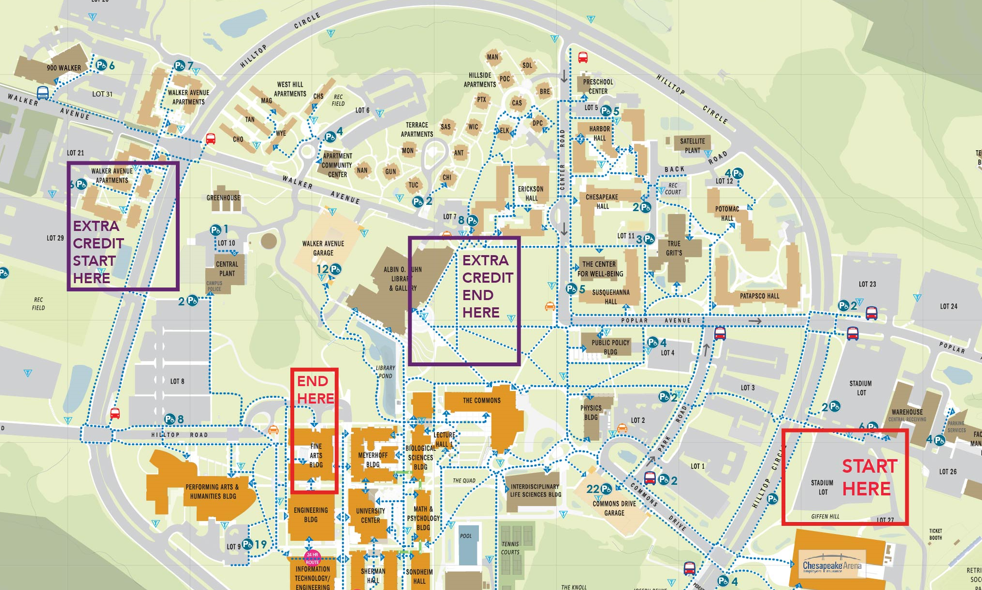
While you are walking, focus in on your body. Ask yourself: What would this walk be like if my calves were screaming in pain? What if I struggled with balance and were prone to tripping on uneven surfaces and could fall? What if I were using a walker right now? What about a non-motorized wheelchair?
What about crutches, or a lower-limb cast? When you arrive at your destination, take a note of the time. How long did it take you compared to using the stairs? Did you have to use a new route compared to your ordinary routine?
It was disclosed to me by several students that after they met all of the (stringent and privilege-laden) requirements to receive an accommodation appointment with SDS, they are told they will be unable to get the accommodations they need. In addition, it has also been reported to me that these meetings are often negative in nature with the student seeking accommodations being met with derision and/or hostility for their accommodation requests. One student, who wishes to remain anonymous, reported being “refused note-taking assistance because they needed to ‘learn how to take notes themselves,’” as well as being refused alternative text formatting as that is up to the teacher and “they cannot do anything about it.” The student accurately pointed out that both of these accommodations are among the published list on the SDS website. Another anonymous student trying to receive accommodations was told, “I know migraines can hurt sometimes but that doesn’t mean you can miss class.”
Many of the interactions that were shared with me have a common thread that is heard all too often by the disabled community: “You’re just not trying hard enough” or “It can’t be that bad”. The implications that we are lazy, that we haven’t developed strategies to succeed in our classes, or that we are somehow exaggerating our health problems are not only outdated ways of thinking about disability but are also extremely harmful. The reality of our lives is that it frequently is “that bad,” and that we wouldn’t be asking UMBC for help if we hadn’t already exhausted all of the resources available to us as individuals. To hear these words from the people put in place to help us succeed is equivalent to lifting us up only to kick us back down. UMBC is not the only institution in Maryland struggling with this problem, as this article (https://www.jhunewsletter.com/article/2021/08/disability-isnt-taken-seriously- at-hopkins) written by a graduate student at Johns Hopkins details out. Laurel Maury was awarded accommodations by JHU but found that her professors refused to use them (even under threat of legal action) and some went as far as to bully her for having them. Maury’s struggle echoes many of the sentiments that have been expressed to me by current UMBC students.
To my fellow disabled students: You are not alone, you have a voice, and your voice deserves to be heard.
You are enough.
Sometimes we lose ourselves when things don’t go as planned. Sometimes we lose focus of what really matters due to the judgement of other or because of our past. Sometimes we hold on to our past because we are scared of change. Sometimes we create very big pictures of our future and then get upset that it didn’t go as planned. This is your reminder that you are enough. Through your flaws and all, you are enough. Never spend your time on earth, being a watered down version of yourself just so people can like you. Sometimes it’s going to feel like you have a long way to go, but just remember you’ll get to through it. Don’t ever sit around and think that you are not enough for someone, you are enough. Sometimes it’s going to feel like you have lost your way or that you have seen almost every shade of gray, just know that everything is going to be okay.
Continue readingThe Art of Letting Go.

Sometimes it’s easy to feel lost when people have a hard time communicating and connecting to you in a way that you need them to be. Sometimes the best thing you can do for yourself is by letting them go. There might be a times where you should be strong and help patch things up, but theres also lots of times where you realize that the best way to love them, is by letting them go. You can’t make someone love you the way you should be loved if things are only one sided. Let them go. You can’t make them love you , if they don’t. So the best thing we can do now is to simply let them go. You can try everything in the world to change how they feel but that won’t change their mind.
Continue readingThe World Around Your Body May Not Be Made For Your Body
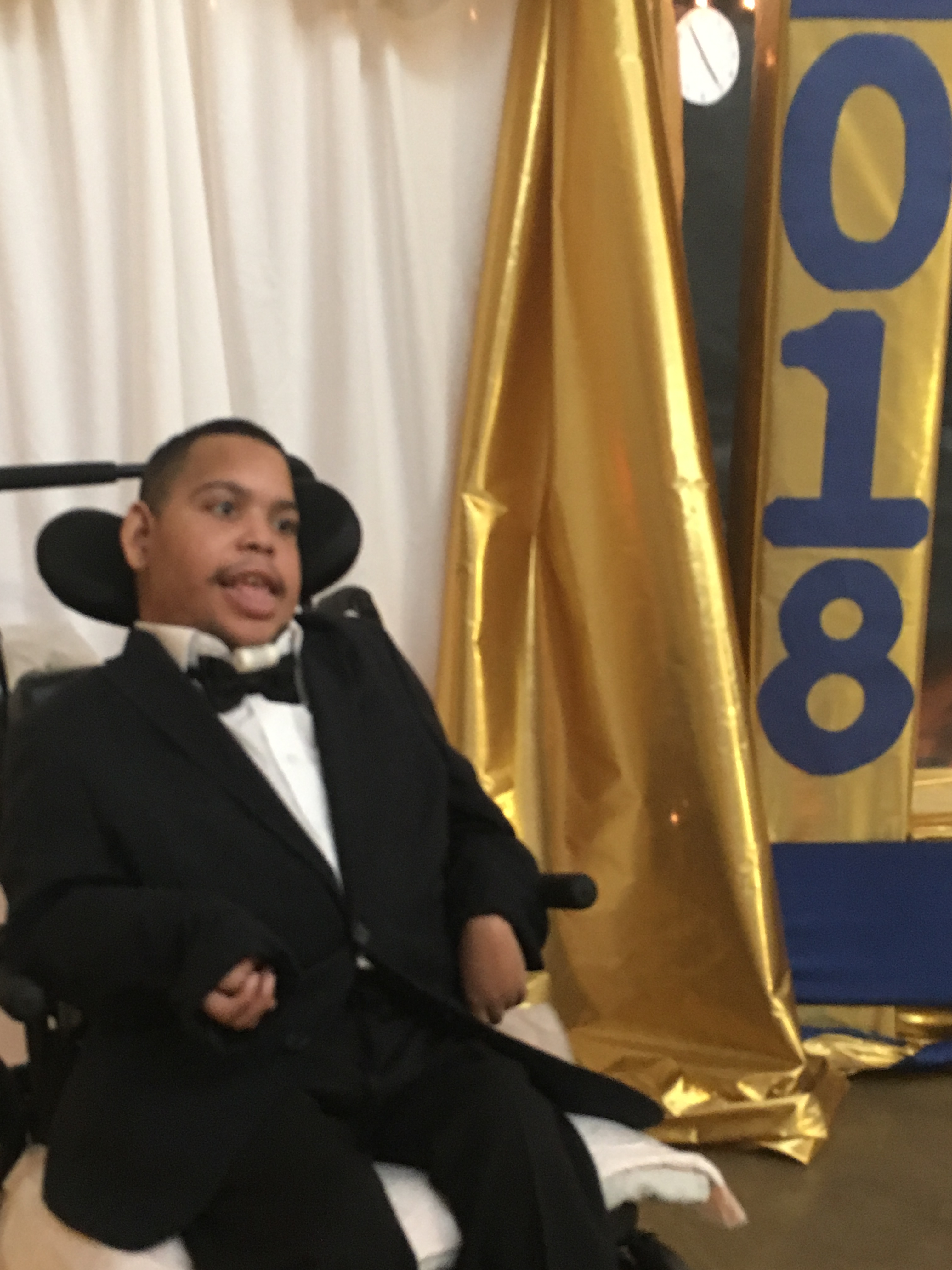 Growing up within a world that was constructed through the naturalized standards of body movements, I noticed my brother’s body stood out. As he stayed wheelchair bound and I walked beside him as my mother lifted him upstairs I felt this desire to want the world to be more accessible to my brother. With small inconveniences becoming the reason my brother’s nurses refuse to take him out his room, I saw that my brother’s impairment in which he did not cause nor create was what caused the world to seem unfair to him. Being diagnosed with something as debilitating as cerebral palsy and having infrastructure built off the assumption that you are an able bodied person creates disability. Tom Shakesphere, an English sociologist sees disability to be “the disadvantage or restriction of activity caused by a social organization which takes little to no account of people who have physical impairments and thus excludes them from participation in the mainstream of social activities.” This depiction of disability seems to be fairly accurate as places such as college campuses do the bare minimum to ensure that people’s impairments don’t stop from being productivity. For example, on my college campus they provide ramps on extremely steep hills reflecting a lack of thought of those who have to wheel themselves up and down these structures. With non-disabled people creating the structures and tools for those who are disabled it continues the cycle of ignorance. It is easy to understand why disabled people have created Continue reading
How to: Activism
Let me first start off by saying, that it is no small undertaking ‘becoming an activist’ & also that that undertaking will never look the same for everyone. But I often find myself frustrated by people who say they care about social issues, but don’t really show their support. I understand that it can be daunting, but here are some of the steps I took to start my activism, hopefully this can help you start/further yours.


