When Accommodation is the Bare Minimum, What Next?

@acaffeinateddesi

why is November is making me so emotional #deaf #deaftiktok

♬ original sound – Sita

First, let me just say that TikTok is a great platform for people to speak out on what seems like small moments in their lives but are ultimately extremely impactful: few other platforms expect you to produce 60-second vignettes of information with little further context, but TikTok allows and almost requires the person behind the camera to get to the point very quickly.

To summarize the video that does not have captions (not all creators in all countries have access to that feature yet): This person is deaf and was raised in a hearing community. They started a new job, and were surprised and overwhelmed when they walked in on their first day and everyone in the office was wearing clear, see-through masks, meaning they would be able to lip read. Their first reaction was to feel gratitude for what felt like a gesture of kindness and welcome, and that they feel seen as a person.

I want to take what this person almost said and bring it a step further. This creator felt gratitude, felt welcomed, and felt seen, and they felt these things because their workplace had done what could be argued they are legally required to do in order for them to be functional in their job. While clear masks may not be spelled out as an accommodation in the ADA, it definitely became necessary during COVID-19 for the deaf community in order for them to be safe, but also to participate in society. Providing clear masks to what is presumably an office would not be considered undue hardship as it would be only slightly more expensive than providing ordinary masks to the workforce. An office with a mask mandate is most likely providing their employees with masks, so an office with a mask mandate and a deaf employee would then be legally required to provide clear masks to their workforce.

I will reiterate: This person felt gratitude because their employer did what they were legally required to do to accommodate their disability and did it promptly so the accommodation was in place when they started their first day of work.

As a member of the disabled community this tells me that the bar is on the ground. It may even be buried, and we are then overwhelmingly grateful when someone unburies the bar and hands it to us. It may still be covered in dirt and we may have a new worm friend but it’s been so long since some of us have seen the bar that we accept it as-is.

Can we even conceptualize what it would look like if every disabled person was given their accommodations on their first day of work? What would it look like if in an interview we could just hand a list to our potential employer and it wasn’t a factor in the hiring decision but simply part of their resume? What if everyone was required to submit a list of accommodations and workplace preferences as a part of their application, and it was simply accepted as standard and a best practice in hiring? What if these were accepted as necessary and automatic requirements as long as they fell under ADA guidelines and did not cause undue hardship to the employer, and thus every employer automatically provided them?

Let’s take this thought experiment one step further. What comes next? What does disability acceptance look like in a world where each individual’s needs were met to the furthest extent possible?

This may take some creative thinking on our part, but I think it’s possible to imagine. I personally can imagine an office where wheelchairs were equally as common as chairs. I can imagine that one person may be at a treadmill desk (there’s always at least one fitness enthusiast in an office) and another desk may be empty most of the time, as its owner largely worked from home. I can imagine that transcription of recorded virtual meetings would be as automatic as meeting notes, and that it would be an expectation that the office would rotate through who took on that job just like we do note-takers. I can imagine that this office would throw out traditional concepts of what a work day would look like, and what work production would look like, and that each individual would be allowed to work and produce work in a way that best suited their personality, lifestyle, neurodivergences and sleep schedules.

These ideas, though, still linger within the realm of accommodation. Is it possible to get even more outlandish in our conceptualization of disability in the workplace?

I can imagine a workplace where a disabled person has been promoted several times. I can imagine a workplace where when someone schedules a happy hour, they take into consideration locations that would be functional and welcoming for every member of the team, which may mean having drinks at a quiet restaurant instead of a loud, difficult-to-navigate bar. I can imagine that at the desk of the person who works from home, there is a prank hidden in the drawer for that person to find from a coworker who is thinking of them whether they’re physically there or not, and doesn’t care how long it takes them to find it. (Who doesn’t enjoy the long game?) I can imagine a scenario where every team member is appreciated for their social contributions to the team, and that for some people that may mean not eating lunch in the cafeteria, but may look like them tracking everyone’s birthdays and sending out celebratory emails to everyone. I can imagine that people with disabilities are treated like people and are accepted in all contexts of the word and are welcomed not only on the surface of being able to do their work adequately, but are welcomed as a human being joining a collective enterprise.

When the bar for disability accommodation is buried underground, acceptance and equity for disability is buried along with it.

Is it worker exploitation, or just high expectations?

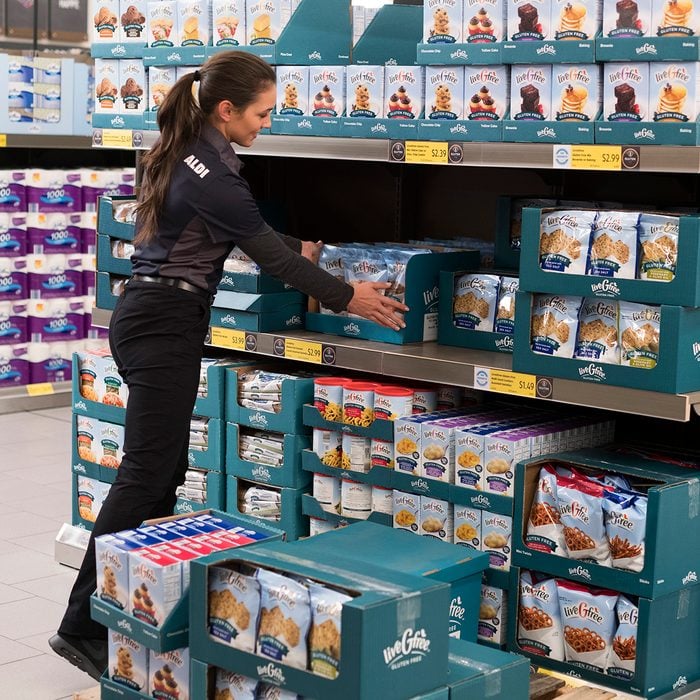
Stock photo of an Aldi worker placing boxes on the shelves with a smile.

I worked at Aldi for nearly two years before disability and injury forced me to quit, and take on several non-physical part-time jobs instead. Aldi runs on an extremely robust high-efficiency model that is designed to eke out every ounce of labor every worker has for every minute they are on the clock in order to keep their costs low and the customer’s costs low. In order for Aldi to be profitable, they must be exploitative.

Many Aldi employees will refute this statement because “Aldi pays more than minimum wage!” And yes, they pay just barely enough to be competitive in the local market they are located in – but only if you are comparing them to other grocery stores. The reality of the Aldi model is the job requirements are more in line with working at a warehouse, and warehouses on average pay quite a bit more than grocery stores as the understanding is that it is a difficult physical job.

Many customers also fail to understand how difficult the Aldi job is. The most common complaint we heard as employees was how lazy we were for getting to sit. This quote from querysprout best explains my feeling on that topic, “Letting cashiers sit down – it’s actually not a comfort thing (employees have described the work at Aldi as “backbreaking”), but rather, the company found employees could scan faster if they were seated.” We as customers praise and stand in awe of the Aldi model that allows us to get basic grocery goods for so cheap because they leave the goods in boxes, how revolutionary! In the next breath we complain that there’s never an employee around to ask questions to – the reason being Aldi staffs the bare minimum of employees at any given time to, again, maximize efficiency.

One of the most interesting facets in Aldi’s worker exploitation is how thoroughly prepared they are for worker injury. The job is intensely physical, the training for the physical tasks is minimal, and the expectation for worker speed and production is through the roof. It’s a breeding ground for serious injury, and the reality I knew working there was anyone who worked as a stocker was injured at least once in a year period. If they lasted more than a year, they typically were hurt at least once a year. I knew several people who had worked there for many years and all of them had received reparative surgery, or desperately needed it.

Aldi has a robust worker’s compensation insurance system, and it’s clear that they fork over a lot of cash for it. (I’ve had worker comp claims at other employers that were much less streamlined, in comparison.) Aldi will happily plan for you to be injured, pay for your recovery and for a short time out if needed, and then expects you to be back on the workhorse as soon as possible. Restrictions are heavily discouraged, though they do, of course, abide by them reluctantly when required to.

What happens if you just can’t come back to work right away? Scalia v. Aldi (2012) is an interesting case in which one employee was booted off of worker’s comp for taking too long to heal, and then promptly fired because she hadn’t worked in 12 months. The employee claimed that her firing was retaliatory for her injury on the job. (She didn’t win, which is hardly a surprise in the U.S.) The reasoning behind the decision came down to Aldi’s extensive policies around termination, worker’s comp, and time out, that enough logic loopholes existed in their policies that had existed before this termination to make it “not retaliatory,” though apparently only in a neutral sense.

What does that mean for you as a consumer, and for Aldi? Well, Aldi has absolutely abysmal employee turnover, akin to the rates of fast food industries. They are a ship with a mild leak that has been patched over and over with mixed success, and only time will tell if their model is truly successful in the long run. For you, I recommend asking yourself when you walk into an Aldi: Do the employees actually look happy, or do they look exhausted? Can you even find an employee?

A Shaky Start to the New Year

I don’t think my hands have stopped trembling since move-in day.  I’ve always had hand tremors, yet the neuroscientist my concerned mother urged me to visit assured me that it’s merely one of many cases she has seen of physiological tremors.  Surprisingly, it’s a phenomenon that is surprisingly very common and one that isn’t dangerous.  True, while this isn’t a condition that severely interferes with my life in the day-to-day, it’s often a channel through which emotions manifest in my body.  This is where my problem begins.  

Continue reading

Is It A Fit, Or Is She Just Skinny?

@brooklyndallen

this looks so bad on me mostly bc I don’t look right in baseball caps😭 it’s not /that/ bad #XfinityFanthem #fashion #pinterest #style #plussize

♬ Need to Know – Doja Cat

Fashion – and by extension, clothing – is created for skinny people.

Our world is built on the assumption that everyone is a certain size (that size being small) and that while some variety is allowable, the range of “acceptable” is even smaller than the jeans they expect us to fit into. Social media influencers flood their pages with images of them in a variety of outfits made by a variety of fashion sponsors, but the question posed here is simple: is the “Look” actually cute, or do we just view smaller bodies as more pleasing?

A recent TikTok trend involves users taking photos of fashion influencers and celebrities and styling themselves in similar outfits to try to answer this question. One note on this: While I have purposefully chosen a video of someone who is not skinny doing this challenge, I also found a lot of videos made by users who could be argued are skinny themselves, just not as skinny as an 18-year-old runway model.

The commonly-reached conclusion most creators have come to is two-fold. First, that the outfits themselves are often excruciatingly basic and boring. They lack color, interesting silhouettes and texture. The majority of these outfits are a pair of jeans or athletic pants and a t-shirt or sweatshirt – the sort of outfit that is typically classified as athleisure or “going to the grocery store.” The people wearing them look good, certainly, but they are not breaking new ground in the realm of fashion and won’t be found on the runways of New York fashion week. The commentary on these photos typically ignores the lack of originality, or even fails to notice it; the comments sections are flooded with people praising them for their beauty and their outfits.

Second, these outfits only look good because the person wearing them is skinny. When placed on a larger body they often look absurd. It’s worth noting that the absurdity is created largely because the challenger is not modifying the outfit or silhouette to more aesthetically suit their body type, as one would typically do when actually buying clothes or creating outfits for themselves; they are purposefully taking the outfit in its original form and simply scaling it up, precisely like modern-day jeans manufacturers. This conclusion only serves to enhance the first one: if the outfit itself is boring or even straight-up bad, why are we applauding anyone for wearing it?

The answer I, and many TikTok users, have come to is that skinny bodies are put on a pedestal of beauty. They are seen as the original, the default, and the gold-standard. They are afforded privilege that larger bodies are denied. They are given beauty labels that are unattainable for those around them, and in some cases like this, may also be completely inaccurate. Even worse, skinny bodies are also seen as the standard in medicine, which can leave massive gaps and inadequate care for those in larger bodies.

Beauty is in the eye of the beholder, of course, and I’m not here to reach any conclusions for you on whether or not you think these influencers and their outfits are pretty, but I would have you start to ask yourself this question every time you see yet another model wearing the same thing your dad wears to mow the lawn: Is it a fit, or are they just skinny?

Bedroom.

A view from my bed [ID: Hazy photograph of a window illuminated by vibrant red and purple lighting. In the center there is an electric candelabra sitting on the window sill, slightly obscured by sheer curtains.]

2011 was the year I began distancing. By which I mean, I began a life lived from my twin bed, fueled by goldfish crackers and electrolyte drinks, seldom able to access the outside world. It wasn’t mine to call home anymore.

I was drowning in conditions that these doctors hardly knew about. I had no choice but to become my own doctor, nurse, and historian. More than anything, I became my own community.

The outside world was stolen from me by sickness, uncertainty, and administrative violence – this world was never built for my survival. Such predicaments were met with constant calls to push through – go into the world anyways, risk it all for a “normal” life. They said adapting to it would make me better. It wrecked my body and my mind. Being bedridden was extraordinarily taxing and painful in a way that cannot be understood by those who have not been fully immersed in it in this way, yet. But I am inseparable from my bedroom life, I am made of soft pillows and the world I built among them. 

Continue reading

Should You Binge-Watch Embarrassing Bodies?

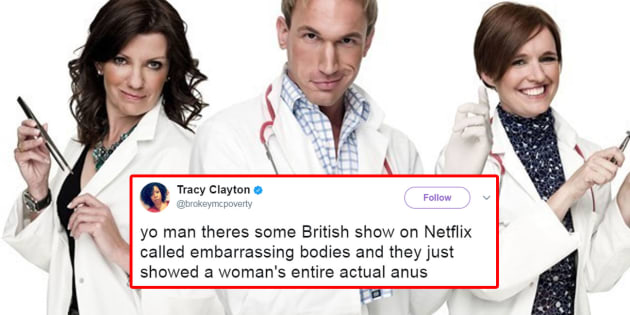
Image result for embarrassing bodies tweetsCircus Water Act


Netflix now carries the British series: Embarrassing Bodies, a show about three doctors who travel through Britain, opening pop-up clinics for passersby seeking cures for a wide array of ailments or deformities.  The show documents one-on-one consults, large group Q and A sessions on specific health-related topics (these are often set in schools, pubs, or other common public gathering places), street interviews on topics such as “baldness” or “boobs” and exhibits set up outside the medical tents where people can learn more about the inner workings of the body.  All of these interventions are designed to make people less worried about their bodies, while setting up expectations about what is “normal” versus what requires medical intervention.

It is hard to think of an American equivalent of this show, though there have been other international spin-offs: Wikipedia lists Embarrassing Bodies Down Under, Dit is mijn lijf (This is my body) in the Netherlands and the strikingly named  Я соромлюсь свого тіла (“I’m ashamed of my body”) in the Ukraine.

Continue reading

The Resting Bitch Face

The Resting Bitch Face

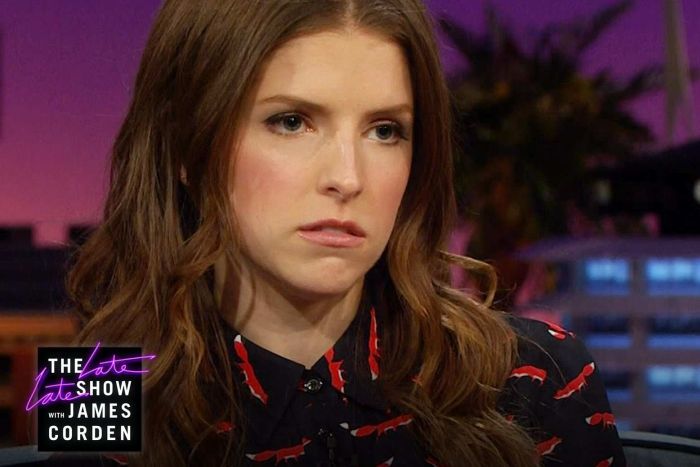
akIn a poem titled “Ode to My Bitch Face” Olivia Gatwood theorizes about some reasons why women have resting bitch face or R.B.F. She says that some are born with it, to some it is a defense mechanism they put up every day, and to some it is a “safe zone.” The resting bitch face according to Urban Dictionary is “a person, usually a girl, who naturally looks mean when her face is expressionless, without meaning to” and “A bitchy alternative to the usual blank look most people have. This is a condition affecting the facial muscles, suffered by millions of women worldwide. People suffering from bitchy resting face (BRF) have the tendency look hostile and/or judgmental at rest.” Continue reading

“The Body I Wear Is Not Perfect”

selective focus photography of skeleton
Photo by Chris Mitchell on Pexels.com

When thinking about the beauty standards of today it’s hard to ignore that bodies within magazines and television are rarely realistic goals for the general public. With bodies that range from what some may consider skinny to what others may consider thick, it’s important that we acknowledge all bodies contain a life within them. Looking at myself in the mirror can be difficult sometimes as I don’t believe my body is what society deems as attractive. Attractiveness is different for each gender as what is subscribed for males and females are different though this is changing it still holds today that men should be muscular and that women should be small and hairless. Focusing on the physical aspect of the

Continue reading

Not Having Social Media Has Given Me A New Confidence!

Everywhere I go I see younger children, teenagers, and young adults snapping everything they do. My sister literally stays on Snapchat/IG so much that I do not enjoy her company because that’s ALL she does. I see people dying to post on Instagram. I see old people on Facebook 247. My mom can barely get though the door before she is on the computer looking at her newsfeed, for hours. Both of my grandparents are 70 and they both are on Facebook, and they comment on EVERYTHING, it is beyond annoying.My grandma has at least 50 repost a day, seriously. About 3 in half years ago I deleted my Instagram for many many reasons. I ended up deleting my Facebook this year, because it was just too many old people and all long post that were just to annoying to take anymore. The first reason I deleted my social media was because I was always stalking someone, wanting to see what they were up to, simply being nosey and accidently liking their pictures…. embarrassing. Continue reading