The Girl With The Dragon Tattoo (WARNING! i tried my best not to spoil anything but….you never know soooo proceed with caution)

Just recently I viewed the movie “the girl with the dragon tattoo”. Though I had never read the book, rave reviews had me really excited to see the film. Ill do my best not to spoil anything for those who still plan on seeing it or those who have not read the book, however there were a few things that definitely stuck out to me.

For one thing, I took notice of how the main character was viewed and treated as a result of her appearance. I would love to say I was shocked, but it is very representative of what goes on everyday in our society. The main character seemed to be a rebel from her piercings and tattoos down to the way that she chose to dress.  Because of this, certain people with whom she worked closely with doubted her ability to complete intricate tasks successfully, though she would prove throughout the movie that she was clearly the best for the job.

At times, the movie reminded me of a class discussion that we had towards the beginning of the semester when we talked about embodiment and how mental abilities are separate yet go hand in hand with what is embodied in physical form. The main character in the movie, who was a warden of the state, was deemed incompetent and as a result was not in charge of everyday things like her own finances for example. It was interesting to me how certain authorities that she had to report to, acted as this so called “mental incompetence” viewed her body.  I think this often times happens during this day and age which leads to serious things such as violence as well as sexual assault.

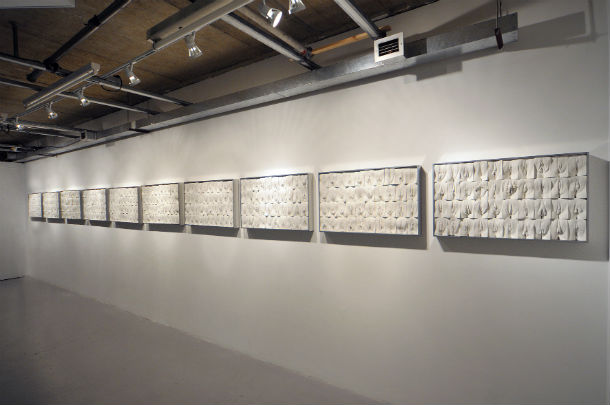
The Great Wall of Vagina

Artist Jamie McCartney is trying to start a sexual revolution… but not the kind we usually think of.

Image

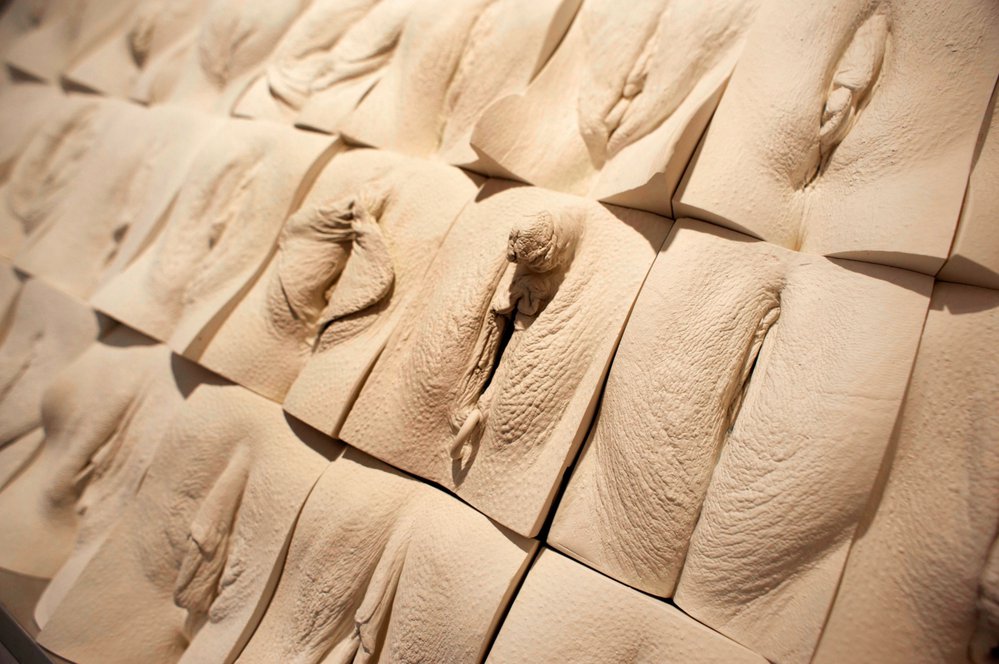
He is attempting through art to change female body perceptions and show us that every woman’s vulvas are normal.  McCartney is a life cast artist; he spent five years collecting casts of volunteers’ vulva mounds and has turned the result into The Great Wall of Vagina.

Image

The work includes 400 casts, as accurate as photographs, displayed in ten wall panels. They range in age from 18 to 76 and include mothers and daughters, identical twins, transgendered men and women, women pre and post natal, and another one pre and post labiaplasty. It is impressive and at times overwhelming, but by reducing the body part to a simple white plaster cast, he removes the sexualization we would typically attach to such a display.  His use of spectacle shows us how absolutely diverse each and every woman’s vulva is – on the website it mentions how each one is as unique as a face.  And they are!

Image

“For many women their genital appearance is a source of anxiety and I was in a unique position to do something about that.” - Jamie McCartney

There are several things I find interesting about this art project.  First, by bombarding us with 400 vulvas in a small space, he reduces the body to a single part, from a view many of us have never seen. And while we ARE viewing the diversity and differences in vulvas, it also manages to emphasize the similarities.  We see the similarities in our differences.

Image

And second, if women are shocked and surprised at the diversity shown here – why is that?  Is it simply because most heterosexual women haven’t seen other women’s open vulvas?  Or is it the “pornification” of our modern culture?  If labiaplasties are on the rise, do you think an exhibit like this would help stop that trend? Do you think hetereosexual men and lesbians are surprised by this diversity?

So, would you go see the show?  And if you are the owner of a vulva, are you looking for one that looks like yours?

Image

“It’s time our society grew up around these issues and I’m certain that art has a role to play.” - Jamie McCartney

Hijabs and Hoodies

After we discussed the horrific and tragic murder of Trayvon Martin in class today, this article in particular caught my attention:

Shaima Alawadi, a resident of San Diego, California, was found beaten unconscious in her home last Wednesday and died of her wounds this past Saturday.  A note was found saying, “Go back to your own country. You’re a terrorist”.

Shaima was a stay at home mother with five children.

http://www.reuters.com/article/2012/03/28/us-california-iraqi-memorial-idUSBRE82R01N20120328.

This happened less than a week ago.

There was mention in class of how certain ideas in society become normalized, for better or for worse. In Trayvon and Shaima’s case there is no question these ideas create a poisonous environment.

But in both cases there was a similarity: clothing.

Trayvon was wearing a hoodie; which according to sources across the spectrum, most notably Geraldo Rivera, made him a target for suspicion. Last I checked wearing a hooded sweatshirt left no one with the ability to label someone as “suspicious” and cause cruel loss of life to another.

Shaima also had an article of clothing that marked her; a hijab. For those who are unfamiliar with a hijab, it is a head covering traditionally worn by Muslim women for reasons of modesty. Yet by wearing a hijab Shaima marked herself as “other”.

I find myself wondering if we can draw parallels between Shaima’s and Trayvon’s murders. They were both marginalized members of society, Trayvon was black and Shaima was an Iraqi-American immigrant. Both were wearing articles of clothing that are innocuous (although a hijab may stand out for those unfamiliar with the garb) but these clothes became threatening to those with prejudices and stereotypes.

I think we, as a Western society, are not past our cultural and racial biases when two murders are committed within a month of each other on the basis of race and ethnicity, with the flimsy excuses of clothing as reasoning. (By the way, I’m not ignoring that there are far, far too many of these crimes that go purposely unnoticed or are unreported).

In response to this hate crime there has been an out pour on social media and I found a group on facebook that seemed particularly fitting: http://www.facebook.com/pages/One-Million-Hijabs-for-Shaima-Alawadi/137306256397032.

When women are told, “you were asking for it”, if they are raped and happened to be wearing a miniskirt, when young black men are shot for wearing hoodies, and a woman is beaten to death in California for wearing a hijab because it “makes her a terrorist”, I have to wonder about the emphasis placed on clothing and the body-the cycle of violence around the clothing people wear for religious or personal reasons and why people use these articles of clothing as excuses for committing atrocities.

I find myself sick at heart with the violence, the hate, the prejudice, and the inbred bias. I send loving and peaceful wishes to the members of Trayvon Martin and Shaima Alawadi’s families.

The Werewolf as Synecdoche of the State?

Two or so years ago in the process of having my political mind entirely changed forever by reading Giorgio Agamben’s brilliant Homo Sacer: Sovereign Power and Bare Life, I came across a lively section on the archetypal wolf-man, or werewolf. Agamben’s thesis in the book is essentially that, since Enlightenment thought and the construction of statehood as a rational institution subject to a code of normative ethics, sovereign state power has been based upon the principle of “exception.” The individual subject is theorized in Enlightenment political literature as being the result of the imposition of a political structure upon a natural “bare life.” Agamben counters this top-down theory by proposing that “nature” or “bare life” only becomes intelligible through the apparatus of sovereignty. The “natural” that lingers outside of the polity or municipality is always already formulated within state terms. The “state of exception”, popularized in World War II era by political scientist Carl Schmitt, is the concept of an emergency structure put in place, outside and beyond the written law, in particular situations (a recent example would be George W. Bush and Barack Obama’s suspension of international human rights laws, through torture and unjust imprisonment, in the name of defending “freedom” in wartime.) Agamben’s theory postulates, however, that state sovereignty is always already a state of exception: “rights,” as the bedrock of law, are always constructed by and “enforced” by the same powers that are supposedly equally subject to them. Thus state power is always already “outside” rights and the law. The rights that are based in “nature” and the natural sovereignty of the individual are codified by state power. The state is thus a liminal between-space, with nature and the political not as two poles but as between and within each other.

Agamben illustrates this theory with the archetype of the werewolf. The werewolf acts as a symbol of state sovereignty as the threshold between bios and nomos, between nature and the political. “It is a threshold of indistinction and of passage between animal and man, physis and nomos, exclusion and inclusion: the life of the bandit is the life of the loup garou, the werewolf, who is precisely neither man nor beast, and who dwells paradoxically within both while belonging to neither.” The werewolf embodies the concept of liminality upon which state sovereignty is founded. Pretty cool, right? I realize I spent more time explaining Agamben’s central thesis than on the werewolf paradox, but it’s something to consider when thinking about the ways in which (fictional and nonfictional bodies) are simultaneously “natural” and continent/political. 

Racing the “White” Body, The Invisible Arab, and the Curious Hybrid.

As a child, people often asked me or my parents where we were from. Was I Iranian? Jewish? French? In eighth grade a boy told me I had “negroid” eyes, and for most of my adolescence I was mocked for having a “ghetto booty.” Last summer while in a thrift store near D.C. a complete stranger, a white middle aged man, approached me and asked in deliberately slow English if I was from Honduras. A former boyfriend once commented on the fact that I was not “pale” when naked in winter. I live in a mixed neighborhood with many Central American immigrants, and have been addressed in Spanish on a few occasions.

To most people, I assume that I appear white. I have brown hair, black/brown eyes, and an “olive” complexion. I consider myself to be on the pale side of this “olive”, paler than most of my father’s family at least.

I am of North African/Tunisian, Sicilian, and “Black” Irish decent. None of these categories have been deemed pure “white” by historically racist notions of U.S. “whiteness.” I am not a WASP. I have often wondered if I had blonde hair and blue eyes if people would ask where I’m from on a monthly basis. I gets worse in the summer as I do tan very quickly. But, if I was clearly white, of no curious or “exotic” background, would strangers feel as comfortable violating my personal space? It’s as if my height, skintone, and eye color are an accent – one to be met with “Where are you from?” My cousin, who like most of the women in my family, has very curly hair, was called a “mulatto” all through high school. We have all learned to laugh this off. We eat ravioli, my grandmother travels to Sicily frequently, we know where we are from. And yet, of all the assumptions strangers have made regarding my or my family’s ethnicity, Arab is never one of them. If we all wore headscarves perhaps our “origins” would be more apparent, more clearly marked. After 9/11 some of my friends would joke about my father getting pulled over due to racial profiling, and I would laugh with them.

So after years of being hailed as less white than my white friends I decided that I am not. I am not entirely white. A few years ago when the U.S. census came to my apartment, I had to check off my ethnicity. While “Other” seemed the best choice for me other than “White”, I noticed that there was no “Arab” choice. “African American/Black” was available, but many North Africans are not black. Most are Arab or Berber. Although Arabs constitute a large number of the world’s population, covering North africa and Western Asia, as a people or race they are simply invisible in the United states. So unwanted as to not be counted. I checked every single box and handed it back to the census worker.


Bows and Arrows vs. Vampire Fangs

If you’re a nerd like me and spent this past Thursday night eagerly waiting for The Hunger Games midnight premier, you might recognize the name Katniss Everdeen. Katniss is the heroine of the wildly popular Hunger Games series by Suzanne Collins. If you haven’t had the opportunity to read these books yet I highly recommend checking them out at your local library.

Recently, I’ve noticed a lot of media comparing Stephanie Meyer’s Twilight with Suzanne Collin’s The Hunger Games, or more specifically, Katniss vs. Bella.

I did a little research and I found this article: http://www.washingtonpost.com/lifestyle/style/in-katniss-of-hunger-games-a-lasting-heroine/2012/03/20/gIQAXvVbUS_story.html

The main point of the article is Katniss is not a new character, her physical and emotional strength are not new concepts to female heroines. However, many of the “sheroes” depicted in present day teen fiction, such as Bella Swan, are the exact opposite of the force that is Katniss Everdeen. Bella doesn’t push herself forward, and fight. Bella’s route is different, but her choices are her own. I am not a Twilight fan in any sense of the word but this article had a fascinating insight: there is room for both sheroes. Katniss needs to exist alongside Bella, both are representational of different aspects of feminism and the choices it allows women to have.

I appreciated the article for having the insight to point out characters like Katniss, who defy the norm, have existed in literature for ages. Has anyone besides me read Little Women? Jo and Katniss would have been best friends.

Ultimately I have to agree with the Washington Post article; Jo, from Little Women is remembered as is Alana from  Tamora Pierce novels, and I don’t think anyone will ever forget the brilliant Hermione Granger from Harry Potter. These women, along with Katniss Everdeen, are powerful, dynamic creatures who put their complete selves into a struggle against all odds.

So I offer up the question, of all the female characters in modern day literature, whom do you think will be remembered?  Will our daughters read about Bella Swan while Katniss fades quietly into the background and is eventually forgotten? Or will it be characters like Bella, who passively accept their surroundings, who will eventually be forgotten?

Orgasm During Birth…What?!?!

http://youtu.be/8EQ_-irO50w

Image

So I came across this video when someone posted it on Facebook a few months ago. The video is a clip of a newscast about women who have experienced orgasms during child birth. The idea of experiencing pleasure during a process that has been portrayed to be the most painful thing a woman can go through is strange and confusing to me. How can birth be so painful to some women, but pleasurable to the point of an orgasm to other women?
    My first reaction was that I was sort of grossed out when I thought about the idea of my own mother having an orgasm while she birthed me. My mother actually had an awful experience with labor, she was given too many drugs accidentally, causing her to lose all feeling in her body. If my mom and other pregnant women could have better experiences I am all for it. About 99% of births in the U.S. are not in a hospital, yet we rank 28th in the world in infant mortality. The hospital setting is no more safe than home births. So why not have a birthing plan that allows you to be in the comfort of your own home, and possibly give you an orgasm? Of course, pregnancies with complications need to be more monitored and may possibly require a hospital birth.
    Ultimately, these are personal decisions that need to be made by each pregnant woman for herself. I still think it is a bit strange to get pleasure from the baby leaving the birth canal, but that is just my opinion.

Sharing the Experience? The Menstruation Machine.

Image

To the phenotypical male, menstruation will always be a mystery that we will never experience.  Or is it?

Growing up as a boy, the only information I received about menstruation was by eavesdropping on girls whispering to each other, or the odd incomprehensible schoolyard insults about PMS.  Television provided images of pads (with wings!) that women were supposed to wear in order to catch an unnaturally blue liquid, but no indication of where those pads went, or what that odd liquid actually was. Sitcoms taught men to just stay out of the way during “that time of the month,” lest all hell break loose.  It wasn’t until many years later, when I screwed up my courage and started to ask questions of my partner, that I was able to come to understand what happened.  Sort of. I mean, I could be sympathetic, but how can one be empathetic of a bodily process you can never experience?

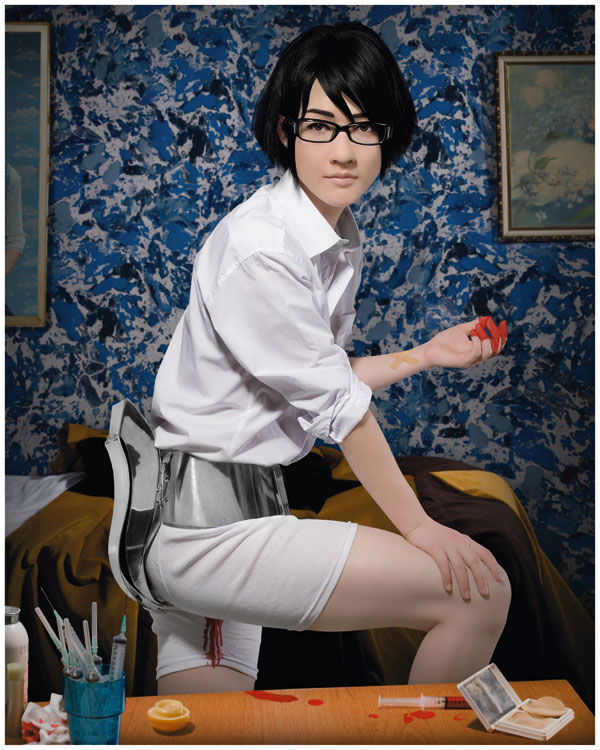
Performance artist Sputniko! (aka Hiromi Ozaki) seems to have developed a solution of sorts to this conundrum.  The Menstruation Machine, a gleaming chrome device that straps to the abdomen, is meant to simulate menstruation for those who would not otherwise experience it.  Prior to putting it on, a vial inside the machine is filled with the wearer’s own blood.  Once on, the strap around the abdomen simulates cramps, and the vial inside slowly drips blood into the wearer’s underwear.  Sputniko! created a music video of Takashi, a drag performer, wearing the machine out on the town and experiencing cramps and bleeding:

On the surface, this seems like a really interesting opportunity for someone who doesn’t menstruate (whatever their gender identity) to experience what goes on during this part of the menstrual cycle.  But in the end, it is just a simulation, and like all simulations, it can be stopped.  And it has limitations- it does not simulate the anxiety of a late period, or account for variations in severity over time.

Obviously, Sputniko! created this as an art piece to stimulate discussion.  Can such a machine be used to bring about empathy in those who don’t menstruate? Or would it create a sort of false empathy because the experience of menstruation is a fully embodied, ongoing experience? I find myself sort of in-between these two stances. What do you think?

The Phallic Titty Manifesto: Queer Sex and the Naming of Parts

Transitioning is often seen through a medical lens, marked by physical changes to the body including hormone replacement therapy and sex reassignment surgery. While transitioning clearly demonstrates the fluidity of gender, the body, and how gender and the body interact and are perceived, the locations of sex on the body are often viewed as static. For someone to have fully transitioned, their gender and biological sex would seemingly “match.” I am in support of people doing whatever it is they need to do to feel good about their gender and I am in no way against this type of transitioning. However, what I believe is problematic is how this is typically seen as the default for trans* people. Not all trans* people transition or transition in this particular way.

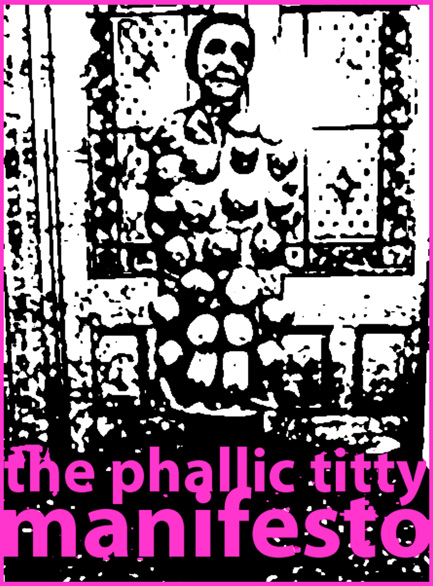
The Phallic Titty Manifesto, a zine by a friend Jackie Wang

discusses the ambiguity of flesh, tits as dicks and dicks as clits, erotic lactation, Judith Butler, pregnant bodies, Louise Bourgeois, the lesbian phallus, unmaking and remaking bodies, expanding erogenous zones, and queer sex.

Through a queer lens, sex is no longer isolated to biological parts associated with our sex at birth or if they are their weight no longer holds. In this sense, there is a radical capability to transition or transgresses gender norms while still seemingly embodying the sex you were assigned at birth.

This makes me think of the usage of terms “female-bodied” and “male-bodied.” I have typically heard them used in the context of referring to trans*, genderqueer, and non-gender conforming folks. While someone will refer to someone with “they/their” pronouns in one breath, they will use “female-bodied” or “male-bodied” to refer to them in another. While I think this is subjective, dependent on the specific person and how they like to be referred to, I think this is extremely interesting. From this example, it is clear how deeply embedded sex and gender are in physical bodies. I think at times terms like these can (unintentionally) reinscribe the gender binary, in which some folks clearly do not identify with. If someone is trans*, why wouldn’t they be trans*-bodied (or however they would like to be referred)? Do you think it is inherently impossible to view the body, specifically sex on the body as fluid?

Transgendered Kids

Most people spend years and years trying to figure out who they truly are. What if you didn’t need decades to figure it out? What if you knew since the age of 11 or even sooner that what you were born into was not fitting of who you were supposed to be. The transition from male to female or female to male (transgenderism) that an increasing amount of individuals are beginning to make has become an uncomfortable and extremely controversial subject for many. Most people see black and white and fall on either end of the spectrum as far as right or wrong goes concerning transgenderedness. These positions become all the stronger however, when children are involved.

The documentary, Jazz: A Family in Transition, and supplementary articles about this courageous kid raised a few questions for me. As much as I value individualism and seeking happiness, when should someone be allowed to have control of their own body? 18 is the official age when an individual can provide legal consent to make important decisions especially life altering ones without parental permission.  But as a parent when do you allow your child to make decisions regarding their identity, appearance, and ultimately their life. Jazz’s parents not only allow her to dress as girl but they have also considered actions for a more permanent changed and have shared her story with the world all of which will impact her for the long run.

Another part of the article that I found interesting was the excerpt regarding the special box of hand -me down bras that Jazz keeps in hopes of one day being able to fill them out with breasts of her own. Though Jazz has already assumed the female gender role, it is interesting to see how the physical features matter. Something such as breasts not only affect Jazz’s self concept, but it also affects the way that others will perceive her and her gendered roles in society.

As Jazz is rapidly approaching puberty, her and her parents now face the question as to whether or not begin Jazz on hormones and hormone therapy to offset the male traits that she would encounter ones puberty starts. As with most medications, there are side effects, many of which can be extremely harsh especially for children. The fact that medications, and hormone therapy is a very real reality for Jazz and her family is intriguing. Unlike many transgendered individuals, Jazz has the support of her family and is able to dress and act accordingly to the gender that she identifies with even at such a young age. The fact that her and her family are strongly considering these possibilities despite all of the ways it can affect her body for the worse is interesting. Though Jazz already assumes the role of female, it seems as though she won’t feel complete until the physical matches up to the socially constructed definition of what a woman is.


http://janetmock.com/2011/11/25/i-am-jazz-transgender-jeanette-documentary/

to see the documentary, enter I am Jazz: A Family In Transition into the Youtube search