“F*ck your disorder”

Photo by Darya Sannikova on Pexels.com

A few weeks ago I had a difficult bipolar/autistic meltdown that spiraled me into a dissociative state. I say bipolar slash autistic because the criteria and symptoms for both disorders overlap so much that it is nearly impossible to tell them apart within my own body at this point.  I wasn’t able to attend some of my classes for two weeks because my mental state was feeling immensely guilty about using my accommodations. Every time I typed up another email to a professor, saying that I once again had to rely on my disability accommodations, I felt my chest tighten with anxiety and guilt, as if I was doing something wrong by needing my accommodations. I didn’t want my professors to think that I was lying to get out of class to go out with my friends. To be fair I did hang out with my friends and try and do stuff during the time I had class, but everything we did was an attempt to pull me out of the dissociative state I was in. As someone who has heard numerous times that they don’t look “autistic” or “disabled”, I am aware that this is a judgment that many pass on me, and I was aware that my professors may think that as well. Perhaps out of guilt, I sent an email to my professors, explaining that I had bipolar disorder and was struggling to pull myself out of a rough episode that left me unable to even read and comprehend the readings for any of my classes. Most of my professors answered with supportive statements, validating my disability and granting me as many extensions as I needed. One professor emailed me back, ignoring the fact that I had just opened up to him about my identity, and demanded I turn in my work within 48 hours, because the accommodation guidelines offered a 48 hour extension as an example guideline. Evidently, I was not able to get my work in, because I am not able to pull myself out of a dissociative episode on command; to make it worse, when I finally returned to class the following week he spoke negatively about bipolar disorder in class, leaving me stunned and panicked. I made the rather obvious assumption that I wasn’t his favorite student. Rather than fighting with him every step of the way, I decided to withdraw from the class, postponing my graduation from this December to May. I was devastated telling my parents that I would not be graduating as soon as they thought, and I was even embarrassed, knowing that if I pushed myself I could have made it through the class. But just because you can do something as a disabled person, doesn’t mean it is worth it. I was reminded in a somewhat blunt manner that not everyone will accommodate your disability, and sometimes it’s better to give up, then to fight for your right to take a class. 

The emotional labour it would have taken for me to fight with this professor every step of the way, just to most likely pass with a C in his class was not worth it for me. Personally, I am proud of myself for knowing my boundaries and how far I can push myself. He made me feel weak and made me hyperaware of how people view me as someone who is bipolar and on the sepctrum. 

Subtle ableism is so present in today’s world that it goes unnoticed by most, unless we are directly affected by it. For me, this was an example of direct ableism, someone who would do the bare minimum to accommodate my needs, and refused to do anything more. It was dehumanizing, but it also reminded me how lucky I am to not be faced with people like him, and ableist challenges on a daily basis. Our world was not made for disabled bodies, whether it’s expectations at work, to campuses being not accessible, to the general population applying certain stigmas to disabled people as a whole. As a physically abled person who is usually able to mask their disability in public, I don’t have to constantly worry how I will make it to class on time, or if the elevator will work today, or if I will be able to make it up the hill to my building for class, and that gives me a certain privilege. The dialectic of both being disabled and abled is an interesting limbo to live in. I can’t imagine how it would be if I had to worry about physical disability on top of my ever present mental disability, still, I can’t help but wonder if I would have been treated better by that professor if my disability had been more visible.

Forgiveness Does Not Always Heal

Honor thy mother and thy father. That’s how I think it goes anyways. Now I’m not religious, nor am I against anyone who is, but that line runs deep into society more than most people think. I grew up experiencing abuse from both of my parents. One more than the other, but abuse nonetheless. My mother, I have forgiven her for what she has put me through. She’s an addict, and has suffered her own plethora of abuse. She never intended on being neglectful. My father on the other hand, I don’t think I can ever forgive. He is abusive in all of the ways you could think of. Society puts on this pressure that no matter what, your parents are your family and above all created you, so you owe them forgiveness. I have heard many people tell me (religious and not) “well he’s your father”, as if that erases all that he has put me through, and like I owe him something. Although I am no longer in physical or social contact with him, his abuse still haunts me. I have PTSD and GAD that I live with, and it greatly affects my day to day life. I can’t go anywhere or do anything without the worry that I will break out into a debilitating panic attack that could last for hours. I rarely (if ever) feel “normal”. I feel like he has robbed me of my life sometimes, a happy one at least. So, to be told that I need to forgive him ignites a fire in my soul. I recently have cut off all communication with my whole paternal side of my family because I realized they all don’t care about how much of a truly terrible human being he is. I even confided in my aunt and others about his abuse when I was younger and got nothing in return. No one should ever feel like they need to forgive another just because they are family, or in general for that matter. Forgiveness does not always heal. With all of this I would like to say, honor thy mother and thy father as they honor you.

Attitudes

I never wanted to be like her

Always complaining and never solving

Making others push her around in a wheelchair when she could still walk

Never taking her medication even as she complains about her failing health.

As I got older, I stopped wanting to be like him too.

Never visiting the doctor

Always making excuses for his aches

He let his body fall apart

Too afraid to admit he needed help.

I was glad they made me independent 

They taught me not to make excuses

They taught me to work harder to be like everyone else

They taught me to get a stool when I was too short

They taught me to go to doctors and take my medicine

They taught me to be better than they were.

I wake up at 8 am

I take my pills at 9am

I wear my brace 

I wear my prosthetics

I wear a smile

I need help, but

If I fall apart

I can put myself back together 

I feel sorry for them

I want to help them

I know I can’t

They gave strength

They gave me choices

They gave me what they didn’t have

Thanks mom and dad ❤️

Emotional Labor and Anxiety

Arlie Hochschild, the sociologist who coined the term emotional labor, defines the term as work, for which you’re paid, which involves trying to feel the right feeling for the job through evoking and suppressing feelings. Depending on who you are or what your job is, the emotional labor of a job can be even more draining than the work itself. For example, jobs in customer service where you have to be attentive and polite to lots of customers within a day even when you are not treated so well, and jobs like nursing or caretaking where you have to take care of many people and deal with sickness or death on a daily basis while keeping your composure. This strain can be added to when also dealing with things such as anxiety or depression, which can make it harder to manage your own emotions.

Continue reading

My Father’s Sacrifice

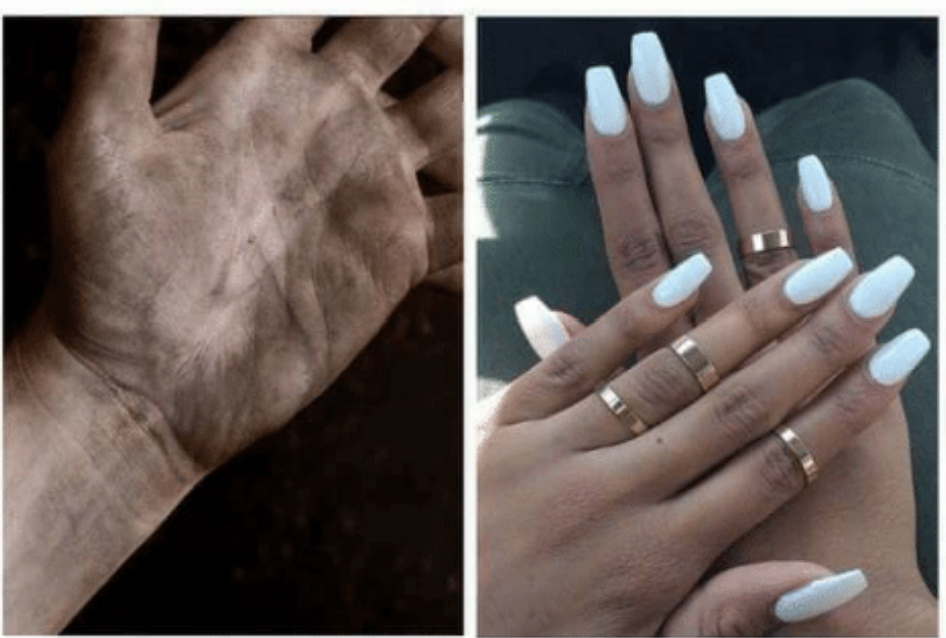
Not even a day before this unit, My father had very bad arthritis in his hands. It was very painful watching him in pain as his hands were spasming and in pain. It is a very direct reminder that my old man is actually getting older. He works at Food Depot in Baltimore, and he has worked there for 5 years. Over time, he has accumulated lesions on his skin (I think its called “psoriasis”) that were caused by him grinding his life away in a freezer. Also, one night he cut his finger very badly and went to the hospital, but still pulled through and bought me a game for Christmas. Despite his faults, he has always pulled through for my sister and I, and worked hard so that I wont have to work as hard. While he worked in a freezer all day, Ill be freezing in an office writing code on a computer. He always told me to be better than him, but I am deathly afraid that he wont be around to see that. Its very interesting to talk about what we do to have just a simple, dignified life. Parents have to destroy themselves just to provide the bare minimum for their kids.

When my sister was Born!! :)

tldr; i love my family very much

My sister and I have a 10-year age difference. College has put some distance between us but the second she needs me, I’m there for her. Although faint, I remember her first rolling over, her first steps, her first words, her cute outfits, changing her diaper, her Halloween costumes, and much more memories. Thinking about the old times me nostalgic. Oh, how times have changed. Oh, how much worse they got. I would time travel back if I could, without thinking. I wish my sister has a more gentle and kind environment growing up but alas, all families have their problems. At least that’s what I convince myself as I grow older. My family is not perfect but we are very privileged. Our parents go above and beyond for us but who is taking care of them? Especially my mother.

My dad and I fought today. It’s complicated but long story short, my dad’s happiness stems from a clean house and a cooperative family. My mother has been fed up for a while now so she has given up on trying to please my dad. They went to counseling a couple of years ago and they explicitly expressed their unmet needs. My mom asked to be thought of more. To be prioritized more. Today, I told my dad he can’t complain about not having his needs met if he can’t meet her needs. Every couple of months I intervene and try to mediate a conversation but all I do is end up in tears. How can I be there for both of them if they aren’t communicating with each other?

My sister and I have a 10-year age difference. I remember the day she was born. I told my 4th-grade class that morning “My mother is giving birth today”. When I visited my mom at the hospital, she was soaked in sweat. Just now, I am coming to understand how traumatic that day was for her. She had a C-section. She was in labor for a long time but my dad didn’t support her. He stood and watched. She was crying and screaming but he didn’t even come next to her or hold her hand or wipe the hair off her face.

What is the laboring body? How do we support pregnant people? Not everyone has the support and love they need as they go through such a painful yet joyous experience. In Aftershock, the scene that sent me over the edge was the woman giving birth at the birthing center. Rather than looking at it as a procedure, the center focused on the woman and the experience she had. How would my mother’s experience be different if she had a doula or a midwife? How else can I explain to my dad that it’s the little things that matter to my mom, not him building a house for us or investing in properties to save up for their retirement? Instead, he claims that I care more about my mom and that I will always take her side and put him down. How many more times do I have to relive my worst nightmare? How do I express that I can’t imagine a life without them, that they both matter so much to me?

Design Accommodation

Back in 2019, my healthy active mom started having dizziness attacks that came and went. Eventually, she went to a doctor who misdiagnosed her and sent her home. She contacted her regular doctor when she completely lost hearing in her left ear and couldn’t move because of vertigo and nausea. She was sent to a specialist, had an MRI, and spent months in bed. She gradually recovered, but she had lost all of the hearing in her left ear. While it was scary seeing her so sick, at the time we all thought it was something temporary. She was recovering from an illness, not permanently disabled. As time went on though we realized it was permanent and a disability. She had to stop teaching since the noise made her head ache so badly that she would have to lie down for hours afterward. Going out to loud venues, from restaurants to concerts was too painful. We all learned to stand on her right and to repeat ourselves when needed. 

I also discovered that there are those who just don’t care. One time we walked by a woman at a store who yelled at my mom, “I was next!” When my mother kept on walking, I stopped to explain that there was another register open and that my mom is deaf. The woman’s response was a snort of disgust. I was furious that my mom’s disability could be dismissed with a snort by a person who persisted in believing that she had been wronged. My mother dismissed it as one of the advantages of not always being able to hear. At my brother’s rugby game she couldn’t hear the racist, sexist and homophobic “jokes” made by the people behind us. She has found it freeing in some ways to not always be able to hear. At the same time, she was excited to go to a theater that had headphones available that made it possible for her to understand what the actors were saying. Having a disability often means that people simply accept the difficulties life presents, but there is an amazing feeling of liberty when an accommodation has been made that removes that difficulty. 

My mom’s experience made me realize how much our society is set up based on some undetermined norm of physical ability when in reality our society is made up of people with a wide range of abilities. We tend to only see a disability when it is obvious: someone in a wheelchair or walking with a white cane. While we have the Americans with Disabilities Act, there are many people whose disabilities go unseen or are unsupported, thus making navigating everyday life more difficult. I believe disability can be viewed as a design issue. We can do more to design spaces that accommodate people with varying abilities. For example, at airports and train stations, having announcements displayed on a scrolling screen, would help direct people who are deaf or hard of hearing. Our government, at all levels, needs to require more up-to-date accommodation standards to be incorporated into our public spaces. 

Hodor, The City of Magic

You are in the campus library when a strange light envelops you, transferring you to another world. With fantasy knowledge limited to pop-culture references, you find that this place reminds you a lot of a very generic fantasy setting. You always liked Dungeons and Dragons, and you hope that you’ll be able to fit right into the world. You approach something that looks like a tavern, and try to open the door. Scanning for a handle, you realize that this door does not have a handle. You try to open the door by pressuring it with your body, but that doesn’t seem to be the way to open it.

You hear a weird voice from behind and slightly below you. It sounds Canadian almost. “Need a wand, stranger?” You turn around to face this person, and realize that it’s Grombletomp Domplestromp, Master of Birds and Words! You don’t realize that your excitement is making you smile until Grombletomp points out that it’s impolite to stare. You remember the situation you’re in and you decide to tell Gromble that you’re having trouble opening the door. “Oh, the glyph. If you can do magic, it’s pretty simple to open.” he says, zapping the door open with ease. You look in awe, as Gromble literally just did magic in front of you. Gromble reminds you that it’s impolite to stare, and begins to ask, “What’s with that face you’re making? It’s just a simple spell.” You explain that you aren’t able to do magic, and he replies, “You’re a Wonbom? We don’t get many Wonboms in Hodor. I can tell you about the place, if you’d like. We can get a booth and talk about stuff.” You agree, and you enter the tavern.

Gromble waves his wand a couple of times towards the podium where a person would normally stand if this were your world, and he leads you over to the waiting area. You ask what he did to the podium. “I just asked them for a table for two, silly. Have you never been to Sabbath’s? It’s a regular thing here.” It seems as though magic is so normalized to him that he can’t imagine life without it. You ask how you’d place an order if you can’t use magic, and he responds, “If you can’t use magic, then I suppose you wouldn’t really be able to live here. You’d have to get help from everyone, all the time. I’d imagine it’d be quite annoying after a while. Anyways, our table’s ready.” He then goes to a seemingly random table and gestures for you to sit, and then takes a seat across from you. You begin to ask how he chose this table, and before you finish asking your question, he says “Once the table’s ready you get the signal telepathically.” You look in awe, and he assumes that this means that you don’t understand, and he begins to further clarify, speaking slower than usual, “The magic signals go in your brain and they tell you where to go.” This feels slightly disparaging to you, his assumption that you wouldn’t understand the concept of telepathy just because you can’t cast spells.

You then realize that in this society, your inability to perform magic will make you a marginalized member of society. This makes you kind of sad, mostly because you haven’t been able to use magic for your entire life, and it’s only becoming a problem in this seemingly fun fantasy world. You then realize that this scenario ties into your Unruly Bodies class because last class you learned about disability and different ways to look at them. You begin to think out loud, saying “I guess I’m disabled here.” Gromble looks at you with confusion, and you begin to explain the many ways to explore disability in a society. You and Gromble decide that for this very specific situation, it may be best to look at your lack of magical prowess through the medical model of disability. Gromble then offers to become your magical guru, much like Yoda, and teach you how to do things like open doors and order food using magic. After long enough, you will be able to assimilate into society. You hope that you can make the world a better place for people who can’t use magic, but until then, you’ll have to find a way to navigate things by changing yourself.

Before you guys do this training arc however, Gromble uses magic to order you guys’ food, pay for the meals, and leave a tip. A lot of seemingly basic things are done with something that you struggle with in the city of Hodor. You begin to realize just how unfriendly this city will be for “wonboms” like you. But until then, you can at least enjoy the meal and atmosphere, knowing that you’ll never truly be alone.

On the Medicalization of Transness

In 1966, Harry Benjamin published The Transsexual Phenomenon, one of the first works to address transness (Benjamin used the word “transsexualism”) as something other than a pathological mental disorder. Compared to modern queer theory this book got a lotttt of things wrong, but in 1966 it was a huge deal and it became the gold standard for medical professionals working with transgender patients. In The Empire Strikes Back: A Posttranssexual Manifesto, Sandy Stone discusses the effect the textbook had on transgender medical care:

“And when the first transsexuals were evaluated for their suitability for surgery, their behavior matched up gratifyingly with Benjamin’s criteria. The researchers produced papers which reported on this, and which were used as bases for funding. It took a surprisingly long time–several years–for the researchers to realize that the reason the candidates’ behavioral profiles matched Benjamin’s so well was that the candidates, too, had read Benjamin’s book, which was passed from hand to hand within the transsexual community, and they were only too happy to provide the behavior that led to acceptance for surgery.”

Continue reading

It’s Okay To Take A Day Off, Or Two…

With the constant hustle and bustle of our ever changing society, it seems like taking a break is viewed as “weak”. We’re expected to perform 120% every single day with little to no leeway or remorse – but why is that? I understand in the working world, notice is required if you want to take off – but how can you plan the unexpected two weeks in advance? Things happen and it’s okay, but time and time again employers, teachers, and society in general show us that it’s not. I’ve worked in the restaurant industry for years and one story always stays with me. I had worked a double shift the previous night and I was expected to come into work in the morning. This was a typical weekend for me, but I was going through a lot outside of work and didn’t have easy access to an iron for my shirt and pants. As much as I wanted to take off, I knew I couldn’t without repercussions. I went in that morning and within 5 minutes my manager looked at my shirt, (I really tried my best to uncrumple it without an iron lol) and sent me home. I mean, I guess I got what I wanted – but why did I have to go through all that when I was ready to work, just to be treated like that? You take abuse for years in that industry, just to come out with little to nothing to show for it.

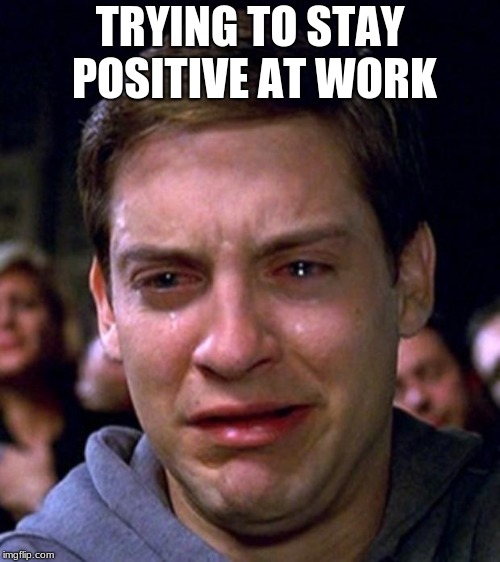
Tobey Maguire Crying Meme -“Trying to Stay Positive at Work” Link: www.imgflip.com

The laboring body is incredibly important in putting the pieces together, whether we realize it or not, but that doesn’t mean the body should take abuse by the isolating effect or how Slavishak put it “[it] is easy to lose sight of human labor in a capitalist system centered on service, global outsourcing, and automated assembly”. We all have a wealth of unique situations – that’s what makes us human –  but we shouldn’t be punished or viewed differently because we took a day or two off. I guess it’s getting better though, every day, and it helps that we are having dialogue about this now. It’s okay to take a break, it’s okay to breathe and live. We’re not corporate machines – our mental and physical well-being comes before anything else. One day at a time.