Why is the world we live in so rigid in it’s practices. So much so to the point that it doesn’t want to accommodate those are whon’t what we would call an unimpaired or non disabled person. This idea of the world and society not wanting to help those who can’t help themselves is very wonderfully explained through “The social model of disability”. This model essentially says that being impaired means that society cares enough about your impairment that you won’t be classified as disabled. Whilst being disabled means being too difficult to help or too annoying. But because of Societies unwillingness to actually help the disabled. They stay disabled. And are ostracized from the communities they call home and are also generally treated like they’re something to avoid or be scared of.
But this idea of disabled people being something to avoid or to outright be hateful against isn’t a very new thing. It’s just how society has always been. And probably will continue to be in my lifetime. I do not know if that is the correct outlook to have about something like this. But to fundamentally change the way the world sees those with impairments and disabilities to the point that they aren’t seen as others, and only for their disabilities, seems like a monumental task. But however that doesn’t mean we should have a negative outlook and that things can’t get better. But all that this means is that it will just take more work to actually get change to occur .
Okay, I might’ve exaggerated the title a bit, but I was saying some pretty controversial things for a three-year-old.
When I first started my education journey at the age of 3, apparently I was scared of the other children in my class because they weren’t Indian.
Just typing that sentence makes me feel foolish because I can’t even imagine myself feeling that way. But unfortunately, that is the truth. After my first day at Montessori school, the first thing I said to my dad was, “Pappa, I don’t want to go back to school; everyone doesn’t look like us and I’m scared.” I promise I wasn’t a bigot; I was just an unaware 3-year-old.
For some context, until that moment I was mostly surrounded by South Asian faces, because I lived in India. But when we moved to New York, my parents decided to put me in Montessori school, and that was my first interaction with American society, so seeing people with different faces that weren’t Indian caught me off guard. If I’m being honest, I don’t even remember feeling this way because I have no memory of it. That’s why whenever my parents would bring this up to joke around, I was always confused as to why I must’ve felt scared.
After learning about the idea of phenomenology, I realized that my experience connects to this concept. Phenomenology focuses on how people’s experiences and the way they interact & interpret the world are based on their own lived perspectives. At that age, my understanding of race was very limited and mainly focused on my lived experiences, which consisted of living in India with my grandparents, walking around the neighborhood, and talking to our neighbors. My world was overwhelmingly Indian; my knowledge of the rest of the world was incredibly limited.
This experience also relates to the concept of Race and the Visible. Race is a visible feature, but the meaning we give race is through humans and their lived experiences. At the age of three, seeing people who looked different from what I was used to, and because it was a completely new experience, it led to me being scared because everything was unfamiliar.
This makes me reflect and think that race is something that is given meaning through humans; it’s just a visible trait, just like our hair, nose, and lips. My experience in school at first, might’ve felt like a major difference to me but over time it became normal. Even though it sounds corny, at the end of the day, we are all human, and we have more similarities than differences, so the few things that are different about us should be celebrated, and everyone’s lived experiences should be valued.
Collectively, the culture of society placing subconscious restrictions on women’s motility places a conscious hesitation and unexpressed movement that women inhabit. A very thorough reading, “Throwing Like a Girl” by Iris Marion Young, demonstrated great examples and analysis of the way society perceives the movements of women which waterfalls to women’s own perceptions of themselves to conform to those of society. Young emphasizes that our movements and sense of space are often not limited by ability, but by social expectations and subjectivity that teach them to be restrained, cautious, and self conscious. Therefore, the summarization is a culmination of how Young mentions that “A woman often does not trust her body to carry her where she wants to go.” In contemporary society it is specifically a learned restriction and/or lack of confidence.
Are any of the phenomena that society has built their understanding of the world around truly changeable, or are humans just flawed to always fall victim to them? I have struggled with conceptualizing if changing how society has built and its understanding of people can actually become a reality, because people will always be flawed if the society they live in was built wrong. I am not saying humans cannot change and we cannot redefine the phenomena that have built societies deep-rooted issues with sexism, racism, homophobia, and more. I truly believe individual people can change, can grow, and can become educated on things that they were not before; and learn from the past. Sexism, racism, homophobia, ableism, and so much more were institutionalized into how our society was built though. If they are built into something, how does it get removed; without completely rebuilding the flawed creation of society? These are not little issues that can be worked around, like sometime happens when something is built wrong, these are fundamental and structural flaws on what was built. Fundamental and structural flaws will often lead to destruction or demise, and that is why many things with fundamental and structural flaws are completely redone. This leads me to struggle with the idea of how to redo society without completely rebuilding it and completely redoing it would be tearing down and stating over without these fundamental structural flaws. Yes, the world is becoming more accessible, adaptable, accommodating, and people can change, but can those fundamental structural flaws/issues ever truly go away or will there always be a struggle for equality because they are built into the world so deeply?
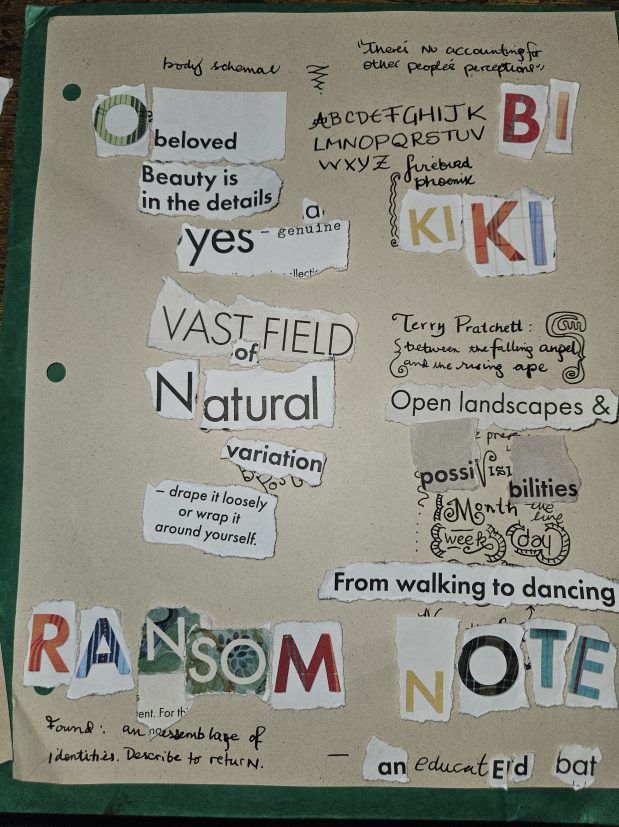
Each person lies within the spectrum of natural human variation, both unique and within a widely-diverse continuum of bodyminds. As this is the case, nothing seemed more appropriate for discussing body schema and the intersection of identities than a literal assemblage piece — layered and gathered letters, words, and phrases. All of the magazine lettering was torn from a single fashion catalog and was completed in one sitting, laid over the handwritten notes I had so far taken for this post.*
I would love for this to be all I wrote about it, but as it’s academic work and also because alt-text is access, there will be unpacking.
A point that stood out to me when reading “The Social Model of Disability,” specifically this line about how society classifies people with disabilities and people who do not. “Disabled people are an oppressed group, and often non- disabled people and organizations…are the causes or contributors to that oppression.” This quote specifically reminds me of a conversation I recently had with a close friend about two programs that are present in many schools — public and private — in the United States: Special education and the “Gifted & Talented” program. In this conversation we had come to the realization that majority of students placed in gifted & talented programs were just as neurodivergent as the students placed in special education, the only difference between them was if the school staff perceived these students as “useful” vs “a burden.” I say this as someone who went through my schools version of the “gifted & talented” program from K-12, I have yet to meet someone who had gone through one of these programs in school that did not also get diagnosed with ASD and/or ADHD in their adulthood. These student’s did have disabilities, ones that significantly impacted how they interacted with the world around them, and yet not only were they classified as “non-disabled,” they were actively made to feel superior to their peers who were classified as “disabled” yet shared the same if not similar conditions.
So why does this happen? Why is does this disconnect between the medical model and the social model of disability happen, and why does it often pit people with disabilities against each other? In a way I like to think that society uses people with disabilities that are disabled in ways that are seen as more “beneficial” are used as a weapon against those who are disabled in ways that do not serve society. Even just the language around how we classify people with disabilities changes depending on if they are seen as beneficial or burdensome. A person classified as “gifted & talented” is meant to feel that they are superior to the rest of the population, especially in comparison to a person classified as “special needs,” perpetuating this idea that a disability is something that can be “overcome” and that those who are unable to are at fault for being unable to navigate a world that was not built for them in the first place.
This is not a new phenomenon, historically society has divided those with disabilities based on how “useful” or how “burdensome” they were seen as. The biggest example of this I can think of is the condition “Asperger’s Syndrome.” The creator of the term, Hans Asperger, was instrumental to the eugenics practices of the Nazi regime which actively classified autistic children based on who had “good vs bad genetic traits” that the Nazi regime would want to pass on. Children who presented as having “good genetics” were labeled as having “Asperger’s Syndrome” because they would be more likely to be well educated and take on high positions in society, thus making them “more valuable.” On the flipside, children who presented “bad genetics” were labeled “autistic psychopaths” and “undesirable” to the Nazi regime, which led to them being institutionalized at first, but from 1939-1945 these children would be systematically murdered under the state-sponsored child euthanasia program, Aktion T4, a program that Hans Asperger himself was complicit in. As we know today, “Asperger’s Syndrome” is really just a certain manifestation of Autism Spectrum Disorder (ASD) and is no longer considered its own sperate condition after being removed from the DSM-5 in 2013. That being said, how it has been used historically tells us a lot about how we classify people as disabled vs non-disabled, how being disabled in the medical sense doesn’t mean you are unable to contribute to the oppression and subjugation of other people with disabilities. In a way, society is the lumberjack, but they use the disabled people who are “useful” as the axe to further chop down a tree they don’t want.
Yet the whole time, we’re both wooden sticks, one was just given a blade.
I believe age gaps in Hollywood raise a question that gets rarely asked in reverse. You may hear several reasonings of why a young, heterosexual, woman might want to date an older man. He’s “mature, stable, more established”. If you were to turn the question around, what is the reasoning behind why an older man wants to date or be with a younger woman? When it comes to a man’s side, there’s less need for explanation. It may be given, he may say he loves her, simple. Now it doesn’t have to be interrogated further. This can get especially complicated around marriage and pregnancy in a heteronormative relationship where the physical and social differences between both partners are built into the power dynamic. Yet continuously this issue can get put down, more notably on the internet because they are “both consenting adults”.
You can see this justification in visible patterns for celebrities who have “pretty privilege”. They can exist outside and above this scrutiny. They are free to date women barely out of their teens, and in the past, it could go largely unquestioned. This while there’s a constant quiet expectation that the woman be held to a higher standard than her counterpart. Through a Hollywood lens being with a younger woman lets the older man’s own image become “youthful, playful” by association, his body, his relevance, are refreshed through the woman. Now the label as a “young woman” stop being categorized as young at all. She is now re-contextualized as being the “girlfriend”, which gets rid of the age difference rather than giving a name to it.
Queerness, at least within queer theory, is the breaking of social norms. Disability breaks the norms of ability, gender, and sexuality. Therefore, Disability is queer.
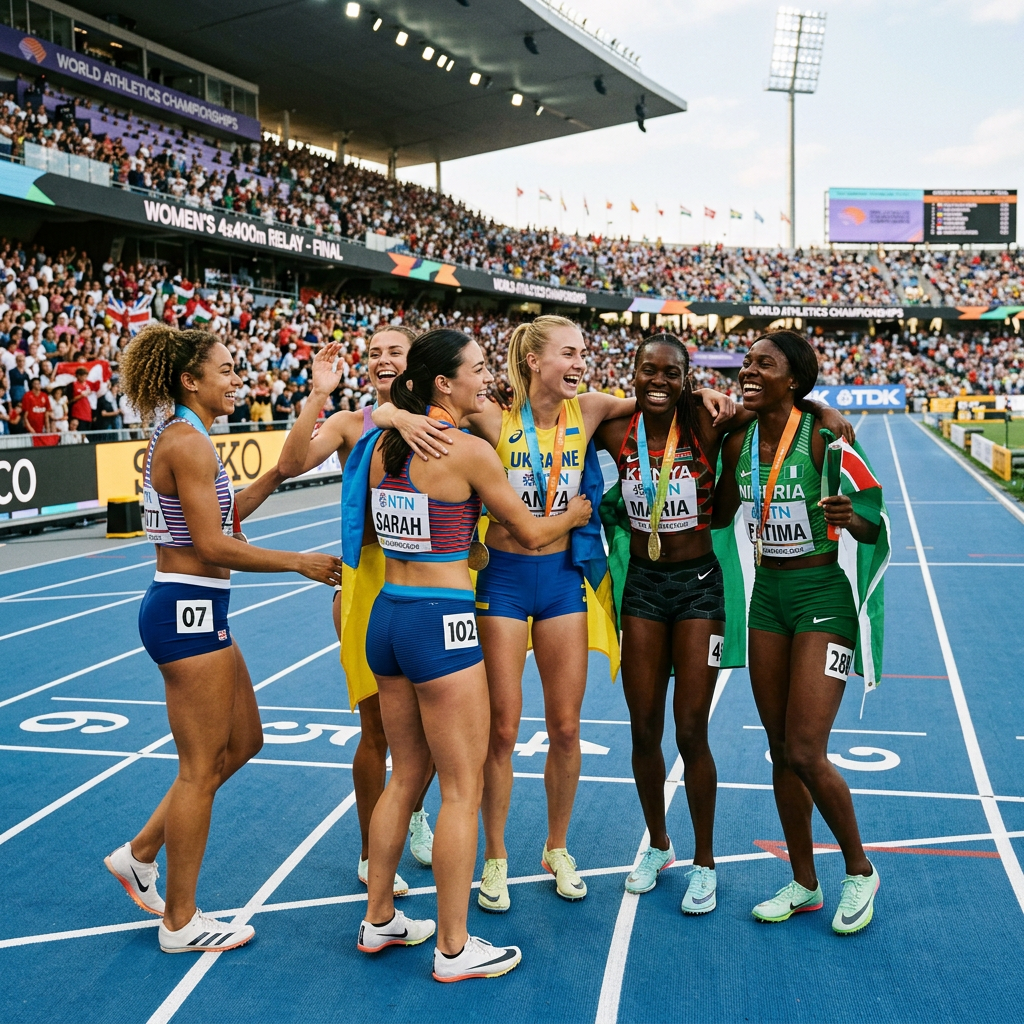
Women’s 4×400-meter relay finalists celebrate together on the track after a championship race.
I found “Throwing Like a Girl” by Iris Marion Young to be the reading I related to the most so far. Young talks about how society can shape the way we see what our bodies can do and how boys and girls can learn to use their bodies differently. One of her examples is throwing a ball. She explains that boys are usually encouraged to use their arms, legs, and the space around them, while girls might be more likely to hold back and not use their whole body. This made me think about how different my childhood was. My dad raised me doing what people would probably call “man things.” We went hunting and fishing, worked on cars, welded, and worked on farms together. He basically raised me like I was his prettiest son. Honestly, I was completely fine with it because I loved doing all those things. Even my brother wasn’t as interested in doing them as I was.
When I think about it now, my dad never really taught me that there were things I couldn’t do just because I was a girl. If something needed to be fixed, built, lifted, or figured out, I was usually right there wanting to help. He taught me to be comfortable using my body and not just assume something was “for boys.” That is one of the reasons Young’s example about throwing stood out to me. My experience was almost the opposite of what she describes. My dad taught me to throw with confidence and actually use my whole body. He even raised me to know how to throw every ball as well as, if not better than, a man. Looking back, I think that had a bigger impact on me than I realized when I was younger.
I also see this same idea with the phrase “running like a girl,” which I see all over TikTok. A lot of the videos and jokes around it make “running like a girl” seem like this very girly, unathletic, almost pretty-looking way of running. It is usually portrayed as someone not really using their whole body or looking very serious about being athletic. That reminds me a lot of Young’s point about throwing like a girl. In both examples, there is this idea that there is a certain way girls are expected to move. My experience was pretty different from that because I grew up playing sports and was used to keeping up with the men around me. I never really thought about changing the way I ran or threw because I was a girl. To me, I was just trying to play the sport and do what I needed to do. I think both throwing and running show how much using your body confidently can become something you learn from the people around you.
This connects to phenomenology because it is basically about people’s lived experiences and how we experience the world through our bodies. Growing up, my body wasn’t just something physical. It was something I used to do the things I enjoyed with my dad. I learned how to weld, work on cars, fish, hunt, and work on a farm, and all of those experiences became a part of who I was. Someone else could have grown up with completely different expectations about what they were supposed to do with their body. That’s what I find interesting about the idea of lived experience. We all have bodies, but we don’t all experience them in the same way.
I also started thinking about this idea differently after reading Linda Alcoff’s “Towards a Phenomenology of Racial Embodiment.” Alcoff talks about how race can affect the way someone experiences their body and how other people see them. Even though she is talking about race and Young is talking about gender, I noticed a similar idea in both readings. The way we are seen and treated by other people can affect our experiences. In my case, being a girl who was interested in activities that were usually seen as “men’s activities” affected how I interacted with people. When I was younger, though, I didn’t really think I was different. I was just doing things I liked doing.
Claudia Rankine’s Citizen also connects to this idea because she shows how everyday experiences can shape how someone sees themselves. Rankine focuses on experiences with race and how something that seems small to one person can mean a lot more to the person going through it. I saw a connection to Young because throwing a ball seems like such a small and normal thing too. There isn’t anything complicated about throwing a ball, but Young uses it to show how gender expectations can affect something as basic as the way someone moves. Both readings made me think about how everyday things can shape how we see ourselves without us even realizing it.
The readings from Tom Shakespeare and Mike Oliver about the social model of disability made me think about what our bodies are actually capable of compared to what society expects from us. They explain that disability isn’t only about a person’s impairment, but also about the barriers that society creates. I can connect this to Young because she also talks about how social expectations can affect what people feel comfortable doing with their bodies. In both situations, there can be a difference between what someone is actually capable of and the limitations that other people or society put on them. It made me think about how often we assume what someone can or can’t do based on their body.
My childhood also had an effect on how I connected with other people. Since I spent so much time doing things that were usually considered “man things,” I sometimes had a harder time connecting with other girls. I didn’t always have the same interests as them, and sometimes I felt like I had more in common with boys because of the things I liked doing. At the same time, the female friends I did make usually had a lot of the same interests as me. I think that actually made those friendships stronger because we already had things we genuinely liked doing together. Looking back, I think the things I grew up doing had a pretty big effect on the people I connected with.
Overall, these readings have made me think about the body in a completely different way. I used to mostly think of the body as just the physical part of a person, but now I see how our experiences, how people treat us, and how we are raised can all affect our relationship with our bodies. “Throwing Like a Girl” connected with me the most because I could actually compare Young’s ideas to my own childhood. My dad raised me differently than what Young describes for many girls, and honestly, I’m glad he did because I loved doing all of those things with him. Growing up that way taught me not to automatically put limits on myself just because I was a girl. At the same time, it showed me that the way we grow up can affect more than just what we do physically. It can affect our friendships, our confidence, and the way we see ourselves. I never really thought about my childhood this way before reading these articles, but now I look back on it a little differently.