Cartoonishly Evil, Enormous, Fuck Ass Human Meat Grinder

I heard an interesting thought in class today from one of my peers: disability is (partly) defined by one’s economic usefulness. If you cannot use your body to produce an economic output, then you are considered “disabled”.

This very reasonable sounding peer brought up the example of “gifted” programs in American public schools. These programs championed the success of neurodivergent students, but only with the goal of making them employable.

In a different situation, these students may have been labelled as “special needs”, those who wouldn’t go on to make a boss very happy one day.

Not only was this an acute observation of the economic motives of the public school system as they relate to disability, but it also made me think about economic exploitation of the body in general.

Continue reading →

Stuck in the middle

I walk in a room and I don’t know who to sit next to. There’s a black girl who looks kind but also like she may hate me. There’s a white girl who looks fun but also like she may hate me. There’s a boy who’s cute but he may hate me. A room full of people but they all may hate me. Maybe a universal experience but racial acceptance is a game in my head. Who’s going to accept me for who I am and what I look like? There’s a divide between black and white, but what about the people who are neither? My dad’s side of the family doesn’t think I’m “asian enough”, my mom’s side of the family simply tolerates me, black people think I’m white washed. White people think I’m too ethnic, people act surprised I speak english but people are also surprised I don’t speak Chinese. So what does life look like when you don’t have a “safe” side. It looks like backhanded compliments, fear from everyone, surprised when people DO like you, and a lot of days spent looking in the mirror wondering how you can fit in. Code switching? I live it, but I never know which code to default back on because who I am is not truly accepted, I always have to do my best to fit in.

The concept of gender

Gender itself is a social construct but it goes much deeper than that. It’s something that is rooted with every day activity, how we perceive our family, friends and especially ourselves. It’s a concept that was made a long time ago that has slowly evolved into something more but the fundamentals of it stay the same.

In Iris Marion Young’s “Throwing like a Girl,” it discussed how there is a “remarkable difference in the manner of throwing of the two sexes.” This is just scraping the surface of how these types of mannerisms and phrases are so ingrained in our minds. When you think of “throwing like a girl” the thing that most people think of is a girl throwing with just her arm and with little to no strength because we are taught to leave sports to boys. It is taught that it is a more masculine trait to be athletic or be strong and that is what makes a man. As the opposite, being weak is associated with being more feminine and that is what makes a woman. These beliefs are everywhere in life, from something simple as throwing a ball to something much more important such as our opportunities in this society when getting jobs and respect from your fellow workers.

Why is this? That is a question I always asked myself every year and every time there is a reason to question it. Why must I be weak to be seen as a girl? Why do I have to wear these clothes labeled feminine to be seen as a girl? Why do I have to be seen as a girl at all? I usually spiral into questions and end up with all different answers. It’s society, it’s my family, it’s our beliefs or it’s just me. These are a lot of questions for just one person but not so much for one society, but to remedy centuries of submitting to one belief, we first have to start with ourselves before it could become a movement.

The Two-Body Problem

Read more: The Two-Body Problem

In classical mechanics, the two-body problem assumes the two bodies under review are perfect spheres that never collide and that no outside forces affect their interaction. It underpins virtually every law and theory in physics. An unshakable pillar of scientific concept.

And yet, phenomenologically, it couldn’t be further from the truth.

Race is arguably the most malleable, in-flux idea ever created. However, it is so deeply ingrained into every part of society that it is basically inextricable from human existence and our modern world. Every group has stereotypes forced onto them. Racism, misogyny, homophobia, ableism- all of it and more infect every institution. Discrimination can even stack on top of each other (intersectionality). Contradictions abound, and my recent summer femme transcendence has made those discrepancies hit like a Mack truck.

Being a Black man in America is one of the most confining experiences of all time. The expectation is for us to be violent, “ghetto”, hypersexual, foolish, and criminal. Hilarious, yet stupid. Lusted after, yet predatory. Athletically superior, but only because of genetics. “Fulfilling” these stereotypes is held up as an example of truth. It’s expected. This is what black men are “supposed” to be.

Subverting them, though, is the more inflammatory choice.

After moving out of my mother’s home, I spent the entire summer completely overhauling my wardrobe. Due to her homophobia, I dressed masculine for the entirety of my freshman year, and I despised every second of it. Needless to say, experiencing gender euphoria is a beautiful thing. The number of compliments I received dressing femme was so overwhelming that I struggled for months to figure out the best way to respond, because I had gone my whole life without that kind of attention. The way people treated me was starkly different too. Expressing my gender the way I was “expected” to, that being a masculine black man, made me nearly invisible. Nobody batted an eye because it was just the way things should’ve been. However, when I began dressing feminine, everything changed.

People would take every chance to compliment me and get to know me. Complete strangers would tell me that they loved my outfit as I walked by. Men, who never gave me any romantic time of day before, were suddenly interested in getting to know me better (I will never forget the first time a man called me “mama”). Still, nothing changed more than how I was treated in a more gendered way. Presenting feminine made people, especially men, more polite and gentle towards me. Doors were held open, feminine descriptors were used (beautiful, pretty, etc.), and most affirmingly, my gender/pronouns started to be explicitly asked for/verified. I loved it, but it also made me feel… weird. Why was I previously deemed someone to treat coldly? Why did I have to present so differently to receive consideration? And why the hell is it that now the white people are disarmed at the sight of me, while the dirtiest looks are coming from my own people?

As you can guess, the answers to those questions were very layered. The class readings of Young & Alcoff were, in fact, very helpful in that regard. Young’s dissection of the male and female socialization and societal expectations was especially illuminating. Spending the vast majority of my life as a masculine-presenting black man, I was raised to fulfill the expectations society expected of my gender and race. I was told to take up space, hold in my feelings (many a “be a man” and “stop crying”), play sports, adopt “manly” interests/hobbies, and never, ever, do anything “girly”. Dolls were out of the question, even though I secretly loved playing with my sisters’ Barbie Dreamhouse. Touching cosmetics earned a beatdown. Affection was looked down upon, with my go-to way of hugging being replaced by a dap. Even as a child, I knew I wasn’t living up to these expectations, nor did I want to. They were forced upon me by my friends, family, and, most extremely, my peers. However, this way of socialization, in some ways unique to my culture, greatly affects the way I subconsciously occupy space. Simultaneously, it’s also something that I’m actively unlearning.

This journey of unlearning has made me realize just how fluid the concept of gender really is, at least in a personal way. I’ve been in queer spaces since middle school, so it wasn’t a matter of ignorance. Rather, I didn’t realize how fluid my gender identity really is (#genderqueer questioning). As I’ve been unweaving my forced masculinity, I’ve been returning to the femininity that I displayed in my early childhood before it was ripped away. I have vivid memories of having a more feminine voice, walking with a natural strut, wearing my mother and sisters’ cosmetics in secret, hugging everyone I liked, and wanting to wear their pretty outfits and jewelry. Now, I do just that. My hip-walk is back, I wear lip gloss and mascara very often, I have 4 piercings with more to come, and I exclusively wear feminine clothes. Anyone who hears my voice immediately clocks me as gay, like that one Lesley Stahl clip. I’ve also been working to make my body fit a more “ideal” femme gay build, as stupid and problematic as that sounds (which is why it’s in quotations).

But what, really, makes all of these behaviors so gendered? As a child, the way I interacted with the world was just a part of who I was. The way I walked and talked came naturally; it was my most comfortable state. My interests were just what I liked. I loved Barbie dolls just as much as I loved my Batman action figures. Physical touch was and still is my favorite way to show and receive. It wasn’t until I was told that these things weren’t what boys “should” like that I started feeling the pressure to change. And it wasn’t just the men; it was the women too.

Patriarchy is such an evil, evil thing. It’s also incredibly layered, especially when it intersects with race. Patriarchy is one of the core tools of white supremacy, but every minority adopts the belief too. The expectations of black masculinity are even more extreme than white masculinity due to the black man’s lack of access to the benefits of white supremacist patriarchy. It calls back to what we talked about in class with afropessimism, though I’d more so call this afrorealism: we can never be good enough. The expectation of black men is for them to be hypermasculine and tough, yet those perceived qualities do not give them access to the higher floor that white men have, and it never will. Therefore, patriarchy and masculinity in the black community are enforced, often violently, through religion, the family, and your peers. It’s so deeply ingrained that in most national polls, Black respondents still trail 10-15% behind their white counterparts when it comes to acceptance of homosexuality. Unfortunately, most queer black people don’t need a poll to know that.

So, when I look at my life, what do I see? I see a paradox. I move through life perceived as a black man, weighed down by all the assumptions about my masculinity, sexuality, intelligence, and much more. At the same time, I subvert many of those assumptions almost exclusively because of my gender expression.

I have two bodies. And that’s a problem.

My Body, Everyone’s Opinion

In “Throwing Like a Girl,” Iris Marion Young defines femininity as “a set of structures and conditions which delimit the typical situation of being a woman in particular society as well as the typcial way in which this situation is lived by the women themselves.”

Read more: My Body, Everyone’s Opinion

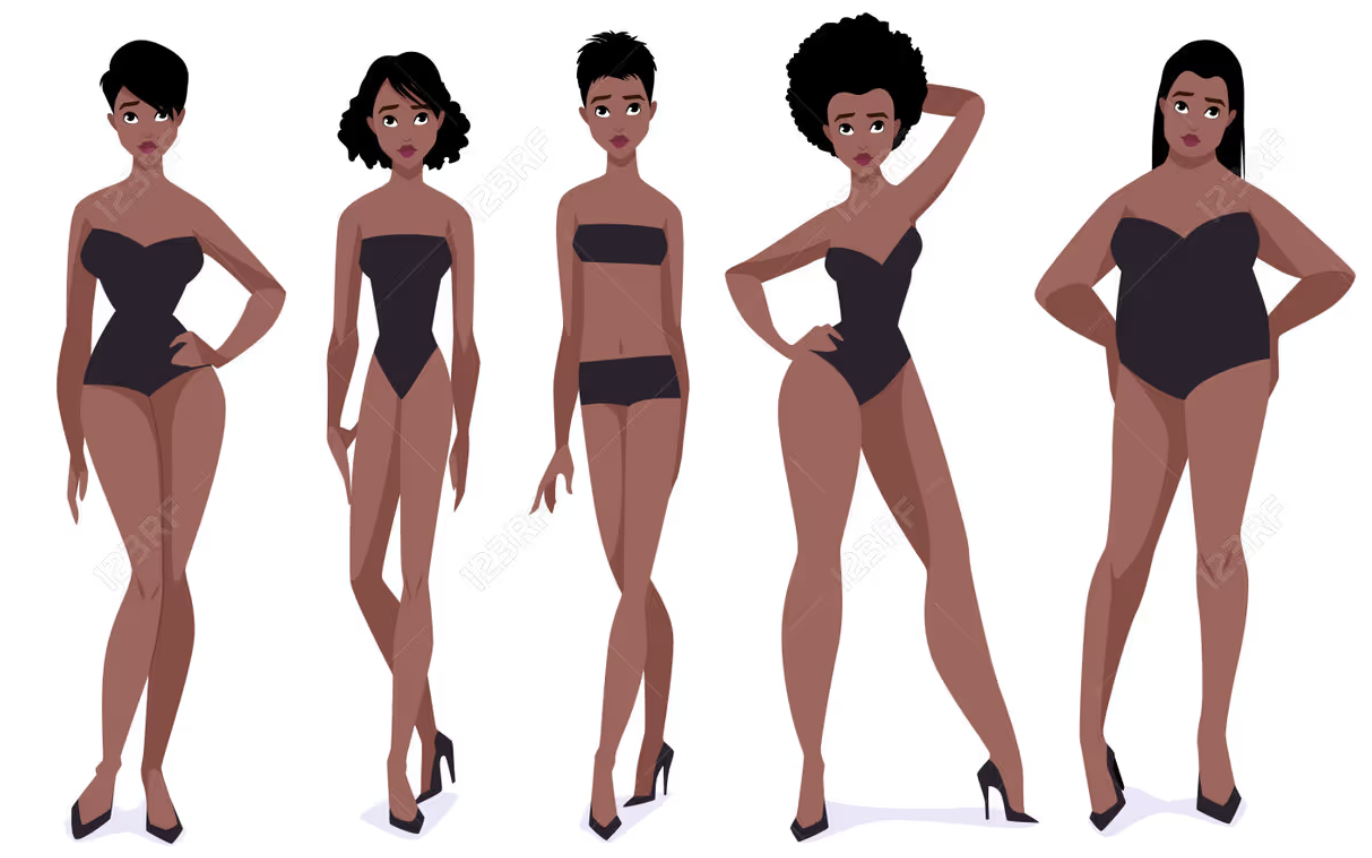
I really began to think about how femininity is shaped by structures and conditions, but also how women in various cultures may experience and utilize these conditions. I also began to think about my experience as a skinny black girl and how my body is viewed and discussed based on the audiences age. I was stuck in between two expectations. My younger peers would make comments about growing my glutes to achieve the “slim thick” figure. At the same time, older women will tell me to enjoy my skinniness (as if there was a timer on my body) because the day was coming when I’d be in their position; Reminiscing of the slimness they once had. Both comments are different, but they both make me think about how my body is being measured against expectation of how a woman’s body should look like. I question the root of where did the expectations come from and at what point did they change? The ideas of what a black woman is supposed to look like has influenced how I see my own body. To the point where I start to ask myself, “well which side of the spectrum should I strive to be on?”

Young’s definition helped me see that these experiences are not just a desire to look a certain way. It is a larger social condition that is shaped by what other think black women’s bodies should look like. The pressure to be “thick,” gain weight, and enjoy my body before it changes all shows how femininity can shape the way women understand and experience their own bodies.

image used from: https://www.123rf.com/photo_88636296_set-of-female-body-shape-types-five-types-african-american-women-vector-cartoon-illustration.html

Ungrieved.

“The meanest dog you’ll ever meet
He ain’t the hound dog in the street
He bares some teeth and tears some skin
But, brother, that’s the worst of him
The dog you really got to dread
Is the one that howls inside your head
It’s him whose howling drives men mad
And a mind to its undoing” – Anaïs Mitchell

A cold room, a lone soul, a lost cause

And yet the silence screeches in their ears

The pounding of their tired heart echos the dreadful reminder

They are alive

They are not sure they want to be

As doubt seeps

What makes their lives worthy of a statement?

Of a movement?

Nobody is listening because nobody cares

Death is not the thing it used to be

People have died before

Some names are sung, faces memorialized across buildings and cities, their stories shared, their families consoled

Millions left us too soon, untraced and unknown

Ungrieved.

You could be next, or you could be the last

Which is worse?

A dog howls in a cold room

He’s a lone soul, a lost cause

His bark is worse than his bite

But the bark is enough to be a mans undoing

Cover art for the concept album, Hadestown, written by Anaïs Mitchell.

Are Men “Visual Creatures”?: A Discussion on Porn & Bioessentialism

TW//mentions of SA, porn addiction, objectification

One thing that really stood out to me in Throwing Like a Girl is how Iris Marion Young criticizes bioessentialism, which is the idea that men and women behave a certain way because it’s just “biology”. She shows how people explain things like throwing differences as natural, when they’re really learned through social expectations. It is similar to how people perform worse due to the stereotype threat, which is when minority groups tend to underperform on tests because they believe that they are not capable of performing well, leading to a self-fulfilling prophecy. 

I think that same logic of “inherent” or “biological” behaviors can be applied to how men justify watching porn by saying “men are visual creatures”, which is not based in fact at all. That phrase is so harmful because it makes it seem like objectifying women is unavoidable, instead of something that men are choosing to participate in. 

Read more: Are Men “Visual Creatures”?: A Discussion on Porn & Bioessentialism

Porn is extremely dehumanizing because it turns people, often women, into objects meant to be looked at, not individuals with complex life experiences who have their own agency. Young talks about how women are taught to experience their bodies as something to be watched and judged, rather than as something they fully control. Porn takes that even further by reducing women to their body parts and presenting sex as something women exist to provide. It trains people to see women’s bodies as products rather than as a part of an intimate and sacred human interaction.

The idea that porn allows people to “buy” consent is disturbing on its own as well. Consent in porn is always available and detached from real emotional or physical consequences. Sometimes consent can even be depicted as NOT freely given, and disrespected, as part of r*pe fetishes. Humans were never meant to have instant and unlimited access to sex like this, and pretending that it’s just “natural male sexuality” ignores how artificial and extreme this level of access actually is. The harm doesn’t just affect the person consuming porn, it impacts the women in it, who are often exploted, and women in the modern dating world that have to deal with unrealistic expectations and porn-driven violence and entitlement.

Just like Young argues, bioessentialism isn’t harmless. It is used to excuse behavior that causes real harm by making it seem inevitable, and vanishing accountability for those who are engaging in them. Saying “men are visual creatures” works the same way as saying “girls throw like that”. It hides socialization behind biology.

Advanced Care Planning, Disability and Queerness

So I am taking a sociology of death and dying class currently, and a lot has stuck out to me. There is this thing called “advanced care planning” which involves things like DNR’s, advanced directives and setting a legal healthcare proxy. Through this class I not only thought about this for myself; I considered sociocultural aspects of planning for worst case scenarios. As a disabled person, I end up in some scary healthcare situation, and often have to think about what happens if I end up unconscious and unable to make my own decisions. Then throw being queer and living a ways away from family on top of that, and it really makes one think. So I have discussed my wishes extensively with family as well as my partner, but that does not mean all is fine and dandy. The family aspect isn’t really an issue when it comes to this as there are inherent legal protections involved with family making medical decisions for a loved ones. For straight couples, an opposite sex partner is often regarded as someone trusted to make some decisions, and in marriage those protections are even more solid. When it comes to queer couples, we face inherent stigma, and less marriage protections. In my particular situation, my family could get to me in an emergency in roughly an hour in perfect conditions. That is an hour unable to have my wishes known if I am unconcious. On the other hand, my partner is much more local. If it was a boyfriend being the emergency contact and someone to speak for me, it wouldn’t be as big of a deal. But I am with a woman, a trans woman at that. This scares me as our relationship will likely be taken less seriously. This is a very common fear for queer couples, as demonstrated in research. A study done by Thomeer et. al studies the occurance of legally binding advance care planning in queer vs straight couples. I will try and link it for the readers out there. Anyways, the researchers found that queer folks are significantly more likely to have legal documents in place, likely due to fears I have highlighted above, supporting my argument that queer folks face healthcare inequality and that is one of many ways sociopolitical factors hurt queer people.

Bitter Aftertaste

My mother is a well-loved woman, and although she passed four years ago, my family and I still make an effort to stay connected with her friends. When we were extended an invitation to the wedding of her friend’s daughter, it was only natural for my us to go.

With less than a month from my twenty-first birthday, my brother and his girlfriend insisted that I visit the bar at the reception to prepare me. “So that you know what you’ll want when it’s time”, they argued. The bartender knew my brother, and the companionship added weight to the pouring hand. After a fleet of drinks, my brother, his girlfriend, and I ended up in the center of the dance floor. It felt lovely to dance with my brother hand-in-hand, to slow dance with his girlfriend and spin her into my brother’s embrace at the end of the song.

Dinner was served table-by-table, and I retreated to feast with my dad when the combination of alcohol and movement got to be a bit much. My brother, however, continued to chat up his friend at the bar. I watched him and his girlfriend distance themselves from the crowd with drinks in hand.

And as the sun set below the trees, the chill of the October air was no longer one I could ignore. Like a moth to a flame, I found my way to the bonfire just outside the tent, letting the flames dance around my hands and face. My brother had miraculously appeared and was seated on the opposite side of the fire. From the way he was roughhousing with me post-dance and pre-dinner, I knew his alcohol intake was increasing steadily. His girlfriend asked me about any plans I had for my birthday – though before I could thoughtfully reply, she was met with a request for water by my brother, to which she promptly scuttled off to fetch. So with my attention redirected to my brother, I told him that, with a twinge of humor in my voice, I’d like to go to a gay bar for my twenty-first. I watched his eyes crinkle shut in amusement, slurring out “faggot” in a laugh.
What? What did he say? What did you say?
My blood ran cold; the dancing embers in front of me felt so far away that even the heat couldn’t reach my body. Before I could respond, my brother was already vanishing into the darkness, gone in the blink of an eye in some random direction. Never before have we had a stable relationship, but the connection I felt to him on the dance floor was real, until he muttered that word and the mirage rippled and faded away when I was just in reach of it and I was left alone in the stinging bitter cold. The pale light of the moon illuminated me and my vulnerability.

When his girlfriend returned with the water, she must have been met with a look of absence plastered on my face, because she asked me what was wrong and where my brother had gone. I told her what he’d said to me, nodding in the direction he’d wandered off in and expecting her to follow, but she looked wounded. She told me that was an awful thing to say, that he’s too drunk and we should leave.
My dad agreed when he encountered my blackout drunk brother. We had driven my truck to the wedding, but my dad agreed to drive back. I sat in the passenger seat, staring out the windshield with the window cracked open, the cold air grounding me. My stomach was swimming, and even the roaring of the wind could not drown out the nauseated groans of my brother on the bench seat behind me.

What called him away that night? Is there any possibility that perhaps he registered what he said? Maybe instead of expressing remorse, he couldn’t bear to face me?
Truthfully, these options are much more appealing. (The zipping-up of his fly upon his return indicated the real reason he left: nature called.)

Alone, in my dark room, my noise-cancelling headphones did nothing to cover up the unmistakable sound of my brother expelling his disgust, spilling all over the front of his formalwear and dribbling from his chin. The kind of stain that can be done away with a fee at the dry cleaners. The interaction that night left a stain on myself, in my mind, and spread like spilt wine down my brainstem to my heart, curdling like milk and pumping through my arteries, clogging my blood flow. Bile rises in my throat when I think of it, but relief can’t be achieved even if I stick my fingers down my throat; it’s the kind of sickness you just have to wait out.

Waking up with the memories of the night before made me want to pull the covers over my head and sleep until I forgot, but that kind of cut simply doesn’t heal with ignorance. My brother issued an apology to my family, though addressed mostly towards my dad, who has been sober for decades and always warned my brother of our genetic alcohol intolerance. He admitted that he was embarrassed about his state that night, promising that it wouldn’t happen again.

How do you resolve a conflict when the perpetrator seemingly has no recollection?

Claudia Rankine’s Citizen tells many stories of this kind of haunting experience, and times like these are painful reminders that you never truly know what people think of you until they slip up and do something to reveal how they truly see you.

Photo ID: A blurry photo of a white pony and a white-and-black cow grazing in a pasture. It’s dark outside, but there are white shining lights lining the fencing.

Prison Labor and Your Couch

An image of a UMBC dorm room from InternHousingHub, showing a desk, chair, and the bed along with some light decoration.

Earlier this semester, I learned that a significant portion of the furniture from our university is made using prison labor. How’d I find this out? I asked for a new desk chair at my job, because ours was falling apart. I was told that it would take months to get one, yadayadayada, something something, and then I heard the words “prison industrial complex” and immediately tuned back in to the conversation.

Continue reading →