Dysmorphic Friends

One of my closest friends is a fashion stylist. She chooses outfits, hair, makeup, and general looks or moods for photoshoots for natural makeup companies and independent designers. I have modelled for her in the past even though I am not a model and don’t look like a magazine model. I also model for my own Etsy store, selling vintage clothing. My friend has had eating disorders since puberty and I have not. I feel that her eating disorders are a sign of privilege and she feels that my “poverty genes” and post thyroid cancer synthetic metabolism are a sign of privilege. The arguments are frequent and comical.

I feel that it would be insulting to her profession and life’s path to say that her involvement with fashion feeds her disorder, so I often try to tell her eating disorders are a result of a sexist, competitive capitalism, a first world problem, and that if she stops aestheticizng the super young and super thin, wheat colored waify girls with vacant expressions, she won’t hold herself up for comparison to them. I tell her to keep her job but change her aesthetic, make it weirder, and I tell her she’s a misogynist. Then I go on like a hypocrite and smooth out my hair, put makeup on, and have my boyfriend shoot photos of me for Etsy, to make money. And I do make money. But recently, editing and cropping photos of myself, I feel like I look OOLLDD. So I call my friend and ask her for a disorder that will make me less old, less short, less frizzy, less dark, less tired. And there isn’t one. I’m really not sure what I’m aestheticising, but even though I’m perfectly happy with my weight I still feel the need to critically tear apart whatever I can about my own image, down to my assymetrical smile or uneven hair texture or slightly more almond shaped right eye than left one. Little little minute stupid details. All while knowing that I’m making this image public by my own free will, by my need to pay the bills and put gas in my car to get to school. Because those waify wheat colored girls are out there, and my tiny little capitalist enterprise is knowingly in competition with them, and growing up in the 80s and 90s, between Debbie Gibson and Kate Moss, I never felt that my features were pure or innocent, only exotic and “olive olive olive”, and now getting older.

Can a woman be this self-critical and also be a feminist?
Do These Pants Make My Ass Look Bisexual?

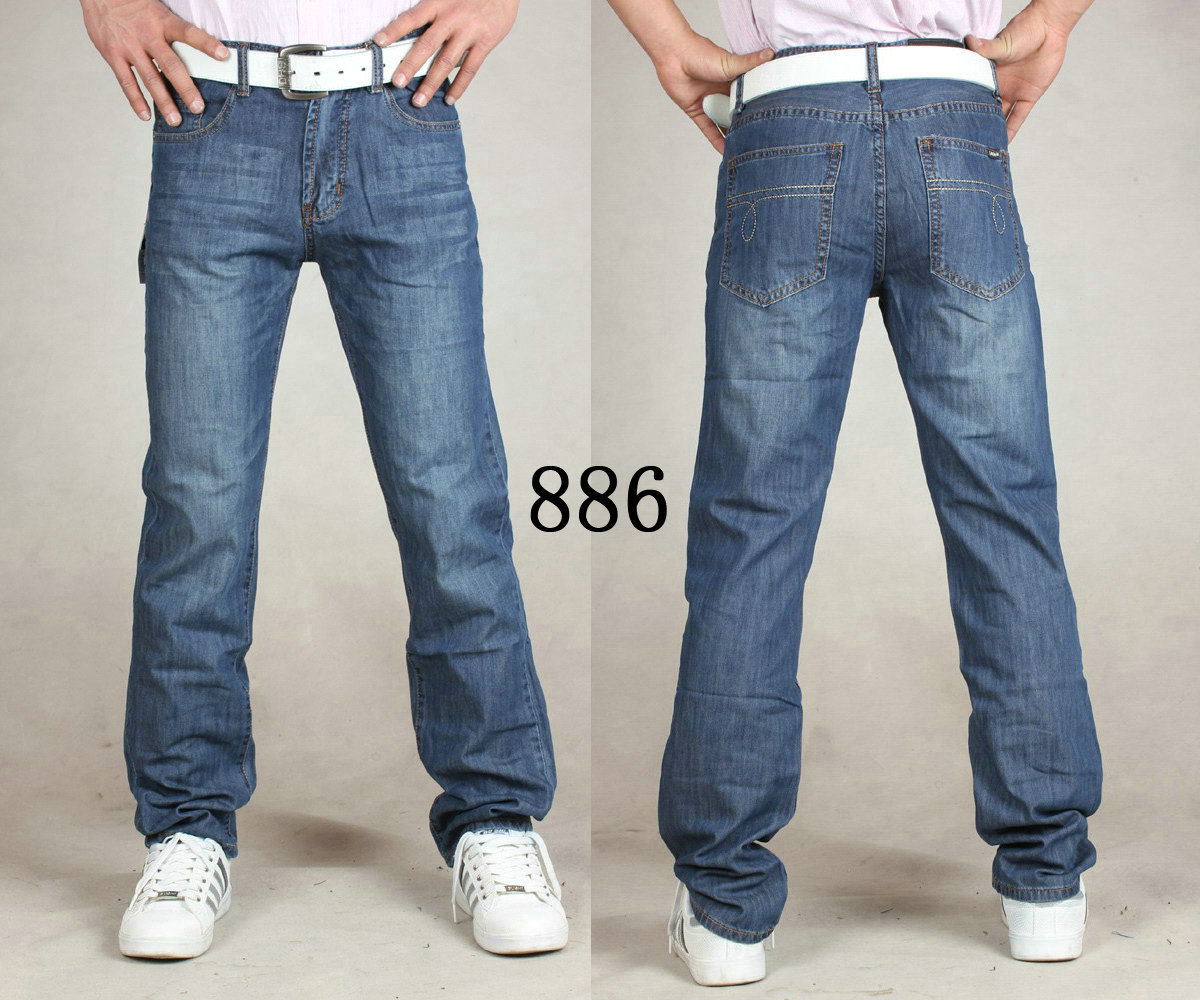
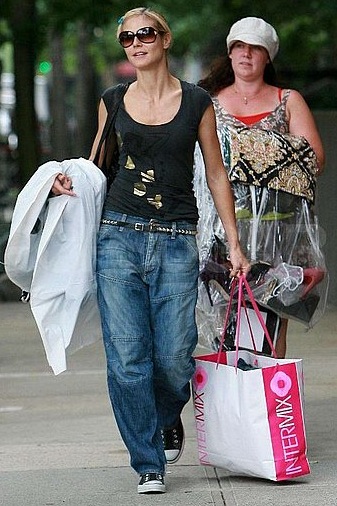
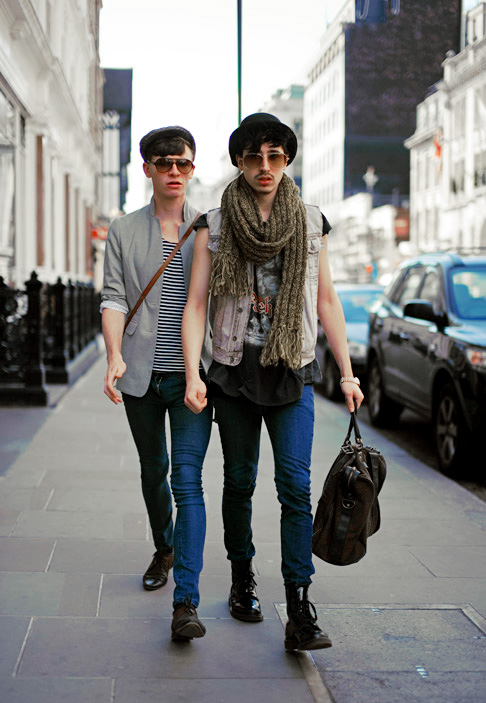
Why does what I’m wearing define my sexual orientation? I’m a 22-year old female, and I often change the way I dress, even on a day-to-day basis. I may feel like wearing a tight skirt, heels, make-up, and jewelry and shaving my legs on Monday. On Tuesday I might wear sweatpants and a T-shirt and throw my hair in a messy bun, and on Wednesday I may wear a baggy pair of guy’s jeans with paint stains on them, a tank top, and skater shoes but do my hair in a cute way. I enjoy dressing in any way that makes me feel comfortable, and I usually do.

But recently, I got a girlfriend, and even though I dress the same way I’ve always dressed, with my same unique style I’ve always had, I’ve heard some interesting comments, even from people that I know care about me and aren’t trying to be offensive. But if I’m dressed up (and meet society’s beauty standards) I’ll hear people say things like “Are you really a lesbian?” or “I don’t understand how you’re gay” and when I dress down, or “more like a guy” I hear “You’re such a lesbian.”

And I’m not even a lesbian! I’m bisexual!

I feel as though society often judges people as being gay or straight based on what they’re wearing. A recent conversation with my (straight, male) roommates went like this:

Roommate 1: “What are you wearing?”
Me: “Jeans.”
Roommate 2: “She has a girlfriend, she can wear what she wants.”
Roommate 1: “She’s only half-gay.”
Me: “What does that have to do with it?”
Roommate 1: “Well sometimes you dress like the straight half.”

First off, I consider myself a hundred percent gay and a hundred percent straight, and I hate it when people call me “half gay.” It’s not like I find women attractive half the time; I find attractive PEOPLE attractive ALL the time. Second, how come I can only wear “whatever I want” because I have a girlfriend? It’s not like my girlfriend dresses me. Could I wear girls’ jeans if I was a lesbian? Could I wear guys’ jeans if I was straight? Why are my roommates only saying things now? Don’t the same rules apply now as when I was single? Or am I “more gay” when I have a girlfriend?

It’s also weird to me that clothes can make you look gay (“He’s totally gay, look at his pants.”  “I can’t tell if he’s gay or if he just dresses really well…”  “She looks like a dyke in those pants.”) or even make you look straight (“Can you believe he’s gay? He dresses so straight!”) but I have never heard of clothes making you look bisexual. If bisexuality, homosexuality, and heterosexuality are all valid sexual orientations, why don’t our clothes make us look bisexual? Where can I buy pants that make me look like I date boys and girls?

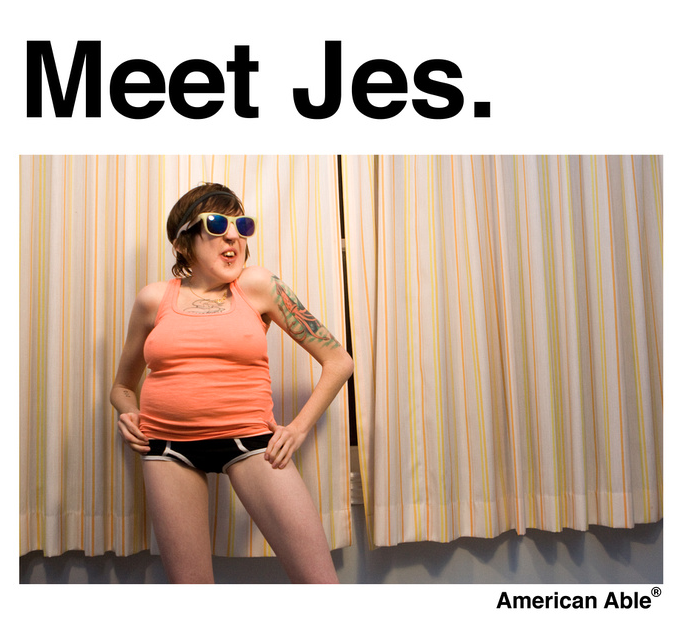
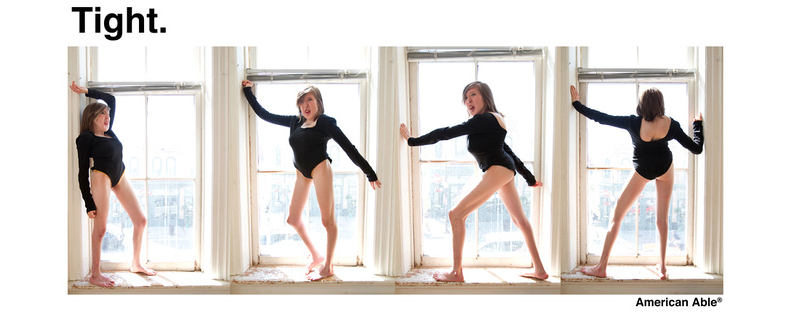
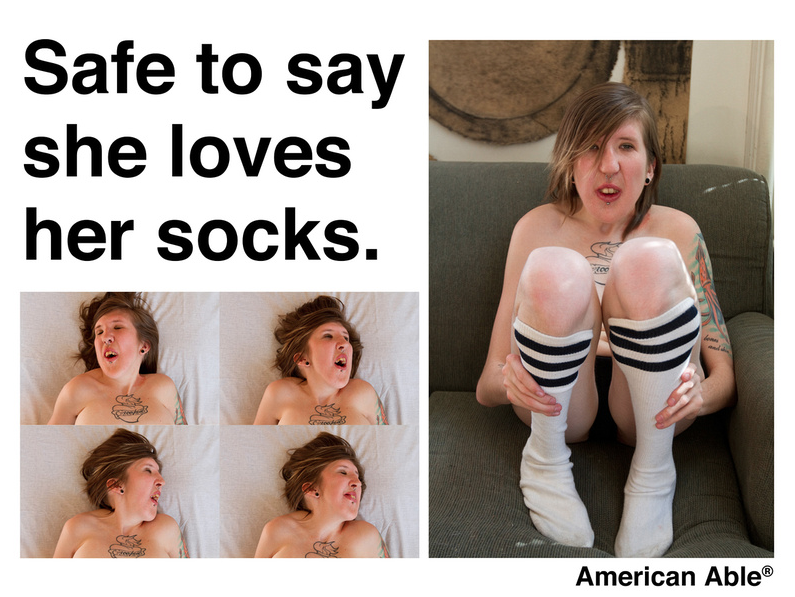
“American Able” – Challenging Media Representations of Disability

Here’s a description of the project from the the artist Holly Norris’ website:

“American Able” intends to, through spoof, reveal the ways in which women with disabilities are made invisible in advertising and mass media. I chose American Apparel not just for their notable style, but also for their claims that many of their models are just ‘every day’ women who are employees, friends and fans of the company. However, these women fit particular body types. Their campaigns are highly sexualized and feature women who are generally thin, and who appear to be able-bodied. Women with disabilities go unrepresented, not only in American Apparel advertising, but also in most of popular culture. Rarely, if ever, are women with disabilities portrayed in anything other than an asexual manner, for ‘disabled’ bodies are largely perceived as ‘undesirable.’ In a society where sexuality is created and performed over and over within popular culture, the invisibility of women with disabilities in many ways denies their sexuality, particularly within a public context.

Too often, the pervasive influence of imagery in mass media goes unexamined, consumed en masse by the public. However, this imagery has real, oppressive effects on people who are continuously ‘othered’ by society. The model, Jes Sachse, and I intend to reveal these stories by placing her in a position where women with disabilities are typically excluded.

I think this project is extremely fascinating in its critiques of advertising and mass media, specifically American Apparel, and the projects counter-depictions of disability.

How is Norris’ explanation of the invisibility of disabled bodies in mass media, including the de-sexualization and undesirability often seen intrinsic to disability, parallel to Garland-Thomson’s “Integrating Disability, Transforming Feminist Theory”? Do you believe that the depictions of disability in American Able are revolutionary? Can these counter-depictions of disabled bodies truly change advertising and mass media and the ways in which we view disability in our society?

Some of the following images by be not safe for work (NSFW).

Bald Barbies

Disclaimer: While I have never experienced baldness personally, drawing from the literature on disability and class discussions I felt an affinity with the topic. If I indirectly offend anyone I offer an apology in advance.Image

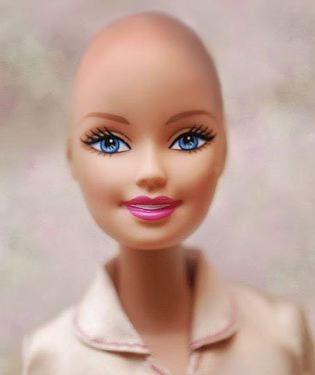
Recently I’ve noticed a lot of rabble on facebook about a topic I never thought would pop up in my newsfeed: Bald Barbie.

There’s a facebook group dedicated to pressuring Mattel to create the Bald Barbie for children who suffer from hair loss due to cancer as well as Alopecia, and Trichotillomania. Mattel has finally released a statement saying they will create Bald Barbie but it, “will be a friend of Barbie, which will include wigs, hats, scarves and other fashion accessories to provide girls with a traditional fashion play experience.”

Hm. So, the new doll cannot be labeled a “Barbie” and she still has to have fashion accessories which, in my interpretation, (and perhaps this is my raging feminist coming out) means people who have hair loss still have to cover up their scalp since baldness cannot be accepted as normal.

Not only will Mattel’s new doll not be a “Barbie”, she will also only be distributed to children’s hospital for reasons of “directly reaching girls who are most affected by hair loss”. But what about the children who are not in hospitals who have experienced hair loss? And how does a hospital reinforcing to the children that they’re still beautiful actually combat the main message that Mattel sends out to the general public on a day-to-day basis, i.e. beauty has a certain standard, and if you don’t have the hair and body for it, you will never be beautiful.

Could placing the doll on the shelves of a toy store create too much of a sense of normalcy towards hair loss?

From the past course discussions on disability, and the invisibility and inaccessibility that many disabled people have expressed they have experienced; I don’t think that Bald Barbie does much to enhance the lives of children who have experienced baldness.

By only distributing these dolls to hospitals Mattel is stating that baldness is still a disability and is associated only with illness. Mattel could release Bald Barbie in mainstream stores and allow Bald Barbie to be viewed right next to a Barbie with hair but then what message would Mattel be sending to the children that experience baldness? Beauty standards can actually deviate from what Mattel portrays them to be?

If Bald Barbie were to be considered equal and sold in the mainstream market right next to a Barbie with hair I think children who experience hair loss could actually feel acceptance and beauty towards their baldness, especially when Barbie is such an icon for female children for femininity and glamour.

I think Mattel’s creation and distribution of Bald Barbie is just another way to emphasize disability rather than accept it.

Design improved by (dis)ability

So we’ve talked quite a bit about how architecture and spaces treat (dis)ability as an afterthought, defining a norm and making often weak attempts to accommodate those who do not fit inside the normative box.  But this doesn’t always have to be the case. There are some really smart designers who have flipped this script- collaborating with people of different abilities in order to come up with design that is beneficial to everyone.

Take for example the OXO Good Grips line of kitchen utensils. We’ve all seen them- peelers with really thick handles, unusually shaped can openers. Cool looking, but not the norm in utensil design.  It turns out, this entire line was designed in consultation with arthritis sufferers, in order to create kitchen tools that they could easily and comfortably use at a reasonable price.  Now, OXO Good Grips is one of the best selling brands of kitchen utensils around the world. A simple thought- making an easier to use potato peeler- leads to better design.

But what about architecture? How can it be impacted by collaboration across abilities? At DC’s Gallaudet University, which specializes in educating those with hearing impairments, new buildings are showing innovative design meant to help the deaf that could end up in your new office building or classroom.  Walking and talking is one of the cornerstone experiences of college life- but this becomes a bit trickier when you’re speaking a language that is visually based.  Buildings offer numerous obstacles to these conversations- narrow hallways, doors that have to be opened.  Gallaudet is creating buildings with wider hallways and wider sliding doors to better accommodate students’ social life.  Eye strain, again a common college problem exacerbated by needing to use your eyes to take in every second of classroom interaction, is dealt with by thinking of light sources and room color.  Each innovation is driven by thinking of (dis)ability first, and each one something that could be valuable to the world at large.

Is this a next stage in industrial design? Instead of trying to make a product comply to Americans with Disabilities Act standards, should we instead focus on making products more inclusive from the start? It’s a bit of a rhetorical question, sure, but the real question is, why aren’t more people thinking this way?

Do you know what you put on your face?

When I was growing up my grandmother had a makeup collection that she let her grandkids use. I loved it, but my cousin was less enthusiastic. One day, when I tried to convince her to let me give her a makeover, she exclaimed, “No! Ew! Did you know that lipstick is made from bat poop?”

I didn’t know that and I didn’t believe her, and I have never found out for sure if her claim is true. And I don’t really want to know. I feel pretty certain that most mainstream lipsticks are NOT made from bat poop (seems logical, right? That’s what I tell myself). And I know that all-natural makeup products exist out there like Burts Bees products, which I assume are made of organic oat fibers, natural colors, and sunshine.

I don’t wear makeup often but I like to for some occasions. I enjoy emphasizing certain parts of my face, or adding color and sparkle for dressy outings. It’s fun to look a little different. I don’t know if as a working professional I might start wearing makeup regularly, but for now I’m content with my sporadic use. I don’t know what my makeup is made out of but I hope it’s fine and I try to make it look nice when I put it on my face.

Over the summer Jezebel posted this video of a year’s worth of make-up on a model’s face. It’s quite a different experience of makeup from what I’m used to – putting a little bit on some nights. Seeing a year’s worth of makeup applied at once changes my sense of the actual stuff that I am applying to my skin. But would a year’s worth of lotion look different? Or sunscreen?

According to the Jezebel post the “whole thing took nine hours, three lipsticks, seven bottles of foundation, and two bottles each of cream blush and eyeshadow to achieve. (That’s 228 mL, or 7.7 fl. oz. of face-spackle altogether.).”

What do you think? Does this change your perception of makeup? Do you think you’ll change how much makeup you wear after seeing this video? What about the money you spend on it?