
Nudity in the airport

Nudity is something everyone comes encounters on a daily basis. Whether it is in the shower or changing clothes the entire populace is naked at some time or another. Although individuals tend to see themselves nude regularly, under certain social situations nudity is considered as a taboo occurrence. However, some people strip their clothes to reveal their undergarments or naked bodies as a sign of protest.

Recently, on April 10, 2012 an unidentified woman was spotted naked in a Denver airport. Denver channel reports the woman was reported to be smoking in a non-smoking terminal, when the woman was asked to put out her cigarette she responded by taking off her clothes. There is differential discourse regarding the causation of this woman’s’ actions.  Reports cannot definitively tell whether the woman stripped her clothes was a result of an airport employee asking her to put her cigarette or if she was protesting against Transportation security administration or TSA pat downs. Denver police claim that the woman was experiencing a nervous breakdown while she unclothed herself. The unidentified woman was not arrested but instead taken to a hospital for a mental evaluation. There has been other news coverage regarding individuals who stripped their clothing at an airport because they were protesting against TSA pat downs. For example, a fifty two year old woman in a wheelchair was reported stripping down to her black lingerie to get through security at Will Rogers World Airport in 2010. In addition, a college student who was protesting against TSA pat downs stripped down to a speedo in November of 2010. Nudity or almost nude bodies undoubtedly brings attention to a situation or cause. Nudity is a factor of life that everyone must encounter. The United States has sexualized the body to the point that we as a society feel embarrassed or uncomfortable when we view another’s nude body or when someone touches ours for an extended amount of time. Therefore, issues such as TSA pat down become problematic because many Americans believe in social situations the body should not be touched extensively or seen without clothes on.

Some people report that these pat downs are an invasive of privacy and feel very uncomfortable after the pat down was conducted. After September 11, airports have become aggressive in mitigating terrorist or suspicious activity that may potentially harm their passengers.  Now the question I pose to all of you is do you believe airports is invading autonomy over people’s bodies even if it occurs for a brief period of time? More specifically, what would you do if you perceived an airport official to have touched you in a sensitive area longer than deemed necessary?

Self-Diagnosis

According to a “recent study,” conducted by a company that maintains an online self-diagnostic tool and then misinterpreted by some website on the internet, “1 in 4 British women has misdiagnosed themselves on the Internet.”  Mind you, this wasn’t just posted on any old internet, it was posted on the Internet, so it’s totally legit, guys.  I believe it.  (By the way, Jezebel has some commentary that, while not problem-free, tickles the funny bone.)

This blog needs more color, so here's a rainbow.

Regardless, it raises some important questions about the role of diagnosis and self-diagnosis.  When overused or used irresponsibly, self-diagnosis on the internet can lead to a lot of unnecessary worry.  It’s an especially big problem in a culture that does not openly discuss bodies or illness, making it difficult to determine what is “normal” and “abnormal” for a body to do.  Female bodies, disabled bodies, older bodies, trans bodies, and non-white bodies, in particular, are susceptible to this kind of worry.  If your body was never “normal” to begin with, how can you possibly know if something is wrong?  If your body has always been strange or mysterious or untrustworthy, when does it cross the line from weird to dangerous, or sick?

I don’t have exact answers to these questions.  I do know, however, that since the majority of people cannot afford to see a doctor every time their body aches or something leaks, and since most female, aging, disabled, trans, and non-white bodies (to name a few) are not given serious consideration in the doctor’s office, the internet is an important diagnostic tool.  Several years ago, for reasons I can’t remember, I found a diagnosis for myself on the internet, and it was a major turning point.  As far as I knew, this was the way that I had always been, but at that time, I started to realize that it wasn’t the way that I would always have to be. It didn’t change my anxiety, but just having a name for it allowed me two conceptualize the phobia and my personality as two separate things.

These people stared at this x-ray for hours before realizing that it was blank.

When I later filled out an inventory or questionnaire, I hit every one of the symptoms.  But I never would have known that these were symptoms without coming across that page on the internet.  How could a doctor have possibly diagnosed me if I never expressed that anything was wrong?

Of course, my story might be unusual, and it might be somewhat unique due to my class privilege.  Still, I maintain that the internet should have a place in diagnosis, since no doctor can ever know a person’s body better than the person themself.  What do you think?  Does self-diagnosis cause more harm than good?  How can the internet be used or changed to improve diagnosis and available medical information?

“Fotoshop by Adobé”, and some discourse on how the media excludes our bodies

I’m not sure how much anyone else has been exposed to people telling them to not trust media images in regards to visual accuracy in depicting bodies, but I have heard that quite often. Speeches on how images of bodies shown in the media have incorporated some form of falseness strike a chord with me, but they often seem to be lacking in one important department: a video representation of how much can be altered, in order to visually prove that manufacturing of a “fake”, so to speak, body in the media is possible with the assistance of technology.

I did not realize this until after I had watched Fotoshop by Adobé”, a video directed by Jesse Rosten that does depict photoshop doctoring of bodies. This editing that is portrayed in the video raises quite a few important points to think about, most generally about the erasure of various bodily features/body types by the media.

Towards the beginning, the video shows a “before” portrait of a female with facial wrinkles (which I inferred to be a depiction of an elderly female), as well an “after” image of a female with no such wrinkles (which I thought was a portrayal of a young female). Clearly, any markings on the face, whether they be natural or not, are subject to censorship. Furthermore, elderly bodies appear to be denied a place in media.

Later, the video depicts a doctoring of a magazine cover that features a female with brown skin into someone with lighter skin. This raises awareness about the omission of bodies with skin tones that are not white/of a light shade from the media. Also, people of color’s bodies seem to be excluded.

Further along in the video, there is a portrayal of the reshaping of a female body from a curvy body shape to one that is less curvier, and once again, the delineation gives attention to the media expulsion of such body types.

It becomes clear, after watching the video, just what the media wants us to see in regards to bodies – and what the media is not showing us. The natural states of bodies continue to be reworked to fit a certain ideal: unmarred, young, light skinned, white, and skinny. In doing so, the “normal” becomes abnormal. The truth about what bodies really look like – that they come in a diverse variety – becomes replaced by a lie that only caters to a certain group.

As one article points out, “…Rosten skewers the breathless tone, too-perfect imagery and dense double-speak of beauty-oriented spots and magazine spreads.”

The Micropenis

I know that as a class we are a pretty open group of people, but because this is a public blog (and because I am unsure how people will feel about me posting pictures) I am going to refrain from doing so for this particular post, however, if you are interested in finding pictures they are very easy to come across online. I will also warn you that the sites I have posted do contain graphic pictures, so don’t visit them if you don’t want to see the pictures.

Interestingly enough, I stumbled upon this topic after our class discussion of a utopian society in which all babies were born with the possibility of all inheriting any genetic traits from the entire population. A conflict arose when two groups of people argued whether or not they should “exclude the negative traits” without ever specifying what those negative traits are or might be. Well, I figure this is easily something that could be seen as a “negative trait”- the microphallus or micropenis.

According to http://www.micropenis.biz/p/micropenis-information.html  and Wikipedia, a micropenis can be defined as “an erect penis that is 2.5 standard deviations less than the average human penis size”. However, the two sites differ on what the average erect human penis size is. The first site defines a micropenis as being 9 centimeters or 3.5 inches or less, while the second site defines it as 7 centimeters or 2.5 inches or less. According to the websites, 0.5-0.6% of the male population has this condition. But does having a condition mean that you suffer from it?

It is possible. Even the author of micropenis.biz says that he “suffers” from the condition. Some people think they no longer suffer if the condition goes away with some form of treatment.

In the 1960s and 70s sex reassignment surgery was recommended for the micropenis condition, and if the parents consented, the testes would be removed, an artificial vagina would be constructed, and the boy would be raised as a girl. Even at our very own Johns Hopkins Hospital they performed 12 of these surgeries. However, these surgeries were based on three assumptions that are now in question:

  1. gender identity and sex differences were solely a matter of social learning rather than biology.
  2. a male with a penis too small to put into a vagina could not find a satisfactory social and sexual place in society.
  3. a functionally acceptable vagina could be constructed surgically

Because intersex individuals and some of these patients believe that children’s sex organs, sexual identity, and gender identity shouldn’t be decided for them, or regretted the surgeries that have been performed on them, many of these surgeries have stopped and parents are waiting until their children are old enough to make the decisions for themselves.

Virgin are we?

So I’ll definitely put myself out there I am a virgin and I am 22 years old. And yes I am waiting till marriage. That being said I am tired of the, what seems to me, random depictions of virgins. In the movies usually the virgin is one prophetess or religious deity like in the movies Immortal and Conan the Barbarian. Or people in generally think that all virgins are prudish, stuck up, extra conservative, and hyper religious. It’s as if within the push for the feminist movement that means that have as much sex as you please and make the choice to have sex. What if you do not make that choice are you then against feminism. I thought the whole point of feminism is to respect women and the choices they make with their bodies (themselves). But more so it is lets show the men we can have as much sex as they can. I personally am not interested. It is as self there are two different secs the women who chose to wait and rock purity rings and the women who engage in sexual intercourse looking down on those that don’t. Of course I know that this goes both ways. But I feel as if women need to know that both options are viable and for this to happen sexual education needs to occur. Sex is everywhere and women are constantly being pressured to engage in something they might not be ready to yet. So where is the dialogue for those who want to wait and those who do not.

I think it is equally annoying to have certain body movements legitimatized by bodies who have sex and those that don’t. Just because I can wind and swirl my hips a certain way doesn’t then mean I have sex. Or if I can’t dance for anything doesn’t mean I am a prude. We create so many binary for ourselves that it is difficult to claim to be a feminist is daunting if as a part of that it means you have a body that participates in sexual intercourse. And to add on to that if you are any other ‘color’ than white your body is then hyper sexualized and expected to participate in sex. And if you are not that you are linked to being a prude. And fyi a prude means “a person who is excessively proper or modest in speech, conduct, dress, etc.” It comes from the french word meaning “worthy or respectable women”. But we take words and add our own derogation connotation to them and look down on the people that fit the altered rhetoric of the word. Lets change our words and connotations or words. In thus doing we change the frame of our world.

Bodies that speak

I’ll put my name in this post because it will make more sense.This is Renita.

So I was born in Cleverly, MD and I have lived in Maryland for 21 years I lived in Oklahoma for one year and I am 22 years old. However when I open my mouth and begin to speak something strange comes out – an accent. I have no idea why or how I sound the way I do. My mother who was born in Nigeria doesn’t have the accent and neither do my cousins who I spent a significant amount of with have one. So I have no idea where my voice comes from. Interestingly enough when in America and in other parts of the world (I have traveled a bunch) whenever I speak people accept that I am from Nigerian as opposed to when I say I am from America.

Usually the conversation goes something like this

“where are you from”

me – “Maryland”

“no I mean where are you really from”

me – “my family is from Nigeria”

“oh so where you born there”

me – “nope I was born here”

“oh so you lived there”

me – “nope I have lived here all my life

This conversation has happened many a time. It is very hard for me to explain to people that I am American and they never truly seem convinced. So more often then not I say I am Nigerian it is a lot easier then the long conversation. Or if I really want to make the person that I am talking to upset I say “I was born in America but I am from Nigeria”. My thing is that everyone has an accent to anyone else. There is no unified way that Americans talk. There are different southern accents, there are new England accents, new york accents so on and so forth. So why the obsession which trying to pin point where a ‘body’ is from based on how they sound. I mean if I wanted I could make my self sound American which probably means Caucasian (which by the way a lot of people that come from Nigeria and move here do). But sorry I am not going to make it easy. This is the way I speak.

Martha Nussbaum Contra Judith Butler: Feminism and disability through two critical lenses

Judith Butler stirred up a bit of debate earlier in the course, relating to readability, obscurantism, and other relevant concerns, but also served to supplement the beginning of the class’s ongoing discussion of disability. I found this essay recently by Martha Nussbaum, an important and frequently quoted political and legal feminist philosopher, raising some very interesting criticisms of Butler’s method and conclusions. This also reminded me that Nussbaum was included in the same documentary of which Butler’s walk with Sunaura Taylor was a part, the very thought-provoking and beautifully composed “Examined Life.” What struck me about this mutual discovery/rediscovery was how similar Nussbaum’s piece in “Examined Life” was to Butler’s, considering her polemic objection to Butler’s work in the essay.

The thrust of Butler’s discussion with Sunaura Taylor was that, rather than society being composed of self-sufficient individual agents working for their own benefit in a public sphere of socio-economic exchange, with marginal disruptive aberrations on that structure in the form of disabled subjects, we are all dependent, and we exist in a network of interdependence and contingency. This served as a critique of individualistic programs of thought that continually attempt to entrench normative prejudices relating to ability, sexuality, and embodiment into society. Nussbaum makes a very similar argument. “The theorists of the social contract…assumed that the parties to [the social contract] really are roughly equal in physical and mental power,” she argues, continuing to criticize this Enlightenment individualistic position by not only asserting that it leaves out consideration of unequal capacities, particularly people with disabilities, but that “it’s all of us– when we’re little children, and when we age.” The ubiquity of interdependence and the importance of inclusive social structures runs through both philosophers’ contributions to “Examined Life.”

I was wondering a couple things as potential points of discussion. 1.) Where do Butler and Nussbaum’s arguments about disability and society diverge in these videos, if at all? Is it purely a difference in scope or method, or is there a real difference in position? and 2.) What arguments of Nussbaum’s, in her critical article on Butler, can be vindicated, and what, if any, arguments in Butler show Nussbaum’s criticism to be incorrect or insufficient?

Stress Kills, or “I don’t have time for a body”

At some point this semester I began screaming at my boyfriend, “I don’t have time for a body!” I was having a pulsating migraine, my skin was breaking out, I had had no sex drive for weeks, and had an endocrinologist appointment and blood test the next morning prior to three classes that day. I was having an anxiety attack at 1a.m.

Everyone says college is stressful. I have found that no longer having the body of a twenty year old makes it exhausting. Running around a hilly campus, trying to get to class on time, parking about a mile from any buildings. All of this physical activity is also time consuming, adding stress to days packed with classes, work, homework, making dinner, buying cat food, paying bills, keeping in touch with friends and family, attempting to relax, and trying even harder to sleep. I often find my inner dialogue about stress going something like: “It’s because I’m a woman” or “It’s because I’m not upper middle class.” I have many found my stress triggers to generally be gender or class oriented.

I found the following documentary on stress very interesting. The director, John Heminway posits stress as not only as detrimental to mental health, but as someting that can kill the body over time  through exposure to dangerous levels of stress hormones. It also argues that stress levels are relational to class structure, with lower rung workers experiencing higher, and more deadly, levels of stress hormones. The documentary follows Stanford University Neurobiologist Robert Supalski in his studies of stress hormone levels of baboons in Kenya. He measured both adrenaline and glucocorticoids in these baboons and found differing levels according to the gender and social class of the baboons. The non-alpha males have higher stress hormones than the alpha males. When most of the alpha males died off due to tuberculosis infection, the stress levels of all the other baboons in the group went down. This documentary is very much worth watching, I believe all parts of it are on youtube and hope you can check it out.

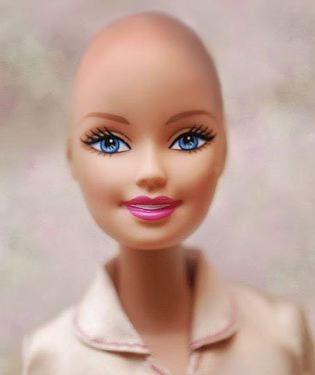
Bald Barbies

Disclaimer: While I have never experienced baldness personally, drawing from the literature on disability and class discussions I felt an affinity with the topic. If I indirectly offend anyone I offer an apology in advance.Image

Recently I’ve noticed a lot of rabble on facebook about a topic I never thought would pop up in my newsfeed: Bald Barbie.

There’s a facebook group dedicated to pressuring Mattel to create the Bald Barbie for children who suffer from hair loss due to cancer as well as Alopecia, and Trichotillomania. Mattel has finally released a statement saying they will create Bald Barbie but it, “will be a friend of Barbie, which will include wigs, hats, scarves and other fashion accessories to provide girls with a traditional fashion play experience.”

Hm. So, the new doll cannot be labeled a “Barbie” and she still has to have fashion accessories which, in my interpretation, (and perhaps this is my raging feminist coming out) means people who have hair loss still have to cover up their scalp since baldness cannot be accepted as normal.

Not only will Mattel’s new doll not be a “Barbie”, she will also only be distributed to children’s hospital for reasons of “directly reaching girls who are most affected by hair loss”. But what about the children who are not in hospitals who have experienced hair loss? And how does a hospital reinforcing to the children that they’re still beautiful actually combat the main message that Mattel sends out to the general public on a day-to-day basis, i.e. beauty has a certain standard, and if you don’t have the hair and body for it, you will never be beautiful.

Could placing the doll on the shelves of a toy store create too much of a sense of normalcy towards hair loss?

From the past course discussions on disability, and the invisibility and inaccessibility that many disabled people have expressed they have experienced; I don’t think that Bald Barbie does much to enhance the lives of children who have experienced baldness.

By only distributing these dolls to hospitals Mattel is stating that baldness is still a disability and is associated only with illness. Mattel could release Bald Barbie in mainstream stores and allow Bald Barbie to be viewed right next to a Barbie with hair but then what message would Mattel be sending to the children that experience baldness? Beauty standards can actually deviate from what Mattel portrays them to be?

If Bald Barbie were to be considered equal and sold in the mainstream market right next to a Barbie with hair I think children who experience hair loss could actually feel acceptance and beauty towards their baldness, especially when Barbie is such an icon for female children for femininity and glamour.

I think Mattel’s creation and distribution of Bald Barbie is just another way to emphasize disability rather than accept it.

Design improved by (dis)ability

So we’ve talked quite a bit about how architecture and spaces treat (dis)ability as an afterthought, defining a norm and making often weak attempts to accommodate those who do not fit inside the normative box.  But this doesn’t always have to be the case. There are some really smart designers who have flipped this script- collaborating with people of different abilities in order to come up with design that is beneficial to everyone.

Take for example the OXO Good Grips line of kitchen utensils. We’ve all seen them- peelers with really thick handles, unusually shaped can openers. Cool looking, but not the norm in utensil design.  It turns out, this entire line was designed in consultation with arthritis sufferers, in order to create kitchen tools that they could easily and comfortably use at a reasonable price.  Now, OXO Good Grips is one of the best selling brands of kitchen utensils around the world. A simple thought- making an easier to use potato peeler- leads to better design.

But what about architecture? How can it be impacted by collaboration across abilities? At DC’s Gallaudet University, which specializes in educating those with hearing impairments, new buildings are showing innovative design meant to help the deaf that could end up in your new office building or classroom.  Walking and talking is one of the cornerstone experiences of college life- but this becomes a bit trickier when you’re speaking a language that is visually based.  Buildings offer numerous obstacles to these conversations- narrow hallways, doors that have to be opened.  Gallaudet is creating buildings with wider hallways and wider sliding doors to better accommodate students’ social life.  Eye strain, again a common college problem exacerbated by needing to use your eyes to take in every second of classroom interaction, is dealt with by thinking of light sources and room color.  Each innovation is driven by thinking of (dis)ability first, and each one something that could be valuable to the world at large.

Is this a next stage in industrial design? Instead of trying to make a product comply to Americans with Disabilities Act standards, should we instead focus on making products more inclusive from the start? It’s a bit of a rhetorical question, sure, but the real question is, why aren’t more people thinking this way?