I’ve always been active. In high school I was a year round athlete and my body reflected this. Looking back on pictures I can hardly believe that I looked like that because I always saw myself as huge. According to my weight which was 15-30 pounds higher than my friends I thought that I was so much larger than I was at 135 pounds, I had an extremely warped view on my body. Now as a senior in college I have gained about 20 pounds and it is a continuous struggle to love myself. There are days I stand in front of my mirror and feel empowered and beautiful and strong and there are days when I’m getting dressed with friends or looking at old pictures that I feel like somehow I’m failing, but why do I think that way? Continue reading
body image
Should I go on a run today?
I haven’t been feeling great about my body lately. It’s because I’ve been spending so much time at my desk or hunched over a book (thanks, finals). But it’s also because I haven’t been able to wear my favorite pair of jeans since I got back from my time abroad (where I ate everything I wanted because cultural experience!). I’m telling myself not to let a pair of pants make me feel this way about my body, but I’m feeling it. Continue reading
Cover it up ( • )( • )
**This post is about breastfeeding. I hope you read it, but if not, please take a look at the resources I’ve linked, as there are many and I have found them to be invaluable tools for breastfeeding mothers.**

Just the word “breastfeeding” brings mixed reactions. I don’t know many people who find it overtly offensive. I know many people who find it as natural as breathing. Most people I know are somewhere in between, approving of the act for its purpose and benefits, but feeling opposed to the actual witnessing of it. I myself have existed on various levels of acceptance as I’ve aged, so I’m not unfamiliar with the uneasiness it gives people. What I hope to do here as I share my personal experience is offer perspective, perhaps a chance for some to alter their view of breastfeeding by considering the breastfeeder. Continue reading
Mirror, Mirror
Mirror, mirror on the wall,
who is the fairest one of all?
Is it the one over there, that skinny girl
or the one with the curves who should give the title a whirl?
Does it go to those wearing the latest brands
or those from the thrift store stands?
People who embrace their “natural beauty”
or those who wear make up as if its their destined duty?
Those dressed nice and straight laced
or those who take trends and happily deface.
…
Snow White you say?
Are you sure your opinion does not sway?
What makes her so special?
Her beauty is not so pure!
She sleeps with 12 men
and never goes outdoors…
(If you argue, take a look
at her skin which is as white as paper in a book)
No. I should not be crude.
My self worth is not based on how she is viewed.
Insulting her does not make me happy
it just makes me seem crabby.
No amount of name-calling will that change
I can only assess the problem in front of me, this issue I estrange
How dare you say I am not beautiful, not the fairest?!
You have no proof on that, I do suggest.
More than that, I know you’re wrong,
In my mind and heart your words do not belong.
I am beautiful, I do declare.
Your opinion, forever more, I do forswear.
I Mind the Gap
As our fat bodies studies took full swing and we were pushed to think about some examples of how the fat body is devalued, my mind also drifted to the obvious counterpart; the thin body. I couldn’t stop my mind from wandering to a website called The Chive… more specifically, an album called “mind the gap”. What gap you ask? No, not the Gap Store… Not the ominous warning at the London Underground, heeding people to be wary of the gap between the train and platform (yes, that’s a thing)… This gap…
***WARNING: thin bodies, thin pictures, thin-talk***
Leaving The Labyrinth of Self Loathing
I was recently perusing the world wide webs when I came across an article entitled “7 Things To Look At When You Feel Bad About Your Body“. I encourage everyone to go read it now. Right this minute and then come back here…Go ahead…I’ll wait… (Warning: Contains bodies, in various forms and fashions)

Whatever Happened to Embracing One’s Curves!?
So after going through the Fat Bodies section in General Women Studies Class, I was left a bit uneasy. And you can’t blame me, like how can I accept the fact that the media wants to control what women put in their mouths and constantly blame regular women for the way they look? It’s all pure nonsense. Whatever happened to embracing one’s curves, however they look, big or small? I just don’t understand it. It frustrates me greatly.
When Were We Happy?

Photo by Marie C.
Recently while I was perusing my Tumblr I came across this post. At first I was just going to scroll past, but then I decided to actually stop and look at it.
The nonpliment – “Oh my gosh, you lost so much weight!”
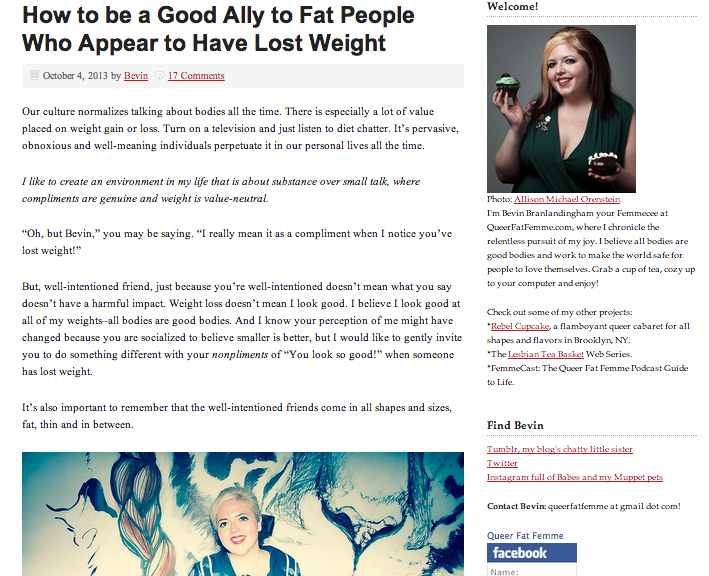 Sitting in my “to-read” list for a bit was this article. It caught my eye because of what we have been talking about in class for our fat studies unit. Now that I read it, I am SO glad I did.
During our conversation last week, we talked about the really important idea of keeping the lives of fat people at the center of our analysis. One of the other points from class that really stuck with me was that it’s not just enough to focus on loving our own bodies and encouraging people to love their bodies, but we also need to respect and love other people’s bodies of all shapes, to accept, to affirm, and to abandon size-judgement. Continue reading
My body and me: the original arranged marriage
As long as I’ve been alive, I’ve been some version of overweight. I was my mom’s biggest baby. There was the “baby fat” phase (which I tried to ride to middle school, much to my embarrassment); the “I’m gaining weight because of puberty but it hasn’t decided where to live yet” phase of middle and early high school; the “I may not actually be overweight but I’m so disgusted with that tiny bit of belly fat that I’m pretty sure I’m obese” phase that seems pretty rampant in American high schools; the “shit, now I really AM overweight because I decided to take birth control and I put on 50 pounds in 3 months” phase of panic, terror and depression; the “I’ve stopped trying to stop gaining weight” phase where I saw numbers over 200; the “I had a baby and despite gaining hardly any weight with pregnancy I’ve managed to get even bigger postpartum” phase that’s pretty popular with new moms; and my personal favorite, the “oh my god, this is the biggest I’ve ever been ever in my life and I’m completely freaking out” phase of morbid obesity that has consumed my adult life.
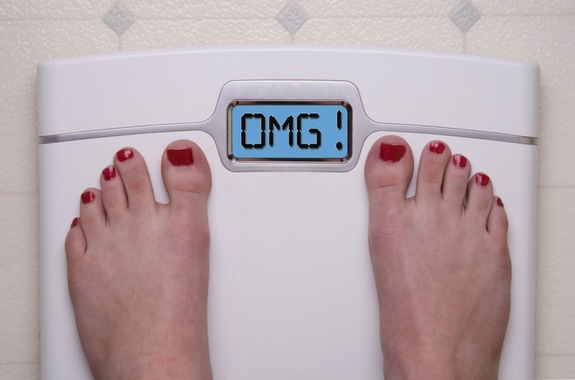
Basically. Though my scale isn’t this clever. And I have better toes.
Sensing a trend? Continue reading

