The Micropenis

I know that as a class we are a pretty open group of people, but because this is a public blog (and because I am unsure how people will feel about me posting pictures) I am going to refrain from doing so for this particular post, however, if you are interested in finding pictures they are very easy to come across online. I will also warn you that the sites I have posted do contain graphic pictures, so don’t visit them if you don’t want to see the pictures.

Interestingly enough, I stumbled upon this topic after our class discussion of a utopian society in which all babies were born with the possibility of all inheriting any genetic traits from the entire population. A conflict arose when two groups of people argued whether or not they should “exclude the negative traits” without ever specifying what those negative traits are or might be. Well, I figure this is easily something that could be seen as a “negative trait”- the microphallus or micropenis.

According to http://www.micropenis.biz/p/micropenis-information.html  and Wikipedia, a micropenis can be defined as “an erect penis that is 2.5 standard deviations less than the average human penis size”. However, the two sites differ on what the average erect human penis size is. The first site defines a micropenis as being 9 centimeters or 3.5 inches or less, while the second site defines it as 7 centimeters or 2.5 inches or less. According to the websites, 0.5-0.6% of the male population has this condition. But does having a condition mean that you suffer from it?

It is possible. Even the author of micropenis.biz says that he “suffers” from the condition. Some people think they no longer suffer if the condition goes away with some form of treatment.

In the 1960s and 70s sex reassignment surgery was recommended for the micropenis condition, and if the parents consented, the testes would be removed, an artificial vagina would be constructed, and the boy would be raised as a girl. Even at our very own Johns Hopkins Hospital they performed 12 of these surgeries. However, these surgeries were based on three assumptions that are now in question:

  1. gender identity and sex differences were solely a matter of social learning rather than biology.
  2. a male with a penis too small to put into a vagina could not find a satisfactory social and sexual place in society.
  3. a functionally acceptable vagina could be constructed surgically

Because intersex individuals and some of these patients believe that children’s sex organs, sexual identity, and gender identity shouldn’t be decided for them, or regretted the surgeries that have been performed on them, many of these surgeries have stopped and parents are waiting until their children are old enough to make the decisions for themselves.

Bald Barbies

Disclaimer: While I have never experienced baldness personally, drawing from the literature on disability and class discussions I felt an affinity with the topic. If I indirectly offend anyone I offer an apology in advance.Image

Recently I’ve noticed a lot of rabble on facebook about a topic I never thought would pop up in my newsfeed: Bald Barbie.

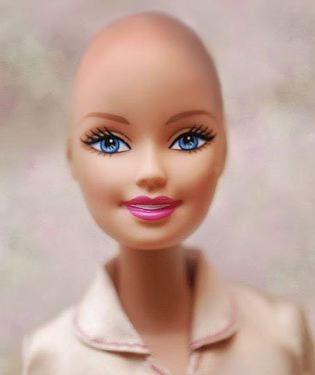
There’s a facebook group dedicated to pressuring Mattel to create the Bald Barbie for children who suffer from hair loss due to cancer as well as Alopecia, and Trichotillomania. Mattel has finally released a statement saying they will create Bald Barbie but it, “will be a friend of Barbie, which will include wigs, hats, scarves and other fashion accessories to provide girls with a traditional fashion play experience.”

Hm. So, the new doll cannot be labeled a “Barbie” and she still has to have fashion accessories which, in my interpretation, (and perhaps this is my raging feminist coming out) means people who have hair loss still have to cover up their scalp since baldness cannot be accepted as normal.

Not only will Mattel’s new doll not be a “Barbie”, she will also only be distributed to children’s hospital for reasons of “directly reaching girls who are most affected by hair loss”. But what about the children who are not in hospitals who have experienced hair loss? And how does a hospital reinforcing to the children that they’re still beautiful actually combat the main message that Mattel sends out to the general public on a day-to-day basis, i.e. beauty has a certain standard, and if you don’t have the hair and body for it, you will never be beautiful.

Could placing the doll on the shelves of a toy store create too much of a sense of normalcy towards hair loss?

From the past course discussions on disability, and the invisibility and inaccessibility that many disabled people have expressed they have experienced; I don’t think that Bald Barbie does much to enhance the lives of children who have experienced baldness.

By only distributing these dolls to hospitals Mattel is stating that baldness is still a disability and is associated only with illness. Mattel could release Bald Barbie in mainstream stores and allow Bald Barbie to be viewed right next to a Barbie with hair but then what message would Mattel be sending to the children that experience baldness? Beauty standards can actually deviate from what Mattel portrays them to be?

If Bald Barbie were to be considered equal and sold in the mainstream market right next to a Barbie with hair I think children who experience hair loss could actually feel acceptance and beauty towards their baldness, especially when Barbie is such an icon for female children for femininity and glamour.

I think Mattel’s creation and distribution of Bald Barbie is just another way to emphasize disability rather than accept it.

Viola Davis: Oscar Loss, Natural Hair Win

Viola Davis, an award winning black actress, recently starred in the movie The Help. At the 2012 Oscars, Viola appeared on the Red Carpet glowing and debuting her natural hair. The media, of course, made this a into a huge story. When asked what made her decide to wear her natural hair to the Oscars, she stated that h

er husband encouraged her to do so.

I believe that Viola Davis was radiant and confident that night. She was absolutely beautiful. Many black women and young girls appreciated seeing natural hair on the red carpet. Wendy Williams, radio talk show host turned television host, did not feel the same way. On her self titled talk show, Wendy Williams insinuated that the Davis’ TWA (teeny weeny afro) made her look mannish, like the history teacher in the 70’s sitcom “Room 222”. At another time, Williams stated that Davis’ hair was just not professional. Many black women were appalled at her statements. They felt that Williams was attacking black women. As you can see in the picture on the left, Davis display of natural beauty was inspirational to black women and girls; and, Williams blatantly shot it down on national television to an audience who probably does not understand natural black hair to begin with.

Black hair has so much politics attached to it. In the past, black women have felt restricted by white beauty standards of straight or wavy hair that is often unnatural to them. I, like many others, am appalled that a black woman would scorn another black woman for displaying her natural beauty. “Natural” hair is our hair. Kinky, curly, wavy, coarse, whatever, it is our hair. I am encouraged by the fact that so many black women have decided to transgress white beauty standards and free themselves from chemical relaxers, letting their own unique beauty shine. Viola Davis certainly took a stand at the Oscars and became even more of an inspiration to black women.

The Great Wall of Vagina

Artist Jamie McCartney is trying to start a sexual revolution… but not the kind we usually think of.

Image

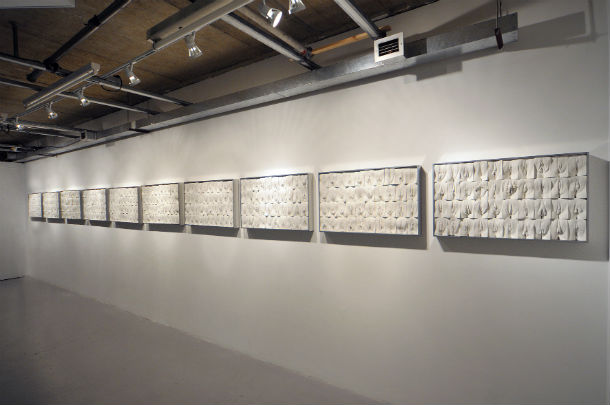
He is attempting through art to change female body perceptions and show us that every woman’s vulvas are normal.  McCartney is a life cast artist; he spent five years collecting casts of volunteers’ vulva mounds and has turned the result into The Great Wall of Vagina.

Image

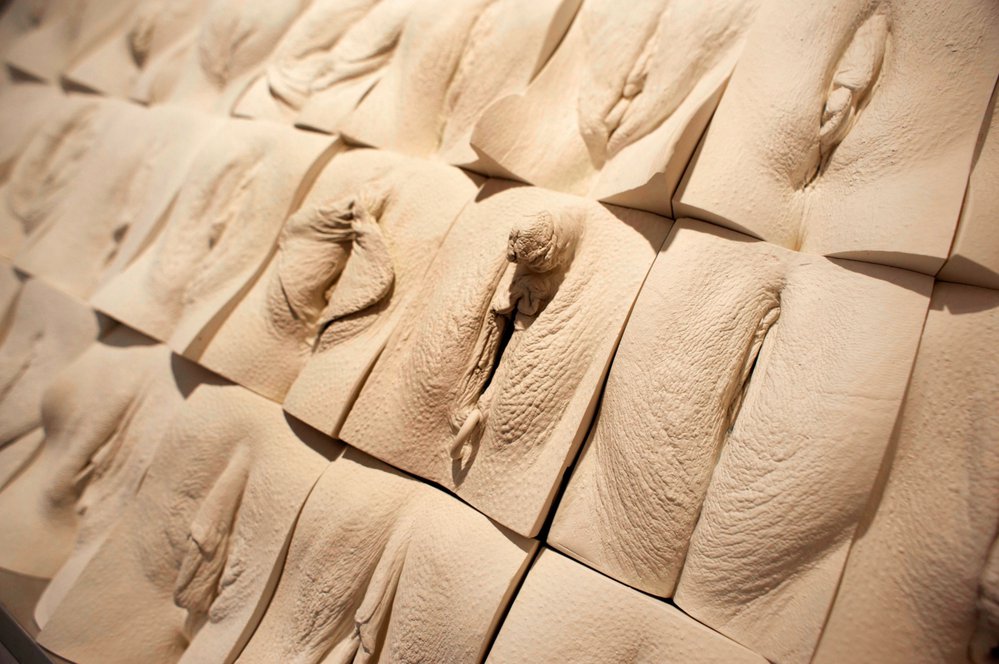
The work includes 400 casts, as accurate as photographs, displayed in ten wall panels. They range in age from 18 to 76 and include mothers and daughters, identical twins, transgendered men and women, women pre and post natal, and another one pre and post labiaplasty. It is impressive and at times overwhelming, but by reducing the body part to a simple white plaster cast, he removes the sexualization we would typically attach to such a display.  His use of spectacle shows us how absolutely diverse each and every woman’s vulva is – on the website it mentions how each one is as unique as a face.  And they are!

Image

“For many women their genital appearance is a source of anxiety and I was in a unique position to do something about that.” - Jamie McCartney

There are several things I find interesting about this art project.  First, by bombarding us with 400 vulvas in a small space, he reduces the body to a single part, from a view many of us have never seen. And while we ARE viewing the diversity and differences in vulvas, it also manages to emphasize the similarities.  We see the similarities in our differences.

Image

And second, if women are shocked and surprised at the diversity shown here – why is that?  Is it simply because most heterosexual women haven’t seen other women’s open vulvas?  Or is it the “pornification” of our modern culture?  If labiaplasties are on the rise, do you think an exhibit like this would help stop that trend? Do you think hetereosexual men and lesbians are surprised by this diversity?

So, would you go see the show?  And if you are the owner of a vulva, are you looking for one that looks like yours?

Image

“It’s time our society grew up around these issues and I’m certain that art has a role to play.” - Jamie McCartney

Summer, Sandals and Socialized Feet

So summer is swiftly approaching. The heat will of course cause a large shift in the way bodies are covered. Shorter and shorter skirts, barely there shorts, sleeveless tops and if your really hot, just bikinis all day! This of course horrifies the conservative sector of society that prefers woman cover up for moral reason. I however am concerned with a very specific body part that suddenly gets over exposed. FEET.

They are everywhere. There are flip-flops, peep-toe heals, strappy sandals and more, all overly exposing the foot to the population. I recognize this is not generally considered a big deal. I’m sure members of the foot fetish society community love this time of year. As for me, it is dreadful.

Here is why. All winter I had the luxury of socks and boots, fully protecting my feet from the public view. Now I have the added hassle of constantly preparing my feet for society. Painting my nails, making sure my heels and toes have lotion at all times, and making sure they have a generally attractive appearance. No one told me explicitly that I need to put the extra effort toward my toes. Yet I know, from the sexy models with the perfect feet in the DSW and Payless commercials. Every single one has toes painted with wonderfully bright colors, their toes fit perfectly in the shoe as if the designer tailored the shoe for that specific foot. Meanwhile, I have to pull of the same strappy sandal with my imperfect feet.  This may just be a personal dilemma, but I’m certain I’m not the only one who has noticed how even the barely noticed parts of our bodies have been subjected to socially constructed norms.Image

A Strange Kind of Mirror

This post could be triggering for people who struggle with body image.

Or maybe not.  That’s the question.

My Body Gallery first appeared on the internet sometime around August 2011, judging by the number of posts written about it on other websites during that time (see: Jezebel, The Hairpin, NY Daily News, Yahoo, and more).  The basic idea is that women upload pictures of themselves and then categorize them based on their height, weight, pant size, shirt size, and perceived body type.  Other women can then search the site by their height and weight, and to see what that looks like on other women.  According to the website, the point is to allow “other women to see that the world is not a place of cookie cutters,” because women “are all different in our body shape and size as well as our place in our journey to loving our bodies exactly as they are, not as we (or others) think they should be.”

Initially, though I recognized that the site obviously had its problems, and that it could be difficult and triggering for people who already had a history of or an inclination to compare themselves to others, I found the site interesting.  It could be helpful for people who have an “ideal” weight to see that their ideal might be different in reality.  There are not a lot of people of my height and weight, on this website or otherwise, especially considering the number of people that uploaded pictures for, say, 5’5″ and 120 pounds.   I like knowing that there are other people who look like me (and, notably, all of the people in that category appear to be white).  If sleeves are never long enough and pants are rarely made in your size (and, when they are, they’re never labeled “regular”), or if you have to order your shoes from a niche company who makes them large enough, or you have to shop in a “special” store, or you’re always hitting your head or ducking, or you’re not tall enough to ride the roller coasters, it can be comforting to know that you’re not the only one.  But good luck if you’re 5’5″ and 360 pounds.  Apparently, there is no one else like you.

So that, then, is one of the problems.  Even if the site continues to exists for several more years, even if people continue to submit their pictures to it by the thousands, it will never encompass the entirety of bodily experience.  It is possible to search for any weight by an interval of ten pounds between 100 and 500 pounds.  That’s a decent range, but there are not many people in the larger or less frequent categories.  They are possibly the people who would benefit most from knowing that there are others with similar bodies.  On the other hand, seeing that there are no pictures in your category- but plenty that are 5’5″ and 120 pounds- only reenforces those feelings of deviance.

Then there’s the fact that the pictures are almost entirely of white people, which in part reflects the general whiteness of representation on the internet.

And the fact that, even though women are not “cookie cutters,” they’re still trying to categorize women into categories of weight, and more tightly into categories of “body type,” which is apparently limited to pears, apples, bananas, and hourglasses.  I have never personally met anyone shaped like a banana.  If you do identify as banana-shaped, I certainly don’t want to deny your experience, but I imagine it would be hard to stand, and harder to walk (Have you ever tried to stand a banana up?  All you get is bruised bananas.).

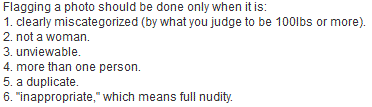
"Flagging a photo should only be done when it is: 1. clearly miscategorized (by which you judge to be 100 lbs. or more) 2. not a woman 3. unviewable 4. more than one person 5. a duplicate 6. "inappropriate," which means full nudity

Are people uploading pictures of dogs?

And then there’s the thing that bothers me most.  This site is for “real women.”  The is an alarming amount of shaming of skinny people within the “body positivity” movement, and plenty of dialogues that replace current beauty standards with other beauty standards- for example, that “real women have curves.”  Worse, the site appears to be only for women, and since whether or not a picture is of a woman is decided by how other members “judge” it, I worry that the site is only for ciswomen.

So, what do you think?  Is this more helpful than harmful?  Do you plan to upload your picture?

“Boobs Don’t Work That Way”

Has anyone come across this tumblr? I really like it.

“Okay, so we want two sexy women on the front cover. Both with tops that don’t cover much and you know what? Maybe one of them is pants-less. Yeah! And have them pose in a really sexy way. Woah, woah woah! What is that? Did you just draw nipples? That’s too far man. Children read these things."

“Boobs Don’t Work That Way” is a “blog about tits and the impossible things artists make them do,” according to the homepage. And it delivers! Each of the 22 pages features numerous renderings of women and their breasts, or I should say, their impossible breasts. Because let’s face it, friends, Real Breasts Don’t Work This Way.

Conversations about our breast-obsessed culture are not new or radical. We know we love breasts, and it doesn’t take a lot of looking around to be reminded of this fact. Breasts are all over the place! On billboards, commercials, movies, magazines, and oh yes, on many of the women we encounter every day. For a lot of us in women’s bodies, we’ve experienced having a conversation with a man and noticing his eyes conversing with our breasts, rather than our faces. I noticed this for the first time when I was about thirteen.

What “Boobs Don’t Work That Way” does that I love is expose some of the absurdity of our breast obsession. Artistic depictions of women’s breasts are often realistic, but this tumblr gives us a cache of the ones that are NOT. And it is refreshing to see someone make fun of these pictures! I mean, they’re so ridiculous! If I were an alien from another world, what would I think if I saw all these pictures? Would I think women have globes of flesh attached to their chests, devoid of nipples? Would I think these globes are perfectly round and humongous compared to their waists? Would I think these globes were detachable? Some of these breasts look like they’re about to fall right off the women who possess them.

And what is particularly interesting about that point what it brings to mind about embodiment. Women who have breasts experience their breasts are part of their bodies, as part of their embodied selves. Women bring their breasts everywhere with them (maybe if they had a choice, they wouldn’t?). Yet pictures like this one obscure this reality. These breasts are for display and affect, and give no indication that they are experienced for any reason other than to tantalize the viewer.

Get Naked to Fight Negative Body Image!

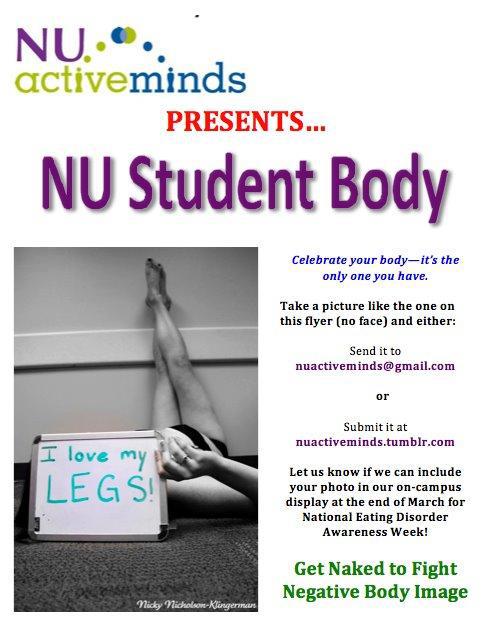
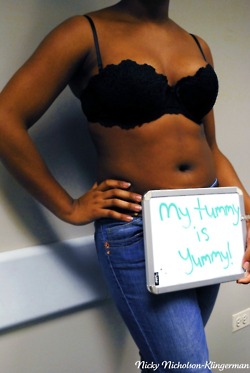
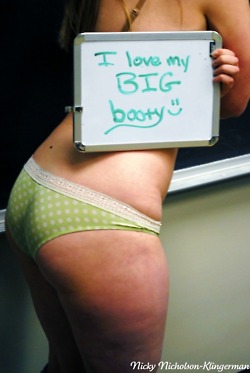
My sister, Lisa, goes to Northwestern University and put the poster to the right on her facebook page. I glanced at it, and immediately loved the idea. A student organization “Active Minds” is asking average students at the University to submit pictures of themselves with their clothing off (without showing anything inappropriate) and without showing their faces to put a cute slogan on a whiteboard or paper and say something positive about that part of their body. I asked her if there were more pictures like the one in this poster. She said yes, go HERE. So I did.

The pictures on this blog are the ones I found on that website. I loved the clever ways people wrote about their bodies and that everyone seems comfortable in their own skin. In a way, it reminds me of the POST SECRET website where people anonymously send in secrets about themselves they’ve never told anyone, and they are viewable publicly on the internet. But unlike PostSecret, this community is just college kids and they’re saying that instead of giving in to the public perception of how bodies “should” be, this is simply the way they are and they’re proud of that and they’re willing to put it in a public place.

I can’t wait to see the kinds of pictures people post, and am also curious to see if anyone will send in a picture of a scar they’re proud of, or if people will send in pictures of their tattoos or piercings like what we’ve discussed in class. I am going to continue to follow this project even after I post this blog and I encourage you to do the same.

The goal of this project by Northwestern University’s “Active Minds” is that they will have lots of pictures of average people who like their bodies the way they are and they will be displayed at the university for National Eating Disorder Awareness Week at the end of March. I couldn’t be happier with this idea.

As a child, I was a ballet dancer, and I was severely underweight. But I thought I looked great because the standard in that environment was, and is, that you are not supposed to have excessive body weight, even in areas like your hips and breasts where you should be gaining weight at puberty. I was exposed to eating disorders at a very young age and know several people who have suffered and nearly died from them.I really like the idea that they’re promoting eating disorder awareness and simultaneously promoting a positive body image. In fact, I like the idea so much I want to start something like this at UMBC. So my question is, if I did, would you join me, and do you think other people would join in?

The Rebellyon

Amanda Palmer (probably my favorite musician, artists, what have you) has a disagreement with the managers of Roadrunner Records, her then point of contact for making music. The short version of  a long story is that for her solo album entitled Who Killed Amanda Palmer? the manager of Roadrunner Records (who also has bands such as Kiss, Korn, Theory of a Deadman, and Nickleback) told her that the video for “Leeds United” would need to be altered because her stomach looked fat. He said according to Palmer, “i’m a guy, amanda. i understand what people like.” The longer version of these events was posted on her blog which is linked here. Amazingly enough, I do believe this is the body he said people would not like:

She proclaimed a return to love the belly, although in her own vanity she was frequently self-conscious of it. After posting a photograph of her belly, many of her fans felt inclined to follow in her actions. At one point there was a website devoted to those pictures (which I can’t happen to find now), but they have been collectively amassed and put on various sites. There have been discussions about how the body should be loved as it is. An interesting take of the Rebellyon is discussed here.

I am actually really saddened by the fact that this occurred because by one man’s standards, the body was judged as if by societal judgement. The amazing thing is that her fan base provided the grounds for substantial protest against the record company (which she was finally able to drop after harsh criticisms). Her body has been put on display by the mediums she works in and it is evident there is a place for politics in this space, but was it fair for the manager to assert the ideal body that her audience would like?

Androgyny

Often, we talk about “beauty standards” as a single set of rules, as though they can be internalized and followed the way one might follow the rules of grammar or mathematics.  Beauty standards have very real consequences for those who break them and also those who don’t, and they are so pervasive as to seem universal.  But they aren’t universal.

Take, for example, the context of the fashion industry.  Granted, there are plenty of harmful aspects of consumerism and misogyny in fashion in general.  Still, fashion is, purportedly, an art that pushes boundaries, even if it has inherited the unfortunate boundaries of the society of which it is a part.  This is an essay in itself.  What is interesting for the purposes of this post is how the beauty standards for fashion models differ from those for the average person in a given culture.  The purpose of fashion is to push boundaries, and so it continually shapes the beauty standards and trends for average people and then changes them.

Similarly, models are not held to the same set of standards.  Successful models have a certain set of common characteristics (tall, thin), as well as something that makes them “stand out”: a sharp nose, strong brow, angular jaw line.    At the same time, the desire for models who are tall and thin has necessarily led to an increase in models with androgynous bodies.  Perhaps the most popular androgynous model at the moment is Andrej Pejic, who in one season walked five men’s shows and four women’s shows.

His body seems to be proof that even biology is not dichotomous.  One would expect this to be more threatening, yet Andrej reports a happy, carefree childhood.  His mother is doting, his brother is supportive, and the hardest part of his teenage years, he says, was figuring out who he was.  The freedom that he seems to have felt from pressure to look or act a certain way, the ability to decide for himself who he wanted to be, is remarkable.  The following interview shows him to be level-headed and surprisingly unaffected by his sudden success as a model.

In the context of fashion, androgyny seems more acceptable, relatively speaking.  What do you think makes this the case?  Is this a positive move, or does it just reflect a fetishization of “unusual” bodies?