Upward Spiraling Out of My Body Dysmorphia

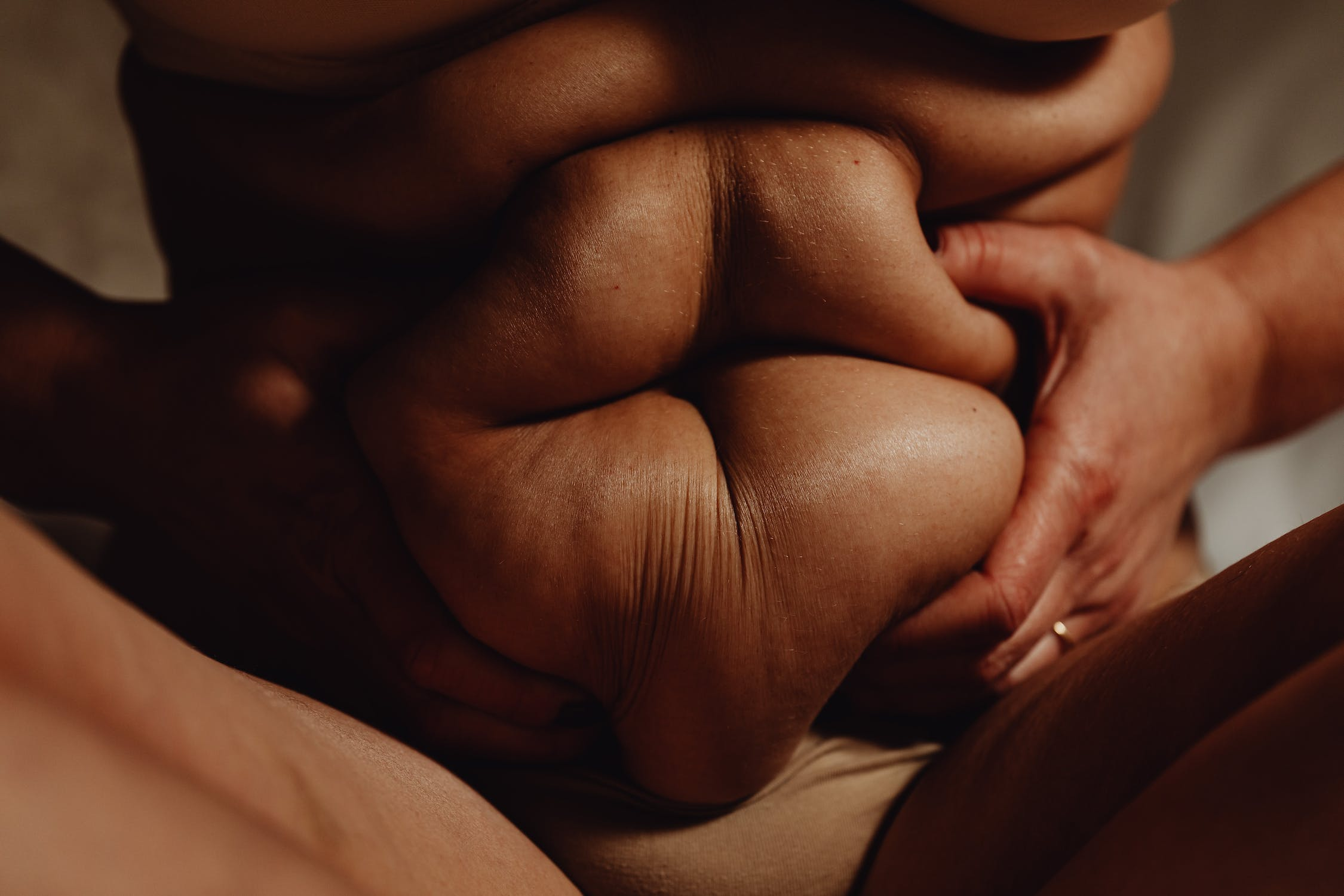
Image by Karolina Grabowska on Pexels.com

trigger warnings: body dysmorphia, suicide, mentions of disordered eating, illness

If you remember what your body looks like, I think you’re one of the lucky ones. If you don’t, then I’m not so glad this is what we have in common. Coming from an older West Indian family, my body was always a discussion. No matter how many soccer practices I showed up to, salads I ate, nor how well I did in P.E. class, whenever an aunt approached me it was always “You’ve gotten bigger!” Even throughout my adulthood my body has gotten bigger. I know I’m big, but I wish they knew that I didn’t need to be reminded every second of my life.  

I think it’s important to note that I wasn’t always fat, but I still struggled with food and dieting at a young age. Having to deal with cholesterol issues during elementary school was the start of my long, relentless relationship with food. I remember sitting in the doctor’s office with my uncle, his eyes glazed over, listening to every word my pediatrician said. My relationship with food not only originates in this moment, but also with my family’s history of heart disease, diabetes, and many other debilitating diseases. By the time I reached high school, my uncle had a coronary angioplasty, stent insertion, triple bypass heart surgery, and several other surgeries for various kinds of cancer. He never wanted me to suffer like he did.  

For as long as I can remember, my uncle micro-managed everything that graced my plate. There were even times we fought at the dinner table so he could see whatever takeout I’d brought home. The stress of bringing home any form of food that he would scrutinize started to transfer into other aspects of my life. In middle school I discovered how uncomfortable it made me feel to eat in public spaces. In high school I even went as far as to become the library aide so I could escape the daunting task of consuming food in the adolescent-filled cafeteria and tried my best to retreat back to the library every lunch break. The library was my safe haven, a place of structure for the moments where I felt the most vulnerable. This is still a habit I have today, I always look for security.

It wasn’t until my senior year of high school that I started my first romantic relationship. He was beautiful, smart, and even had a piercing on one ear that was the jackpot of my teenage girl fantasies. Being with him was the first time someone told me I was pretty. For someone that had only dreamed of having a boyfriend, that meant the world to me. I naively thought that feeling would last forever. As the pandemic raged on, and quarantine forced us into our isolated nests, there became an evident strain on our relationship. Still, we continued to stay with each other. I never noticed when his demeanor changed or that I couldn’t fit into half of my jeans anymore, or even that I was getting bigger than him. I made a huge mistake. You know that horrible mistake people make when they get lost in a relationship because they already have constant bodily validation? Yeah, that one. I gained the “happy weight”, I let myself go. People hate happy weight because being fat makes you feel empty and alone after a relationship. Nobody thinks that you’re attractive anymore and it feels like now there’s this huge responsibility that you have to get back to when you were skinnier. I fucked up.

Coming out of that relationship I became extremely depressed. I moved back in with my family, back to a space I never felt secure in. Endless nights spent scrolling through Tinder, a space where your body is always being perceived, felt completely invalidating. I was a completely different person. And I didn’t feel that way because I had loved and learned valuable lessons about navigating relationships, but it was because I was fat. Everytime I looked into the mirror, a devil appeared on my shoulder pointing out every flaw on my now monstrous body. It’s like my ego had turned against me. 

I didn’t want to live in my body anymore. I thought I was nothing without the comfort of another person telling me I was good enough. I can’t say that I never feel that way today, but I’ve worked on it. I’m not about to go on a spiel about how much it matters to love yourself, nor about how self-love is a journey and not a destination… but would love really be worth it if it meant that I had to be skinny, athletic, or fit any of the aesthetic qualities guys on dating apps wanted? Probably not. But I want to be better, because I know that the moments in between these feelings of doubt and despair are much more important than these superficial views of my body. Though, how I never saw myself changing is still a phenomena to me.

In the end, I’m still trying to upward spiral out of this feeling called body dysmorphia.
Thinking without a body

As a bioinformatics student working mostly with AI, I find myself thinking a lot about non-human thinking systems. It makes a lot of sense in a mind/body dualism school of thought to take a brain and put it into a computer. Actual research into the field of machine intelligence has found that, while neuromorphic AI (AI designed based on models of the human brain) is the place where the best progress has been made, models of the brain are only about a tenth as capable as an equally complex biological network. Additionally the constraints of these systems don’t behave in a way consistent with that of our subjective experience as thinking systems. The one most relevant to the conversation around phenomenology is that of the input requirements for neural networks. Even “generative” neural networks like StyleGANN (https://thispersondoesnotexist.com) use an input of random numbers generated by a computer to give an output. For a thinking human this tends to go against one’s general impression of how their own thought processes work, however phenomenology points out that we are constantly receiving input both from our bodies/senses, as well as in the form of the recursive input of our own focus.

Another thought I have had is whether or not animals have a sense of mind-body dualism. This is actually something that has been studied experimentally! The experiment generates involves a control of placing the animal in front of another member of its species and watching its reaction(s) followed by placing the animal in front of a mirror and watching its reactions. Some animals see their reflections and interpret them as another animal of the same species, unable to distinguish between reflections of the self and other individuals. Most animals just generally ignore their reflections. especially adults who have seen their own reflections in water or glass. Some animals show initial confusion followed by an understanding that the animal in the mirror is the body that is attached to the stream of thought in their head. Most of these animals will remember that experience too and will no longer show confusion in front of the mirror, showing that they have some persistent sense of self. It’s all fascinating and while I would love to write more about it I have to run this in since it’s getting late.

We Go Jim

For the entirety of my life up until college I was living with the view that how society saw me didn’t matter, that I could reach my goals by acting and looking however I wanted. I was naturally skinny and with my tall build I looked like a noodle. My social skills were severely underdeveloped, I wore clothes that didn’t help my appearance, I only showered when I felt like it; for a time my hair looked like I went to the barber and asked for the lamest looking cut they could think of. My first semester living on campus I decided to change that. I started going to the gym. I made a friend there, and we started going to the RAC everyday at 7:00 in the morning. I liked the progress that I saw from working out, and my newfound confidence helped me make friends in my dorm. We went shopping together to buy clothes that weren’t hand-me-downs and three sizes too big on me, and eventually I found that my lame old self that I pitied was gone.

This drastic change in my life has altered the way I view society. Society today has taught us that we don’t need to change ourselves because we are perfect the way we are, but that is simply untrue. Unless you are your best self you should always be changing and bettering yourself in everyway possible; that is evolution. Now whenever I see someone defend their lazy actions it irritates me that they believe that they think the choices they are making are correct. “Oh, I have a fast metabolism, I can’t gain weight!” – eat more, “I don’t have enough time to workout.” – cut out the time wasters from your day; these are statements from people that I regularly see do the absolute minimum to take care of themselves, and prioritize indulging in media instead of being productive. They’re unenergized, they’re not social, and they wonder why they are depressed. They remind me of who I used to be before I started working out, and I truly believe that everyone would be an infinitely better version of themselves if they started to “Go Jim”.

How far can the mind and body split?

In our society, we are often taught and encouraged to see the mind and body as two different entities, separate from each other. In this mind and body split, the mind is usually the part of us that is more important. We are conditioned to choose things that relate to the mind over things that relate to the body. For example, we are supposed to come to school/work when we are not feeling well, because our minds are prioritized in those settings. With schoolwork, we are supposed to “grind,” and may ultimately be forced to pull all-nighters to complete an assignment, or study for a test. For our bodies, when it comes to “body projects,” we only involve and focus the body (and when the journey of these body projects gets rough or hard, we are supposed to put aside our complaints). Overall, it’s very apparent that in society we are taught that the mind and body are separate things, even though both are simultaneously a part of us, and supposed to work together.

But how far can the idea of this mind and body split be pushed onto us?

Continue reading

On Embodiment and Gender

As I understand it, the concept of embodiment seeks to move away from the Cartesian mind-body dualism, which posits that our minds and our physical bodies are distinct entities, and towards the idea that we are our bodies. We experience, know, and perceive the world through our bodies, and in return we are experienced and perceived by others through the lens of our bodies. An important factor in our body experience and the way our bodies are perceived is gender. Do I have a gender, or am I my gender? Do I have a body, or am I my body?

Continue reading

From being a bystander to becoming an ally

I looked at myself as an ally for all my life but, looking back now, I put on the mask of a helper and fully convinced myself that I was making a difference by following the cause, but I never really acted for the better of it. In college I became an affiliate of the Center for Women in Technology, an organization at UMBC fighting for equality for all. CWIT opened my eyes to the issues that plague today’s society and how I could assist in the fight for equality. I am surprised that a course like my first-year experience for CWIT is not mandatory for everyone. I feel like a simple course like this being worked into all high school curriculum would make a world of difference in the visibility of today’s issues and gather more support for the cause. Coming out of high school, I knew these problems existed, but they were not in the front of my focus because I am a cis white male. I did not have to experience the pain that comes with most of them, however I did secondhand experience them through my mom and stepmother.

Image showing off CWITS logo. A yellow C that is like a gear and the i has a power symbol for the dot.
Continue reading

What *Are* You

So all my life I’ve lived with this one question: “What are you?” Whether it came from people I didn’t even know, or it came from my friends, they all had the same question. And I understand to some degree. I am pretty ethnically ambiguous looking and sometimes I straighten my hair which further confuses people. It still doesn’t make it okay though.

Continue reading

Can’t Show the Big O

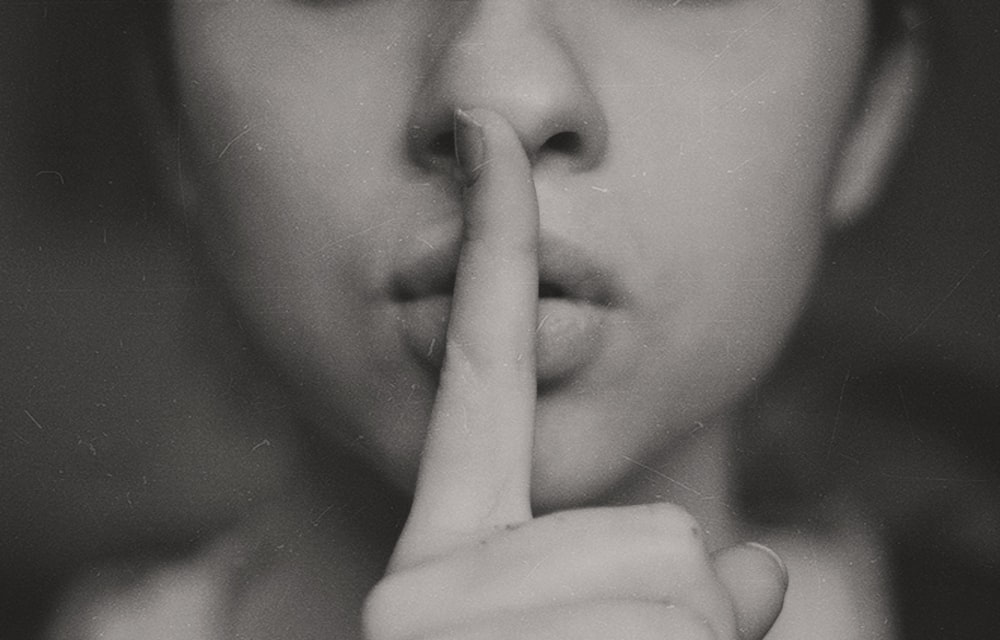
Black and white photo of a woman with her hand up to her lips "shushing".

In the TV and film industry, there are various ways in which women are not seen or treated as equals. It can be as simple and commonly known as the lacking amount of pay a woman receives for a role, and as deep as it starting with the character in the script. Stereotypes and gender roles are everywhere, and are engrained in our minds by the media we consume. Take a moment to think about the long term amount of male dominant sexual themes in TV and film. It is seen as okay for a man to explore his sexual urges and fantasies. It is also okay to show a man pleasing himself and reaching climax, sometimes even showing the messy aftermath. But women? Forget about it. Unless satire, I don’t know of any movies where they are portraying a woman sensually. It wasn’t until recent years that I’ve seen female roles that get to indulge in their sexual desires. A few examples; “50 Shades of Grey” (although it portrays male dominance), and Netflix’s “365 Days” (also male dominated, and based on manipulation and abuse that turns into “love”, yikes). I believe the reason for this mostly ties back to stereotypes. Religion is also a factor at times, but that is a whole different side of the story for another day. A man and a woman can have the same “body count” and one would be a “god” while the other “used up” and dirty. Men that are sexual can be praised for it, while if women are sexual they are “slutty”. Unless women are being dirty on a man’s terms, of course. Then, it’s a hot, kinky medium and she’s a freak! I hope for a day where I can see more media where stereotypes are shattered. I understand that they will likely never be fully rid of, but I am looking forward to see the growth in each generation to come.

Are women or men better?

What does it mean to act like a woman? Back in the day to meant to be a housewife, a mother, and never to speak up. While many people still believe these things, I think they are stupid and should never be brought up. It is very offensive to be called a girly girl with no definition. Just because I wear makeup or where women’s clothing does not mean I am a girly girl and can not do the same thing as women. I am a big fan of Harry’s style, not for his music but for his faction choices and how he has broken the rules of clothing differences between women and men. It is just not fair for someone to say that women should be here to be pretty. The other day I went to a conference with my dad, and it was a petroleum c store convention, a male-dominated industry. And I saw women dressed in tight revealing clothing passing out business cards.

Also, no vendor was willing to talk to me about a business venture or selling their product in my dad’s stores. I would have to make the first move and break the ice, but everyone would want to talk to my brother. This was just shocking to see how women are perceived as just the pretty thing to the side. As a woman who wanted her company, this was very offensive to see how my gender was perceived by an industry run by many old white and Indian males. Women run a gas station or a hotel just as efficiently as men. I think women can run a business just as well as males; I believe there is no difference in intellectual properties. There is no objective evidence that males are better than women! Women and males act the same. They have the same resources to be successful.

Embodying Invisible Disabilities

I am disabled. It took me a long time to call myself by that name. I used to think disability was a term restricted to people whose disabilities were obvious — you could see it in their gait, or how they fidgeted in their chairs, or the way people would talk around them instead of with them. My disabilities manifested in less noticeable ways: poor time management, perfectionism, relentless talkativeness, trouble sleeping, etc. I always considered these manifestations “personality defects” and personal failures rather than symptoms.

I think for a while I was afraid of co-opting the term from a group that seemed more minoritized than myself. I didn’t see myself as having real struggles (thanks, internalized ableism and impostor syndrome!), at least, not like those that other disabled people grappled with. Even when friends would describe their experiences of disabilities we shared, I would sympathize with their stories, rage at the injustices they faced — but I couldn’t give myself the same grace. 

It wasn’t until I experienced a visible disability that I realized how disabled I’ve been. The last time I had COVID, I noticed something was off. Ten days, six weeks, then three months later, I wasn’t better. The cough and congestion were gone, but I still felt slow, like everything around me was playing at 2x speed, and it took all my energy to keep up. My brain was so laggy I struggled to compose coherent sentences; catching up with a friend over dinner left me lethargic and almost dizzy for days. People asked if I was alright, worried why they hadn’t talked with me in weeks or seemed so dazed at work. 

I couldn’t deny it anymore, I was disabled. When everyone noticed it, I believed it. But, really, it wasn’t all that different from how I experienced disabilities before, except that, this time, there was an easy before and after comparison. Everyone knew pre-COVID me and post-COVID me. There was never a version of myself before ADHD or Anxiety; they’ve been with me since birth. There’s no telling where the diagnoses end and I begin.

Long COVID made my other disabilities entirely unmanageable. I didn’t realize how tumultuous my balance was until COVID gave me a shove and sent me tumbling off a cliff. It was a wake-up call: just because I was compensating for my disabilities well enough before COVID didn’t mean they weren’t there. Just because other people couldn’t see them didn’t mean they weren’t real. Long COVID forced me to accept that I needed support. I couldn’t keep trudging through life, exhausted from playing on an uneven field and unwilling to accept the help offered to me. My disabilities were — are — real, and I deserve a level playing field. 

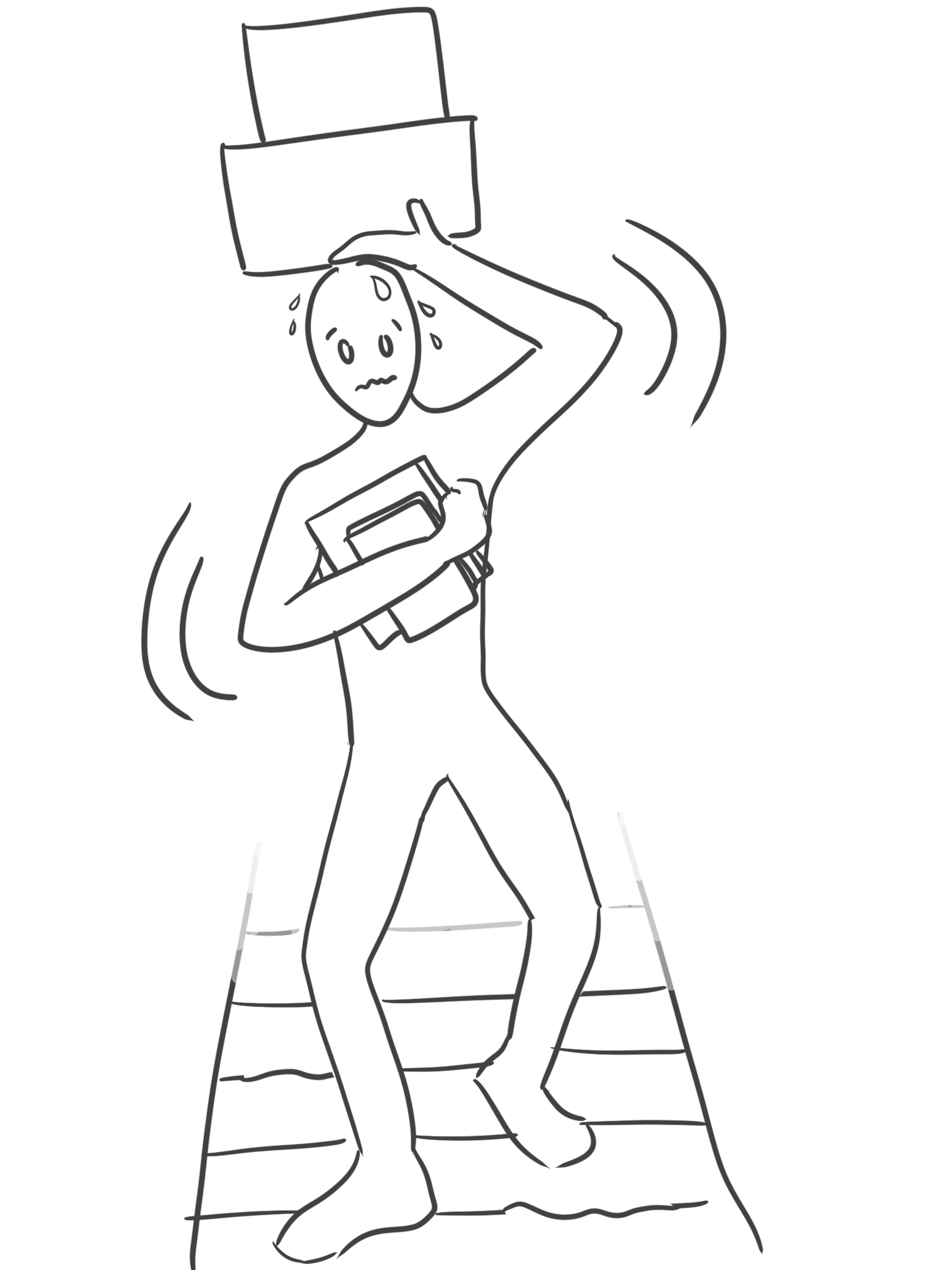
Digital sketch of a person walking down uneven stairs while carrying a stack of books in one arm and balancing boxes on their head with the other. They are sweating and wearing an anxious expression.
A quick sketch of how I feel internally when dealing with disabilities.