Slavery in the Name of Incarceration

About a few weeks ago, I came across an informative Twitter post. This Twitter post was informing the general public on incarcerated firefighters in California and how these same firefighters are paid little to nothing AND are not allowed to acquire firefighter jobs upon release. My first thought was, “how can this make any sense? And why are we still promoting slavery of people in the name of incarceration?”. So, I’m going to start by being completely honest… I’m a HUGE advocate for prison reform. This is for two reasons: although incarcerated people are deemed criminals, they still deserve basic humans right and the way in which incarceration completely ruins people’s lives, it’s not morally right… at all and no matter what.

Honestly, incarcerated people deserve their basic rights. To me, it doesn’t really matter who a person is or what they have done, everyone deserves basic decency, such as being paid/compensated a sufficient enough amount to sustain themselves. In one article, (link listed below) by a non-profit news source “High Country News”, author Maanvi Singh writes, “in exchange for extremely dangerous work, prisoners earn time off their sentences and are paid between $2 and $5 a day, plus $1 per hour when they are on a fire. Because incarcerated firefighters are paid so little, the program saves the state of California $90 million to $100 million a year”. What I took away from this data is that my argument was further supported. Let’s put this into context. The average minimum wage for firefighters in California is $21/hour, but prisoner firefighters can only receive, at most, $5 a day… Now, I know incarcerated people are housed, fed and not having to worry about bills, but how in the world is this fair? These prisoners literally risk their lives for $5 a day? Then, on top of that, they save the state of California $90 to $100 BILLION dollars a year, through their labor, it’s not morally right, any way you look at it. I don’t even want to go down a rabbit hole with the taking off time from their sentences. I’ll just leave it at that’s not right.

Second, incarcerated firefighters aren’t allowed to apply or acquire firefighter jobs once they have completed their sentences. Of all things, I find this the most absurd. I say this because these incarcerated firefighters literally took on the role of non-incarcerated firefighters. Also, with how prison completely ruins a person’s record; I think the least society can do is allow them to pursue a career after they have served their time. I feel incarceration completely disables people from allowing them to move on and better their lives. Instead, prison only sets its victims up to fail again. #PRISONREFORM!

Continue reading
Weight Watchers: The Eating Disorder You Can Buy

Content Warning: dieting, disordered eating, fatphobia

My mother started a new Weight Watchers program recently and it’s been bringing up a lot of feelings for me. To start, it’s always weird when you see exactly where some of your problem behaviors come from. My mother has been dieting, cleansing, counting calories for the ultimate goal of losing weight my whole life. Naturally I picked up on these behaviors and attitudes towards fatness as a child and carried them with me only until I started learning about fatphobia and toxic diet culture on social media in the past few years. Watching my mother never be satisfied or proud of her body instilled in me deep beliefs that gaining weight and being fat are the worst things that can happen to you and you should avoid it at all costs. Throughout middle and high school, I also was obsessed with dieting and would feel guilty when I ate “too much” food or food that was “unhealthy”. I congratulated myself for making it through the day only eating two meals. If I ever did lose weight, my mother would tell me I looked good. She always told me about her diets and asked if I wanted to do them with her. She would never ask my younger sisters who have always been thin. To this day, I struggle with feeling embarrassed about being the only non-thin sibling. I wonder if my family ever feels ashamed of me or if other people notice when they see us all together and wonder what went wrong with me. 

Even though I’m used to my mother dieting and obsessing over losing weight, it’s been especially triggering for me to hear her talk about Weight Watchers now that I’m educated about fatphobia/diet culture and while I’m working on unlearning my disordered eating behaviors. It makes me sad to see her at 46 years old still thinking she needs to fix her weight. It’s hard to hear her decide between “one point” and “two point” foods. It makes me extremely uncomfortable when she praises herself for restricting her eating. Throughout my journey of learning to accept my body at all sizes, I’ve learned that food is not only something that is necessary for your survival, but is also supposed to be a source of pleasure. You should eat what your body tells you it needs. You should eat what you actually enjoy and makes you feel good. It’s draining to hear her reinforce the ideas I’m working so hard to unlearn. I want better for her, but I still have discomfort talking about eating and dieting so I don’t know how to have the conversation with her about it. I usually don’t respond when she talks about it because I don’t want to encourage or reinforce it. Eating alone or in secret is still a behavior I resort to much more often than I think is good for me, so at the beginning of quarantine I even found myself scared to eat around my parents. The messages about eating and gaining weight I internalized from them made me feel like they were judging me or disgusted by me. It makes me wonder if my mother ever feels that way. Listening to her try to talk to me about Weight Watchers also makes me wonder if she’s subtly trying to suggest that I start it. But also that could be me projecting… 

It’s wild to think about how something as simple and essentially human as eating can be turned into a basis for making moral judgements about others. We decide who is good or bad based on how much they eat, what they eat, and what size their body is. We do this so much that people actually pay money to have their eating policed. It’s my opinion that diet programs, especially with names like Weight Watchers, are capitalist ventures that train people to develop eating disorders. I’m frustrated that my relationship to eating has always been so troubling, when it should be so simple. I think one thing I’m becoming more aware of in this class is how my perception of my body shapes almost all my behaviors. I remember going to college dining halls and being anxious to put the foods I really wanted on my plate because I thought everyone was looking at me disgusted, thinking “This is why they’re fat.” Sometimes I notice the ways I try to physically shrink myself when I’m around other people, especially people that are smaller than me. Standing next to someone smaller than me has always made me very anxious and still does. But I’ve also just recently started to realize that my body was never actually as big as I thought it was and the way body dysmorphia has really just been playing with me my whole life. And also that my body dysmorphia most likely originated from the fatphobia my mother passed down to me and grew from there. It’s interesting to think about how our bodies are forms of communication, too. We assume that people’s bodies tell us certain things about them. I assume that my body tells people I lack self control and don’t care about myself. But I’m learning that eating is caring for yourself and policing your eating is not.

Hygiene Product Shame: Pads vs. Tampons

For as long as I can remember, I’ve always used pads when I had my period. I was NEVER able to get a tampon in– it was uncomfortable, hard to insert because of the shape of my vagina, and just–not something I was socialized to use, I guess. When I was 11 and had my first period, I was traumatized and in so much pain. I never knew really before then about hygiene related to periods. My Mom told me I wasn’t old enough to use tampons yet–so she bought me pads and explained how to use them, how often to change them, etc. I remember asking when I could use a tampon, but I don’t remember the response.

Now at 23, I’ve never used tampons regularly. Only if it was an emergency, and that was a whole process in the bathroom! But, whew, there have been times where I felt so shamed and weird when others would say, “OH. MY. GOD. You still use pads?” I remember my face getting hot and just being like, “Yeah…?” People would question my choice on how to keep myself “clean” when I menstruate saying, “Oh, are you too tight? Haha, tampons are better, and cleaner. You’re just not putting it in right.” Over time, I’ve just ignored that rhetoric about what people think I should be using because of the shame associated with their words, and lack of understanding. Some hold the stereotype that pads are juvenile, and tampons are for ‘grown women.’ But it still gets to me sometimes. This past summer, I went to the beach with my friend (who has always used tampons). I started my period and I wanted to be able to swim, so I reluctantly asked her at the age of 23 to help me put it in. She spent a good amount of time with me in the bathroom, literally watching me put it in–she even attempted to insert it for me. But, there was no luck. In the end she was like, “Wow, I see what you mean now. I’m sorry this doesn’t work for you.”

Out of all ways people with uteruses have been controlled related to their reproductive organs and health, this is another way I feel the patriarchal system has perpetuated how we should respond to menstruation and uteruses–the use of tampons. The idea of a phallic object being put in a vagina to control and catch bleeding doesn’t sit right with me, especially it being designed by a male doctor (Dr. Earl Haas in 1860). When the topic of reproductive labor was brought up, and I was reminded of my own shame surrounding my uterus, menstruation, and vagina. Especially with the aspect of men using women’s bodies for scientific purposes, and shaping the way we experience them through what they prescribe for people with uteruses.

People with periods should be able to use whatever they want if/when they menstruate. That includes using pads, tampons, diva cups, and doing free bleeding without a negative stereotype being attached to whatever method they choose. One’s reproductive organs are personal, and the what people decided to do with them and their health surrounding that is a personal experience and choice! Hopefully, one day we can stop shaming one another for what hygiene product they use for periods, and other choices related to reproductive autonomy and experiences.

Is This Mascara Really “Better Than Sex”? Some Thoughts on Makeup

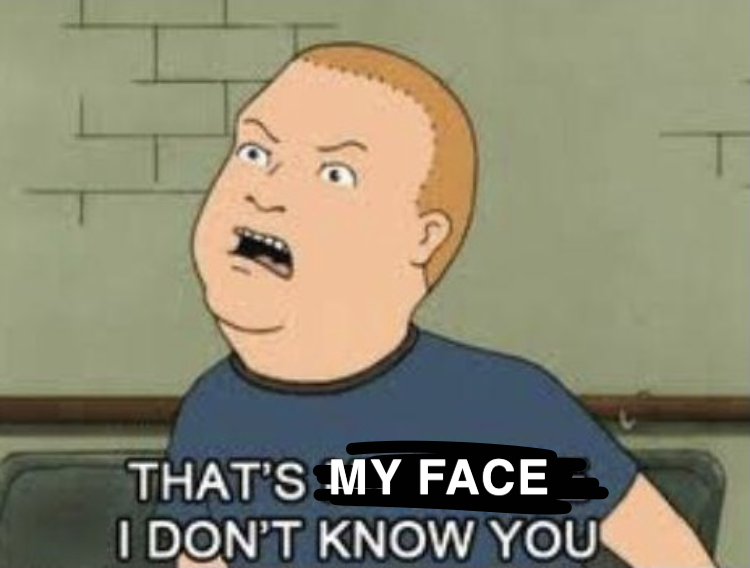
This is (another) photo of Bobby Hill where, instead of saying “That’s my purse, I don’t know you!”, I edited it so he’s saying “That’s my face, I don’t know you!” because I am worried about the alienation people could/can feel when they see their face without makeup as unrecognizable.

I am prefacing this post by saying I barely wear makeup (is slapping glitter on your face “real makeup”?, the next presidential debate topic), I don’t know how to do makeup, but I really think we underestimate the power and psychological issues/potential trauma makeup can create. Granted, makeup can be and is gorgeous/fun because you can accent your favorite features or you can coordinate it with a cool look (i.e. special effects makeup or just a really bold neon green eyeliner), but at what point is it too much? Is it at the point where you have put on a full face for a beach trip? Is it when you have to put on a full face for a gym session? Is it when you’re incapable of seeing yourself/allowing yourself to be seen without makeup, so much so that it dictates how, when, and if you’re even going to be seen in public that day? Or when seeing your bare face strikes actual fear and depression into you? I do not think the idea of seeing your bare face exposed or exposing your bare face to the world, rendering you depressed, disturbed, or even disgusted is given enough space in talking about dismantling body dysmorphia. The alienation experienced at the disconnect of seeing your bare face and not registering it as your own because it has no makeup on it sounds like a trauma response to me. The gym comment is from a conversation I had with a friend. She legitimately could not go to the gym with me (or outside for that matter) without applying at least five different products and I remember pointing out, “dude you’re gonna sweat that off 5 minutes into rowing” and she told me she “wouldn’t allow” herself to go outside without it.

Continue reading

Interracial Relationships

An interracial relationship is when two persons of different races are in a relationship with each other. Interracial relationships has a colorful history that has impacted society in a variety of ways. It has become an increasing common type of relationship that was previously been deterred, frowned-upon, and even criminalized at certain points. Although today’s society has become more accepting towards interracial relationships, there are several ways in which interracial relationships are still seen as wrong.

One of the most commonly discussed and scrutinized types of interracial relationships is that between African Americans and white Americans. Due to the terrible history of racism and the perpetuation of the idea that Africans/African Americans were inferior to white Americans, it became increasingly more important to deter relations between the two races due to the belief in innate differences between the two. Although it is known that race is a social construct and has no biological merit, it has real social implications that impact everyday life and relationships. This can be seen in cases such as Loving v Virginia where banning interracial marriage was finally eradicated in from the law in 1967. The fact that banning interracial marriage was not removed until 1967 showed how important it was in society to keep race relations to a minimum.

The social implications of race still played a significant role in interracial relationships after interracial marriage was legalized. Although it was legally recognized, it was still socially frowned upon. As the United States became increasingly more progressive, the idea of interracial relationships increasingly became more acceptable. However, there are still factors impact these types of relationships including ideas of colorism, becoming a “traitor to your own people”, and the fundamental ideas of racism that has still permeated society despite the social acceptability of interracial relationships.

As an African American woman in an interracial relationship, I have become increasingly more aware of the impact society can have on a relationship. Situations such as being stared at when going out or feeling like I must defend my relationship to others has become something that I have noticed as a part of my relationship. Although race is not a factor to me and has no standing in my relationship, society has created factors that have inevitably made it a part of my relationship. Interracial relationships have become more common in society, but the negative feelings have not disappeared.

Coming out as queer to various loved ones (Pt. 1)

TW: transphobia, homophobia, biphobia

To put my queer experience in a nutshell: I came out as bisexual in 2018, and trans in 2019/2020. In my family, my mom is the only one who knows either. Since coming out and being out to most people, I have felt like a weight has been lifted from my shoulders. I can finally be true to myself and stop living a lie around close people in my life. That does not extend to my father or any part of my extended family. When I say family, I am referring to birth/biological family, but as I say: blood, genetics, nor genes mean shit about who is really family.

Continue reading

Trans Doubt and Acceptance (9/25)


TW: dysphoria

I am trans… or am I??? Part of me knows that I undeniably am. I have had dysphoria for years, although I did not know what dysphoria was or even what being transgender meant. But even still, that tiny voice in the back of my mind likes to sow seeds of doubt in my thoughts. Maybe it’s denial, internalized transphobia, fear, or some other mix of emotions.

Continue reading

The human cost of taboos

I thought at first I was just weak. No one else struggled as badly with their periods. Clearly, everyone could handle these debilitating symptoms just fine. Therefore I was weak for struggling with something so natural. Then I realized there was something very wrong with my body. I would say something completely normal to me and people would react with confusion. At this point, I switched to feeling like a freak. It sounds egotistical, but at the time I had zero information about menstrual cycles. That’s sadly not an exaggeration. Oh, sure public health classes gave those deemed female basic biology information. But any useful information that could help people like me was never given. Like what are reproductive diseases? Or plenty of women struggle with periods its ok. Here are some ways to get help if you need it. Or heck, a simple don’t be ashamed to go to the doctors if you need help!

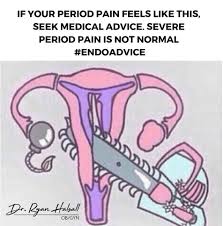
Our society tends to normalize the idea of pain caused by periods. However, there needs to be basic knowledge that such extreme pain is never normal
Continue reading