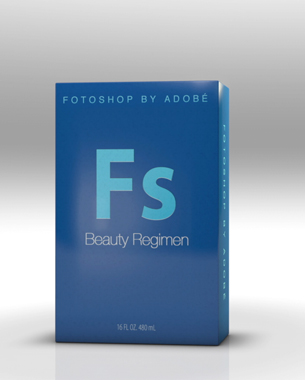
“Fotoshop by Adobé”, and some discourse on how the media excludes our bodies

I’m not sure how much anyone else has been exposed to people telling them to not trust media images in regards to visual accuracy in depicting bodies, but I have heard that quite often. Speeches on how images of bodies shown in the media have incorporated some form of falseness strike a chord with me, but they often seem to be lacking in one important department: a video representation of how much can be altered, in order to visually prove that manufacturing of a “fake”, so to speak, body in the media is possible with the assistance of technology.

I did not realize this until after I had watched Fotoshop by Adobé”, a video directed by Jesse Rosten that does depict photoshop doctoring of bodies. This editing that is portrayed in the video raises quite a few important points to think about, most generally about the erasure of various bodily features/body types by the media.

Towards the beginning, the video shows a “before” portrait of a female with facial wrinkles (which I inferred to be a depiction of an elderly female), as well an “after” image of a female with no such wrinkles (which I thought was a portrayal of a young female). Clearly, any markings on the face, whether they be natural or not, are subject to censorship. Furthermore, elderly bodies appear to be denied a place in media.

Later, the video depicts a doctoring of a magazine cover that features a female with brown skin into someone with lighter skin. This raises awareness about the omission of bodies with skin tones that are not white/of a light shade from the media. Also, people of color’s bodies seem to be excluded.

Further along in the video, there is a portrayal of the reshaping of a female body from a curvy body shape to one that is less curvier, and once again, the delineation gives attention to the media expulsion of such body types.

It becomes clear, after watching the video, just what the media wants us to see in regards to bodies – and what the media is not showing us. The natural states of bodies continue to be reworked to fit a certain ideal: unmarred, young, light skinned, white, and skinny. In doing so, the “normal” becomes abnormal. The truth about what bodies really look like – that they come in a diverse variety – becomes replaced by a lie that only caters to a certain group.

As one article points out, “…Rosten skewers the breathless tone, too-perfect imagery and dense double-speak of beauty-oriented spots and magazine spreads.”
Bald Barbies

Disclaimer: While I have never experienced baldness personally, drawing from the literature on disability and class discussions I felt an affinity with the topic. If I indirectly offend anyone I offer an apology in advance.Image

Recently I’ve noticed a lot of rabble on facebook about a topic I never thought would pop up in my newsfeed: Bald Barbie.

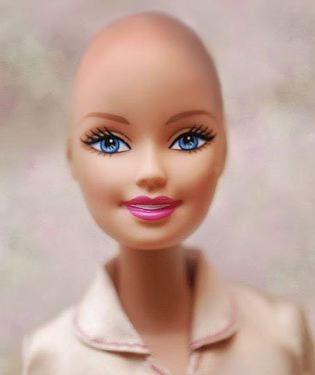
There’s a facebook group dedicated to pressuring Mattel to create the Bald Barbie for children who suffer from hair loss due to cancer as well as Alopecia, and Trichotillomania. Mattel has finally released a statement saying they will create Bald Barbie but it, “will be a friend of Barbie, which will include wigs, hats, scarves and other fashion accessories to provide girls with a traditional fashion play experience.”

Hm. So, the new doll cannot be labeled a “Barbie” and she still has to have fashion accessories which, in my interpretation, (and perhaps this is my raging feminist coming out) means people who have hair loss still have to cover up their scalp since baldness cannot be accepted as normal.

Not only will Mattel’s new doll not be a “Barbie”, she will also only be distributed to children’s hospital for reasons of “directly reaching girls who are most affected by hair loss”. But what about the children who are not in hospitals who have experienced hair loss? And how does a hospital reinforcing to the children that they’re still beautiful actually combat the main message that Mattel sends out to the general public on a day-to-day basis, i.e. beauty has a certain standard, and if you don’t have the hair and body for it, you will never be beautiful.

Could placing the doll on the shelves of a toy store create too much of a sense of normalcy towards hair loss?

From the past course discussions on disability, and the invisibility and inaccessibility that many disabled people have expressed they have experienced; I don’t think that Bald Barbie does much to enhance the lives of children who have experienced baldness.

By only distributing these dolls to hospitals Mattel is stating that baldness is still a disability and is associated only with illness. Mattel could release Bald Barbie in mainstream stores and allow Bald Barbie to be viewed right next to a Barbie with hair but then what message would Mattel be sending to the children that experience baldness? Beauty standards can actually deviate from what Mattel portrays them to be?

If Bald Barbie were to be considered equal and sold in the mainstream market right next to a Barbie with hair I think children who experience hair loss could actually feel acceptance and beauty towards their baldness, especially when Barbie is such an icon for female children for femininity and glamour.

I think Mattel’s creation and distribution of Bald Barbie is just another way to emphasize disability rather than accept it.

Viola Davis: Oscar Loss, Natural Hair Win

Viola Davis, an award winning black actress, recently starred in the movie The Help. At the 2012 Oscars, Viola appeared on the Red Carpet glowing and debuting her natural hair. The media, of course, made this a into a huge story. When asked what made her decide to wear her natural hair to the Oscars, she stated that h

er husband encouraged her to do so.

I believe that Viola Davis was radiant and confident that night. She was absolutely beautiful. Many black women and young girls appreciated seeing natural hair on the red carpet. Wendy Williams, radio talk show host turned television host, did not feel the same way. On her self titled talk show, Wendy Williams insinuated that the Davis’ TWA (teeny weeny afro) made her look mannish, like the history teacher in the 70’s sitcom “Room 222”. At another time, Williams stated that Davis’ hair was just not professional. Many black women were appalled at her statements. They felt that Williams was attacking black women. As you can see in the picture on the left, Davis display of natural beauty was inspirational to black women and girls; and, Williams blatantly shot it down on national television to an audience who probably does not understand natural black hair to begin with.

Black hair has so much politics attached to it. In the past, black women have felt restricted by white beauty standards of straight or wavy hair that is often unnatural to them. I, like many others, am appalled that a black woman would scorn another black woman for displaying her natural beauty. “Natural” hair is our hair. Kinky, curly, wavy, coarse, whatever, it is our hair. I am encouraged by the fact that so many black women have decided to transgress white beauty standards and free themselves from chemical relaxers, letting their own unique beauty shine. Viola Davis certainly took a stand at the Oscars and became even more of an inspiration to black women.

Hijabs and Hoodies

After we discussed the horrific and tragic murder of Trayvon Martin in class today, this article in particular caught my attention:

Shaima Alawadi, a resident of San Diego, California, was found beaten unconscious in her home last Wednesday and died of her wounds this past Saturday.  A note was found saying, “Go back to your own country. You’re a terrorist”.

Shaima was a stay at home mother with five children.

http://www.reuters.com/article/2012/03/28/us-california-iraqi-memorial-idUSBRE82R01N20120328.

This happened less than a week ago.

There was mention in class of how certain ideas in society become normalized, for better or for worse. In Trayvon and Shaima’s case there is no question these ideas create a poisonous environment.

But in both cases there was a similarity: clothing.

Trayvon was wearing a hoodie; which according to sources across the spectrum, most notably Geraldo Rivera, made him a target for suspicion. Last I checked wearing a hooded sweatshirt left no one with the ability to label someone as “suspicious” and cause cruel loss of life to another.

Shaima also had an article of clothing that marked her; a hijab. For those who are unfamiliar with a hijab, it is a head covering traditionally worn by Muslim women for reasons of modesty. Yet by wearing a hijab Shaima marked herself as “other”.

I find myself wondering if we can draw parallels between Shaima’s and Trayvon’s murders. They were both marginalized members of society, Trayvon was black and Shaima was an Iraqi-American immigrant. Both were wearing articles of clothing that are innocuous (although a hijab may stand out for those unfamiliar with the garb) but these clothes became threatening to those with prejudices and stereotypes.

I think we, as a Western society, are not past our cultural and racial biases when two murders are committed within a month of each other on the basis of race and ethnicity, with the flimsy excuses of clothing as reasoning. (By the way, I’m not ignoring that there are far, far too many of these crimes that go purposely unnoticed or are unreported).

In response to this hate crime there has been an out pour on social media and I found a group on facebook that seemed particularly fitting: http://www.facebook.com/pages/One-Million-Hijabs-for-Shaima-Alawadi/137306256397032.

When women are told, “you were asking for it”, if they are raped and happened to be wearing a miniskirt, when young black men are shot for wearing hoodies, and a woman is beaten to death in California for wearing a hijab because it “makes her a terrorist”, I have to wonder about the emphasis placed on clothing and the body-the cycle of violence around the clothing people wear for religious or personal reasons and why people use these articles of clothing as excuses for committing atrocities.

I find myself sick at heart with the violence, the hate, the prejudice, and the inbred bias. I send loving and peaceful wishes to the members of Trayvon Martin and Shaima Alawadi’s families.

“Boobs Don’t Work That Way”

Has anyone come across this tumblr? I really like it.

“Okay, so we want two sexy women on the front cover. Both with tops that don’t cover much and you know what? Maybe one of them is pants-less. Yeah! And have them pose in a really sexy way. Woah, woah woah! What is that? Did you just draw nipples? That’s too far man. Children read these things."

“Boobs Don’t Work That Way” is a “blog about tits and the impossible things artists make them do,” according to the homepage. And it delivers! Each of the 22 pages features numerous renderings of women and their breasts, or I should say, their impossible breasts. Because let’s face it, friends, Real Breasts Don’t Work This Way.

Conversations about our breast-obsessed culture are not new or radical. We know we love breasts, and it doesn’t take a lot of looking around to be reminded of this fact. Breasts are all over the place! On billboards, commercials, movies, magazines, and oh yes, on many of the women we encounter every day. For a lot of us in women’s bodies, we’ve experienced having a conversation with a man and noticing his eyes conversing with our breasts, rather than our faces. I noticed this for the first time when I was about thirteen.

What “Boobs Don’t Work That Way” does that I love is expose some of the absurdity of our breast obsession. Artistic depictions of women’s breasts are often realistic, but this tumblr gives us a cache of the ones that are NOT. And it is refreshing to see someone make fun of these pictures! I mean, they’re so ridiculous! If I were an alien from another world, what would I think if I saw all these pictures? Would I think women have globes of flesh attached to their chests, devoid of nipples? Would I think these globes are perfectly round and humongous compared to their waists? Would I think these globes were detachable? Some of these breasts look like they’re about to fall right off the women who possess them.

And what is particularly interesting about that point what it brings to mind about embodiment. Women who have breasts experience their breasts are part of their bodies, as part of their embodied selves. Women bring their breasts everywhere with them (maybe if they had a choice, they wouldn’t?). Yet pictures like this one obscure this reality. These breasts are for display and affect, and give no indication that they are experienced for any reason other than to tantalize the viewer.

Get Naked to Fight Negative Body Image!

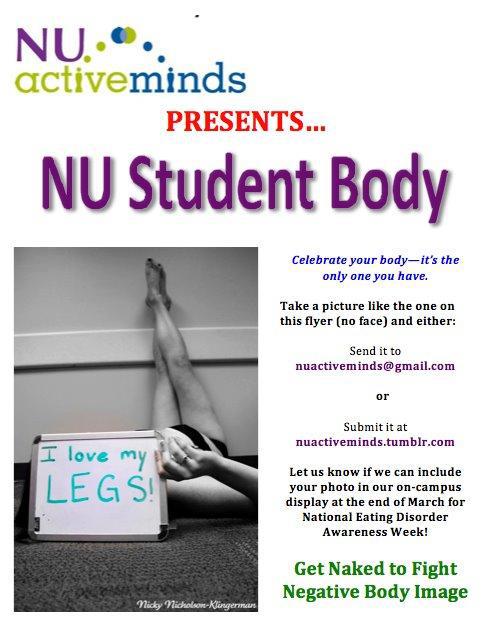
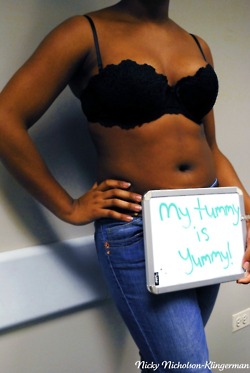
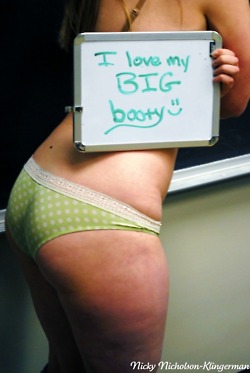
My sister, Lisa, goes to Northwestern University and put the poster to the right on her facebook page. I glanced at it, and immediately loved the idea. A student organization “Active Minds” is asking average students at the University to submit pictures of themselves with their clothing off (without showing anything inappropriate) and without showing their faces to put a cute slogan on a whiteboard or paper and say something positive about that part of their body. I asked her if there were more pictures like the one in this poster. She said yes, go HERE. So I did.

The pictures on this blog are the ones I found on that website. I loved the clever ways people wrote about their bodies and that everyone seems comfortable in their own skin. In a way, it reminds me of the POST SECRET website where people anonymously send in secrets about themselves they’ve never told anyone, and they are viewable publicly on the internet. But unlike PostSecret, this community is just college kids and they’re saying that instead of giving in to the public perception of how bodies “should” be, this is simply the way they are and they’re proud of that and they’re willing to put it in a public place.

I can’t wait to see the kinds of pictures people post, and am also curious to see if anyone will send in a picture of a scar they’re proud of, or if people will send in pictures of their tattoos or piercings like what we’ve discussed in class. I am going to continue to follow this project even after I post this blog and I encourage you to do the same.

The goal of this project by Northwestern University’s “Active Minds” is that they will have lots of pictures of average people who like their bodies the way they are and they will be displayed at the university for National Eating Disorder Awareness Week at the end of March. I couldn’t be happier with this idea.

As a child, I was a ballet dancer, and I was severely underweight. But I thought I looked great because the standard in that environment was, and is, that you are not supposed to have excessive body weight, even in areas like your hips and breasts where you should be gaining weight at puberty. I was exposed to eating disorders at a very young age and know several people who have suffered and nearly died from them.I really like the idea that they’re promoting eating disorder awareness and simultaneously promoting a positive body image. In fact, I like the idea so much I want to start something like this at UMBC. So my question is, if I did, would you join me, and do you think other people would join in?

The Rebellyon

Amanda Palmer (probably my favorite musician, artists, what have you) has a disagreement with the managers of Roadrunner Records, her then point of contact for making music. The short version of  a long story is that for her solo album entitled Who Killed Amanda Palmer? the manager of Roadrunner Records (who also has bands such as Kiss, Korn, Theory of a Deadman, and Nickleback) told her that the video for “Leeds United” would need to be altered because her stomach looked fat. He said according to Palmer, “i’m a guy, amanda. i understand what people like.” The longer version of these events was posted on her blog which is linked here. Amazingly enough, I do believe this is the body he said people would not like:

She proclaimed a return to love the belly, although in her own vanity she was frequently self-conscious of it. After posting a photograph of her belly, many of her fans felt inclined to follow in her actions. At one point there was a website devoted to those pictures (which I can’t happen to find now), but they have been collectively amassed and put on various sites. There have been discussions about how the body should be loved as it is. An interesting take of the Rebellyon is discussed here.

I am actually really saddened by the fact that this occurred because by one man’s standards, the body was judged as if by societal judgement. The amazing thing is that her fan base provided the grounds for substantial protest against the record company (which she was finally able to drop after harsh criticisms). Her body has been put on display by the mediums she works in and it is evident there is a place for politics in this space, but was it fair for the manager to assert the ideal body that her audience would like?

Deceased “Etiquette”

The media heavily covered the death of legendary singer Whitney Houston.  There was much speculation about the circumstances surrounding her death all of which were reported on in the media.  The latest story about the singer’s death is the National Enquirer publishing a photo of the late singer in her casket.  There is an article on Celebritology on the Washington Post which reports on this latest media frenzy.  Where do we draw the line when it comes to respect of the deceased?  Is showing their body in a casket appropriate, especially when her family did not authorize such a photograph to be published let alone taken? 

The singer’s entire life was in front of paparazzi as is any other celeb’s.  But is this same extreme invasion of privacy acceptable after death when the star is no longer her to be a voice for herself?  The media feeling the need to publish such a picture is extremely indicative of  how we view bodies.  Whitney was famous mostly for her voice, however the voice went with the face and body.  At one point in time she was a model, however her notoriety came from her vocal skills and stylings.  So following death people do not separate the two?  The deceased corpse is no longer able to produce the angelic sounds that it once did, however there is such a focus on the body. 

In my opinion it is extremely disrespectful of not only the celebrity but her family as well to post pictures of her body in a casket.  Why does the media feel such a need to be so intrusive into the lives of people?  There should be more of a line drawn between reporting on what needs to be known or what is of interest and respect of the privacy of those being reported on.

http://www.washingtonpost.com/blogs/celebritology/post/national-enquirer-publishes-photo-it-alleges-shows-whitney-houston-in-casket-has-a-line-been-crossed/2012/02/22/gIQAjrrnTR_blog.html

Making “Private Parts” Public

Over the summer I was an intern in the gardens at an intentional community called Heathcote. Intentional communities are essentially communes but the members do not have a shared income or business, so the members have outside jobs.  I instantly felt at home with the members, a group of older radicals and hairy second-wave feminists. One Saturday evening  the community was hosting a hot tub party in their handmade cob hot tub that sits over a fire. Although I was not interested in getting in, considering it was the middle of the summer and extremely hot, I was interested in attending the party to enjoy some conversation and vegan marshmallows. The party was taking place about a 10 minute walk through the woods from where my room was. As I approached I started to notice something was odd, everyone in the hot tub was naked.         I was stunned. These people I had gotten to know so well through everyday interactions were now baring it all in front of me. Going into this internship I was not expecting to see my boss, the intern coordinator, naked. My own reaction to the nudity of the community members was surprising to me. I needed to analyze why I felt so uncomfortable about this.
My first thought was that I felt uncomfortable because no one has warned me in advance that clothing was optional, and perhaps they should have. But, what was the real reason for my discomfort? The human body itself is simply raw material, however it is also packed with meaning given by society. The body is sexualized; society has created a framework in which certain body parts are not to be shown to the public. Even in more enclosed and safe environments, like the one I was in, to many is thought to be eccentric. Sexualized body parts are labeled with words like “private” and are expected to stay that way unless that are being used for arousal.
Something many young people rarely see is a naked average-sized body, imperfections, cellulite, and all. When “plus-sized” women are shown in the media, like in the Dove Campaign for Real Beauty,  the images of the body are distorted with airbrushing, thus creating a false idea of what a “real” body looks like. Because of my instilled sexualized associations and my lack of experience in seeing what real naked bodies look like, my experience at the hot tub party was an awkward one.

Everybody Say, “Baby Bump!!!”

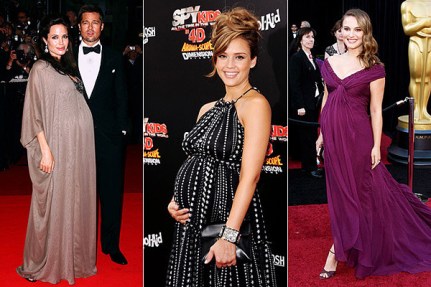
Baby, oh, baby, show us a woman who still thinks style has to suffer during pregnancy, and it’s a pretty safe bet that she hasn’t been keeping an eye on red carpet mamas.

Image

Best Dressed Baby Bumps

The quotation above was taken from this slideshow over at youbeauty.com. When I stumbled upon this slideshow, I was pretty shocked. Hollywood portrays its pregnant celebrities in interesting ways. Hollywood is constantly checking female celebrity’s bodies for “baby bumps” at the slightest appearance of a bulge. That one extra cupcake at a party or that extra french fry could potentially be a baby bump. After a celebrity has finally announced an official pregnancy, before or after they are actually ready to announce it, eyes are constantly on the tummy.

Of course, pregnant superstars cannot let their bodies or their fashion sense slide during pregnancy. Their body is still supposed to look like one of a superstar. The only piece of the body allowed to grow is the belly. The rest of the body is still as sexualized as it was before. Red carpet commentators drool over that motherly glow and growing tummy. Even with the growing bump, these women are supposed to dress to make the public comfortable, not themselves. Instead of maternity sweatpants, pregnant stars instead wear maternity gowns that accentuate the bump for all of the world to take part in her pregnancy.

Superstar bodies are constantly on display, even during pregnancy. Talk about the laboring body! I can only imagine how uncomfortable pregnancy is by itself. Adding on paparazzi cameras, heels, a drapey gown, and keeping a stellar body is way too much! Having a body that is constantly on public display, being praised and criticized, must be a big stress on famous women. What do you think?