Unforeseen Fears

I know the depths of that joy and excitement in planning to have a child, but for me, it’s layered with fear. My partner and I have been having conversations about having a child sometime in our lives but still, there is something like heavy, unshakeable dread. My partner is a Black woman, and the more we forge ahead, the more the stories and statistics about the alarming rates of complications and even mortality that Black women face in childbirth haunt me.

It terrifies me, actually, just to think that only because of a certain somebody whom I hold so dear, she will be at risk because some system is broken and not because the natural risks involved in childbearing are at play. To be so in love and so excited about family, only to be burdened with the fact that for Black women, having children presents a certain unique and profound peril. I imagine her being dismissed, her pain being chided, and my heart goes out.

You wouldn’t know that by looking at us. Still, it is part of my day: visualizing hospitals and staff of medical professionals, creating options, and even finding an advocate to hire, in a desire for her to get the respect, care, and empathy that are due to her. Nothing every plan, every reading, every advocacy can eliminate one terrible fact: Black women in America have added risks due to systemic racism and neglect.

I hate that this fear even exists, that I have to think about it, that our joy is clouded by an injustice so deep it’s shaped by centuries of prejudice. This fear lives here in the quiet spaces: in the way I think about a future, in the way I look at her and feel in my heart the love we share, the life we want to build. It’s in those fears that, on a day that’s supposed to be nothing less than perfect, I’ll have to fight for her to be seen and heard.

We really don’t talk about this enough weight carried by families like ours. I truly hope sharing this brings to light what has been a reality for many but understood by few. This should not happen to anyone, and it is high time things change.
Warning: Fat Lesbian. Do Not Touch

I’ve always been weird about physical touch. Even from a young age, I have been hyperaware of my body in relation to others’ bodies. I have also always been fat. I have also always been queer.

In first grade during cheer practice, I was always the base. Everyone took turns being a flyer, but I stayed the base. Even at 6 years old I told myself I was too big to be lifted. Even at 6 years old I saw my weight as a burden. Even at 6 years old I felt like people would be repulsed by touching me because I was fat.

Growing up, I was always the biggest person in my friend groups. Everyone around me was tiny and cute. They would pile on top of each other and carry each other and joke about being “too heavy”. I stood to the side and watched. If they were “too heavy” then what was I?. There was no way they would want to carry me or let me be a part of the pile. 

From elementary school through middle school, I remained the biggest girl in class. Then in high school, I came out as a lesbian. And I was still one of the biggest people in class. And was still in a friend group of thin people. I would look around and see all the (straight, thin) girls climbing all over each other and being all touchy-feely with each other without reservation, meanwhile I was too afraid to even hug a person or lean on them. No doubt my weight would crush them. I was probably disgusting to them. I didn’t want to be the weird, predatory, fat lesbian at the all-girls Catholic high school. I didn’t want people to see me as that fat dyke who stands too close for comfort (think Big Boo in Orange is the New Black). So I once again distanced myself. I never leaned on someone unless they leaned on me first. I overthought every interaction. My mind went into a panic whenever I accidentally stepped on someone’s foot or grazed their hand or bumped into them. How could I? How could I enter their personal space? How could I repulse them by my presence.

It is this intersection of being fat and queer that I think has held me back from so many relationships, familial, platonic, romantic, sexual, you name it. Da’Shaun Harrison said it best in Belly of the Beast: “The feeling that your gut is figuratively and literally keeping you from experiencing what it’s like to wrap your whole self around someone and for them to do the same to you is almost suffocating” (Harrison 22). Who would want me? I can’t go on a date because I’m a fat lesbian. I can’t cuddle because I’m a fat lesbian. I can’t have sex because I’m a fat lesbian. No one wants to touch a fat lesbian. 

This insecurity is why I allowed myself to be in a toxic friendship/relationship. She called me beautiful. She allowed me to put my weight on her. She initiated physical contact and made me feel like my body wasn’t a burden. I saw past all the toxic things she did because of the way she treated my body, even though she just wanted to use me to experiment with a (fat) lesbian.

This feeling, this anxiety that I ingrained in myself from childhood has been nearly impossible to shake. I am still trying to teach myself that my fatness shouldn’t prevent me from living and loving. Starting small with letting my arm touch my friend’s arm if we are sitting close together. Initiating a hug. Laying my head on my friend’s shoulder. Slowly, but surely, allowing myself to just be a fat lesbian.

When It’s Time for Self-Awareness

Growing up, mental health was just one of those things we never talked about. Within my community, illnesses such as depression or anxiety, or even everyday stresses, were looked at as weaknesses, something you had to bottle inside you or defeat on your own. And I will be honest; I am guilty of once believing the same stereotypes-that people who struggled with their mental health were somehow less capable or resilient. I lived by these assumptions ever since, feeling that if anything similar happened to me, I would simply get over it somehow. Life does not work that way, however, and finally, after a while, I ended up suffering in silence. The burden of all the things was more than I can bear, and then I realized how my beliefs about mental health had been not only wrong but damaging-too much to myself and others.

It wasn’t until I faced my own battles with anxiety and depression that I truly understood how damaging stigma could be. I remember feeling so isolated and ashamed, somehow convinced that I was failing, that I was somehow “weak” for needing help. But in time, through some therapy, support from friends, and my own reflections, I came to learn that struggling with mental health does not make you weak; it makes you human. The shame I grew up with was based on illusions. As I regained my freedom from stigma, self-compassion fostered my journey. Now, I see that there is nothing different between mental health and physical health. And for healing to take place-not just for me, but for everyone-silence and stigma surrounding mental health have to be broken.

Stigma on Mental Illness

In my freshman year of high school when I was either 14 or 15 years old, my mom found out I had depression. Long story short it was through a situation that happened at school and they had to inform my mom about it. Let’s just say that things didn’t go the best. But for a backstory, I grew up in an Ethiopian household which included my mom, sister, and aunt. It is pretty common for most Ethiopian households to be religious, as religion is deeply rooted in the Ethiopian culture. Although my mom and family have always included me in our religious practices and have taken me to church since I was a kid. I have always felt conflicted when it came to our religion (but that’s a whole other story). But going back to high school, when my mom found out I had depression the school had recommended I get a therapist, which I did. The only thing is that since the second I had gotten the therapist, my mom was against the idea. She kept on telling me that therapy would not help me and would say something along the lines of “Just pray and you will feel better” or “Jesus will help you”. This honestly made me feel more of a burden and I felt that something was wrong with me and that I was causing my mom stress and suffering. So after a while of doing therapy and my mom’s persistence, I finally gave up on therapy.

Continue reading

How can I tell if a cis man is a chaser?

Throughout college I’ve had a recurring will-they-won’t-they relationship with a friend of a friend – nothing major, we don’t see each other too often, but we’ve flirted back and forth for a few years now – recently that relationship came to a head, and I found myself confiding in another friend of mine, while catching her up in all the drama I’ve found myself in recently during one of our once-in-a-blue-moon wine nights. As I was regaling her about my situationship, she stopped me halfway. “Wait wait wait, is this guy cis?” As I sheepishly affirmed her assumption she continued “Cause so far this guy sounds like a chaser.” Just a little embarrassed, I took another sip of wine. I had been afraid of that, but didn’t want to think too hard about it. The thought that this guy I had been talking to only wanted me to fulfill some sort of fetish, to have sex with me only for bragging rights, that my body would have been nothing more than a bucket list item for him, it was a good way of making me feel cheap, unloved, unwanted any further than through sex. 

There’s a sort of pressure you feel if you’re a trans person to only date or hook up with other trans people. It makes sense honestly, how can you – as a trans person – be sure that your partner sees you the way you want to be seen? Knows and validates the struggles that you face in your day to day life? Understands the intricacies of your body outside of a cisgendered understanding of the gender binary? Acknowledges the importance of your identity without making it the entirety of your being? Date another trans person. Really it’s best to avoid cis people all together.

Some people, like my friend, are lucky and stumble into a t4t relationship almost accidentally – she and her fiance had been dating for years, before both realizing and coming out as trans to each other around the same time – others find it relatively easy to find and be with other trans people – finding a mystical Goldilocks zone where they’re able to signal to each other that they’re both trans without outing themselves to the cis crowd around them. I, on the other hand, find it to be a herculean task to find a trans partner, possibly in no small part due to – and forgive me if I’m being full of myself here – my ability to pass remarkably well as a cis man. I’ve gotten to a point in my transition where when I come out to cis people, their first reaction is to think I’m a trans woman early on in her transition, instead of a trans man with years of HRT, surgery, and social training under his belt.   

While I have many friends who are trans, just by coincidence I tend to find myself hanging out and partying with cis people, drunkenly telling strangers and friends of friends that I’m trans, seeing their look of surprise, trying my best to answer their genuine questions, listening to my friends roommate – a little drunker than I meant to be that night – tell me that “Really I’m bi, but I never had the chance to try anything out before” as I vaguely register him moving his hand from my shoulder, to around my waist. 

How do I know if a cis man is a chaser? Really it’s best to just avoid cis people all together.

I wish I could give myself a lobotomy

This is gonna be a word salad but it’s actually crazy navigating this world as a person with anger issues, bpd, anemia and autism. I know, girl pick a struggle. To give you a little glimpse into my life. Being anemic is weird. As stated in class, people only think disabilities you can see are valid. And don’t get me wrong if I’m being honest I don’t consider being anemic disabling but maybe I don’t consider it disabling because of that subconscious bias as well. As someone with anemia one thing I do ( as well as others) is when I get up too fast my vision gets fuzzy like I’m seeing circles and static and I have to lean over and sit sometimes even lay down. One could argue that that is disabling. And I could see why because that affects me when I’m working (as a receptionist I’ve had to do that sometimes) when I’m at a conference or meeting or babysitting just anything in life.

Read more: I wish I could give myself a lobotomy

Don’t get me started on having bpd- I sorry un-medicated and untreated bpd. And yes you guessed it ( that is because of finding a psychiatrist and therapist that will take our parent’s insurance). It affects every aspect of my life as well but especially my relationships with other human beings. People think they are accepting and “woke” until your friend goes off and becomes satans right hand man in an argument and then 25 minutes later is like “bro remember this lmfaooooo” like NOTHING happened. I’ve lost friends over it. And I’m not okay with it. I’m not. I’m not gonna sit here and lie to you guys and be like it’s whatever it’s there loss. No my feelings are hurt and I wish I didn’t have this in my brain. It’s almost kinda debilitating. But idk it feels wrong to call it debilitating because that feels reserved for things like schizophrenia, Down syndrome, paralysis etc… I wish I could just take a pick and fix my brain and be normal. Yes I said it. Don’t believe these people- having mental illnesses is not normal and that’s okay. It’s not a bad word.

Read more: I wish I could give myself a lobotomy

And to TOP IT ALL OFF god just had to make me neurodivergent as the final touch. Everyone in my family is neurodivergent. From my mom to my dad to me and my little sister. Shit we think the dog is too 💀. But it’s so crazy cuz the reason my parents (mainly my dad) never had anything done about it was because not just because they didn’t have the money, but also the community they’re in. It’s already bad enough society is so 👀 about being autistic and then you have the black community which is like worse towards people who are different. For lots of black people who have autism/neurodivergent or physical disabilities, our first and main bullies are the people who look like us, talk like us, dress like us, worship like us. It’s so alienating. Don’t worry it’s gotten better because of the newer generations but it’s just like damn can we catch a break . It’s a good thing this is not an on paper assignment cuz there’d be tears stains all along the page😹.

Waking up in a new world

I dont really know where to begin. I remember as though through a haze… the feeling of mingled anticipation, dread, and sense of unreality leading up to the 2024 election. Logic said no, of course good must prevail, we can’t lose. Look at the numbers, I thought, there is no way this can go astray after the statistics of 2016 and 2020. If I’m being honest, it’s been days and it still doesn’t feel real. I woke up on November 6th in a different world, and Ive been going about my life, waking and sleeping and waking again feeling like I’m still in a living nightmare and it just simply can’t be real. 

Lives were dismantled on Wednesday. My outlook on the rest of my life and on the entire world changed. 

I remember waking up, rolling over, and checking my phone, a bit apprehensively. The first thing I remember processing was a text from my aunt saying how sorry she was for my generation, and how we will find a way rise above. The second I saw it I knew, before I even read the dozens of other messages. 

I immediately had a panic attack. 

I texted my girlfriend.

I called my mom.

I don’t think I’ll ever forget that morning. 

I remember panicking the night before, just anticipating the results with my girlfriend. My girlfriend is a hispanic immigrant, an amazing female athlete who came to America to pursue her dreams. I knew what this election could mean for her very directly.

I knew what it could mean for every immigrant, every queer and trans person, every woman, every minority living in this country. 

This country that was built on native land. 

Built on the dream for a better future, a better democracy. 

A place for people to come from all walks of life to live the “American dream”.

What happened? 

When did it go so wrong?

 I think we have lost the definition of patriotism. These self centered, bigoted, so-called patriots who claim to seek salvation for their country… How don’t they see it? 

Is it so easy to follow along, to parrot what you’re told by The Man?

Were this many people really just waiting for someone to come along and validate their hatred and say, “no please, go ahead, it’s ok to be a bigot and oppress that which you do not understand”? That which doesn’t have quite literally anything to do with your life. Individual and private parts of other people’s lives

I really don’t understand what happened, I don’t understand the logic, I don’t understand how we got here, I will simply never understand the hate. 

I fear for my country, for every person less fortunate than me. For my girlfriend. For my friends. For every young girl growing up in a world teaching them that they actually cannot achieve anything. That they are objects. I fear for all those stuck in deeply red states who have to worry for their safety every day. I fear for everyone who is in danger of losing their home. Their rights. Their fundamental human rights. And really, I fear for everyone living in ignorance. What a sad existence it must be to live a life governed by hatred. To lack the privilege of independent thought. Now though, it is time for those of us who can to fight, and keep fighting. We may not live to see the future that we are fighting for, but it is crucial that we carry on. It’s not about us, maybe it never has been. But we are strong. And we are living in this world which is demanding us to take action. I am tired. We are tired. But it is never easy. Yet when we fight for love and we fight for hope, and when we fight together, we truly embody our full power and I have faith that we can make that future that we dream of.

The art of bodies

Do you ever notice how easily influenced this generation is? The power that influencers hold over “Gen-Z” is huge. These influencers often overlook the power they hold. The podcast episode “Ozempic” is a perfect example of the trend of wanting to be thin has become widely popular. Most of the audience on social believed that influencers are using this type 2 diabetes drug to lose weight. Over 50 influencers who drastically lost weight have been accused of using this drug and many of them won’t deny that they haven’t used it.

Influencers who constantly post updates about their daily lives disregard the power they hold over other individuals who look up to them as inspiration. If they are magically losing weight and ignoring comments to address tips they’d suggest to help their audience who are struggling, this will lead to negative stereotypes about body image. I wonder if influencers feel offended by their audience making assumptions or if they acknowledge the mindset they are putting out to everyone? If so, why not address it instead of ignoring it? Is it to gain more popularity?

Normal/desirable bodies are the affect that come from losing weight so suddenly. Why does one need to have extreme weight loss to be appealing to a crowd or feel beautiful? “More weight loss than any previous generation of weight loss drugs and we’ve had this immediate huge wave of media being like is this the end of obesity does this invalidate body positivity”. This quote from the podcast highlights how media will encourage one another to love their body and embrace the flaws yet, they will say this is the cure to losing fat. We need to do better…

Understanding Autism and Neurodivergence: My Sister’s Journey

Autism: autism spectrum disorder (ASD), is a neurodevelopmental disorder characterized by repetitive, restricted, and inflexible patterns of behavior, interests, and activities and persistent deficits in social communication and interaction.

Neurodivergence:  people whose brain differences affect how their brain works

Autism and neurodivergence have always been a part of my family’s life, and navigating these experiences through my sister’s journey has taught my family and I so much about the importance of understanding and acceptance. Growing up, my sister always felt a bit different from her peers. Social interactions were often challenging for her, and she had intense interests that set her apart. It wasn’t until later in her life that she was diagnosed with autism. This revelation was both a relief and a catalyst for self-acceptance. Understanding her neurodivergence allowed her to embrace her unique strengths and acknowledge the areas where she needed support.

As I continue to educate myself on said topics I learned that one of the most significant challenges for autistic individuals, including my sister, is the tendency of society to infantilize them. This concept, extensively discussed by Jennifer L. Stevenson, Bev Harp, and Morton Ann Gernsbacher in their work, highlights how autistic people are often perceived and treated as less capable or childlike. This infantilization can lead to a lack of autonomy and respect, further perpetuating the stigma and misunderstandings surrounding autism. On the contrary Damian Milton and Lyte’s work on the normalization agenda and the psycho-emotional disablement of autistic people sheds light on the harmful effects of trying to “normalize” autistic behavior. The pressure to conform to neurotypical standards can be damaging, leading to feelings of emotional distress. It’s important to recognize that neurodivergent individuals, like my sister, have unique ways of experiencing and interacting with the world, and these differences should be celebrated rather than suppressed.

With that, I think in order to truly support autistic individuals, we must move beyond the stigmatizing narratives that surround autism. Understanding autism as a form of neurodivergence rather than a deficit allows us to appreciate the diverse ways in which people think, feel, and communicate. Education and awareness are crucial in breaking down these barriers. By fostering open dialogues and promoting acceptance, we can create a society where everyone is valued for their unique contributions. It’s crucial to listen to the voices of those who live these experiences every day. Their insights and stories are invaluable in shaping a more inclusive future. Challenging the stereotypes and misconceptions that surround autism and work towards a world where everyone feels seen, heard, and respected.

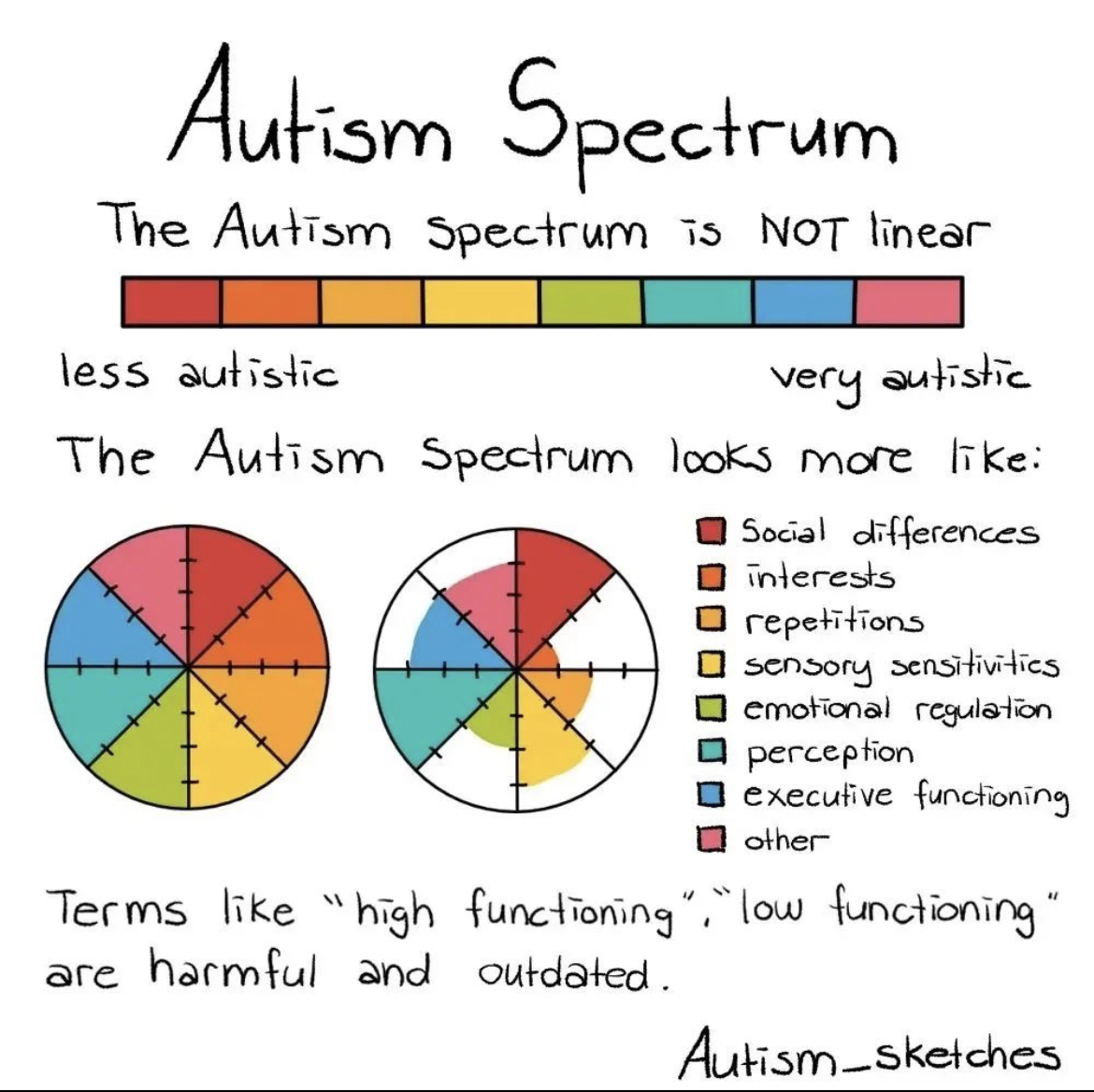
Below is the autism spectrum color wheel designed to help individuals with autism spectrum disorder (ASD) identify, express, and communicate their emotions and needs. It bridges the internal emotional landscape of a person with autism and the external world, providing a common language for understanding and interaction. The color wheel is particularly useful for individuals who are visual learners and process information more effectively through images, colors, and visual representations rather than verbal or written instructions. It can help reduce anxiety by providing clear, predictable information, enhance understanding of abstract concepts, improve independence in daily activities, and facilitate communication between individuals with ASD and their caregivers, educators, or therapists.

-Santana A 😕