I’m fat. I’ve been fat. I will be fat. Fatness is just another item on the laundry list of my descriptors, and yet it is always at the forefront of my mind. I find myself reflecting on a meal debating my total carb versus fiber versus protein intake despite having stopped macro counting years ago. I quite literally cannot or it sends me into an episode of hypomania. And yet I still find myself falling into my old unhealthy habits and I can’t seem to stop wondering why. I have an incredible community, some fat some not, who operate and speak in ways that have nothing to do with weight. My opinion on my body tends to lean positive. And I’m sure you could bring up the fact that social media, especially TikTok, is slowly transforming into ED tumblr 2.0 – every other post being a scary WIED or thinly veiled body checks under the guise of an outfit video. But I think there’s something more there. I think fatness, moreover, a fear of fatness is so deeply ingrained in our culture that there’s nothing I can do to escape it. I find myself stifling my labored breaths after trekking up 5 flights of stairs, tugging at the corners of the clothes, sucking it in, all in an attempt to “feel better” about myself. I live in constant fear of people “finding out” that I’m fat. Newsflawsh, buddy I am fat. Anyone who can see me knows this and in that reminder I find myself more free than I ever have been.
Ft. A poetry video I used to love in 2014 (a little cringe now but powerful nonetheless — same content warnings)
Although I haven’t formally been diagnosed with autism, the understanding is that if you feel as though you have autism you should treat yourself as if you have autism. As the Stevenson article discussed the infantilization of autism erases the existence of autistic adults. But, here I am an autistic adult. I can discuss my experiences with autism.
I did not have any experience with ABA therapy. At best it seems controversial at worst it looks problematic. As we discussed in class if we have adult autistic representation in the ways of them talking about their experience with ABA therapy and how destructive it can be. Then, this would lead to a capitalist problem, in that, it would lead to the multibillion-dollar industry of ABA therapy to its demise.
Growing up I would stim, have trouble with eye contact, not understand or be able to read emotions, and was just in general weird. Not to associate negatively with the word weird just like atypical, not a part of the norm, not “normal.” Whatever that means. No one noticed. Maybe I became really good at masking? Later in life, I thought I had ADHD, another invisible disability, this explained the stimming, but not the other symptoms. But, here I am an autistic adult. And I’m confused about what I should do in the future. A diagnosis is much too costly and I don’t know if it would help. I guess I will just be emboldened by community.
In light of our recent readings, I wanted to dedicate this post to my dear friend (without spilling too much of her tea). Obviously, this post does not even come close to embodying our 10 year friendship.
We met in high school, and I knew from the beginning that my friend was someone special. There was a fire in her soul, similar to mine, and we were destined to be lifelong friends. She was chaotic, messy, and downright sassy but most of all she was kind. As close as we were, I could tell she was holding something back, like a part of her had not been unleashed yet. A beautiful butterfly yet to emerge from its cocoon.
The changes were gradual, from experimenting with makeup to doing drag for the first time. Each step of the way I was there to support her and supply her with anything materials she may need or want to try. I remember feeling so grateful that I had such a unique and special friendship with her. She trusted me to be a part of her journey. And over the years, I had the privilege of watching her blossom into her true, authentic, and unapologetic self.
However, the transition wasn’t easy and there were struggles. I watched as her family tried to tear her down each step of the way, unable to accept her. Already a family of gay sons and lesbian daughters, but a trans daughter? That was unacceptable. Family members, straight and queer, struggled with using her new preferred pronouns and chosen name, both out of habit and resistance. After years of confrontation and conflicts her family eventually grew to accept and understand her. I believe that they were afraid because of what they did not know or understand at the time. Fear of the unknown.
I do not want to put too much of her life on blast but being her friend through this beautiful yet challenging journey has taught me so much. I’ve learned about resilience, about self love, and about the POWER of living as your true self, no matter what comes your way. I’ve seen firsthand that everyone deserves to be celebrated for who they are, not for who the world expects them to be. I am endlessly proud of her and her strength to move mountains. My friend you are so loved and I will always support you no matter what.
As a Black woman, I feel like I’m always pushing myself to do better whether it’s excelling in school, handling multiple jobs, or meeting life’s demands. But along with all of this, society expects me to stay strong, composed, and, above all, to “look good” no matter the circumstances. “Being Black and Looking Good While Chronically Ill” reminded me of how “looking good” often makes people overlook the emotional struggle behind the polished surface. While I don’t have a chronic illness, I can definitely relate to the pressure of presenting a flawless image for everyone else’s comfort. The burden of “looking good” isn’t just about appearance, it’s about hiding our real selves. We’re expected to show up as perfect versions of ourselves, and anything less risks being judged or dismissed. The emotional toll this takes is real. It’s draining to keep up a facade of strength when, inside, I’m just trying to survive like everyone else. I sometimes wonder: If I let my guard down and show my vulnerable side, will people still see me as capable? Or will they think I’m less valuable because I no longer fit the image they’re comfortable with?
The pressure to always be strong is exhausting. In “You Are Not Entitled to Our Deaths”, the author talks about how society demands marginalized people, especially Black women, to sacrifice their own needs for the comfort of others. This really resonated with me because I’ve felt that exact pressure to hold it all together, no matter how much it costs me. But through these readings, I’m starting to realize that real strength doesn’t mean hiding my true self. It’s about showing both my resilience and vulnerability. Let’s stop pretending to be perfect. True strength lies in embracing both our power and our humanity—because we are enough, exactly as we are. And maybe, just maybe, it’s time to stop pretending for others and start living for ourselves.
Since I was a wee little lad I have always felt a sense of otherness between me and other kids. Having no friends throughout elementary school certainly did not help this sentiment. Being constantly told you’re annoying, you’re loud, you’re a troublemaker and this is excluding the comments made on my general appearance. All this tends to take a toll on the mind. To my knowledge I don’t remember being disruptive in school but according to my teachers asking too many questions is an offence as well as being generally under stimulated with their slow paced classes and I couldn’t get in any higher classes due to my test anxiety. My earliest memory of ever interacting with anyone autistic was my mother best friends daughter. She was this cute little girl same age as my brother. I noticed she didn’t talk she made sounds to indicate if she wasn’t comfortable with something but none of it really bothered me we just vibe. Her mom seemed really happy that we got along. However when I on my way back home my mom gave me and my brothers a lecture about thank god that we are ‘normal’ and to make sure we don’t have kids to late so they don’t end like ‘that’ and all I could think about was how heartless to describe such a sweet child like that.
As i continued to grow up that strange sense of otherness didn’t disappear I just learned to ignore and try and act more like the people around me so that way I felt less out of place. In middle school i had made friends with a person who I thought shared a similar sense of strangeness and I confided to them about my fears of being perceived as strange and they told me they didn’t find me strange and thought I acted pretty similar to them and told me that I might have adhd like them. After that I spent several nights researching symptoms and signs and reading about peoples experiences with adhd and how they knew they had it and once I felt confident enough I brought up these concerns to my mom. What i failed to realize is that my mom is a west african pentecostal christian and if there’s one thing christians love to do its ignore real world problems. So obviously when I told my mother I wanted to get tested she got mad and defensive and insisted that she couldn’t have given birth to a ‘wayward’ child. After that I never asked again till this day I still wanna get tested its just a matter of when cause.
We had a reading titled the “Normalization Agenda and the Psycho-Emotional Disablement of Autistic People” this reading kinda heightened my fears about being confirmed to have adhd because really what would a therapist do about it? Give me Pills? Tell me to just fit? I’ve already been doing that. The author talks a lot about how a lot of neurodivergent people are just treated like afterthoughts in society and are taught to conform and if they dont they risk being seen as social pariahs and “disruptions” in the world of the neurotypical and Ive already spent a large part of my life being seen as a disruption and socially awkward weirdo so I just feel like medications or telling me how to adapt is gonna make it any better. But who knows mabye if I eventually come around to that therapy thing Ill find a therapist who’ll change my mind until then
I know the depths of that joy and excitement in planning to have a child, but for me, it’s layered with fear. My partner and I have been having conversations about having a child sometime in our lives but still, there is something like heavy, unshakeable dread. My partner is a Black woman, and the more we forge ahead, the more the stories and statistics about the alarming rates of complications and even mortality that Black women face in childbirth haunt me.
It terrifies me, actually, just to think that only because of a certain somebody whom I hold so dear, she will be at risk because some system is broken and not because the natural risks involved in childbearing are at play. To be so in love and so excited about family, only to be burdened with the fact that for Black women, having children presents a certain unique and profound peril. I imagine her being dismissed, her pain being chided, and my heart goes out.
You wouldn’t know that by looking at us. Still, it is part of my day: visualizing hospitals and staff of medical professionals, creating options, and even finding an advocate to hire, in a desire for her to get the respect, care, and empathy that are due to her. Nothing every plan, every reading, every advocacy can eliminate one terrible fact: Black women in America have added risks due to systemic racism and neglect.
I hate that this fear even exists, that I have to think about it, that our joy is clouded by an injustice so deep it’s shaped by centuries of prejudice. This fear lives here in the quiet spaces: in the way I think about a future, in the way I look at her and feel in my heart the love we share, the life we want to build. It’s in those fears that, on a day that’s supposed to be nothing less than perfect, I’ll have to fight for her to be seen and heard.
We really don’t talk about this enough weight carried by families like ours. I truly hope sharing this brings to light what has been a reality for many but understood by few. This should not happen to anyone, and it is high time things change.
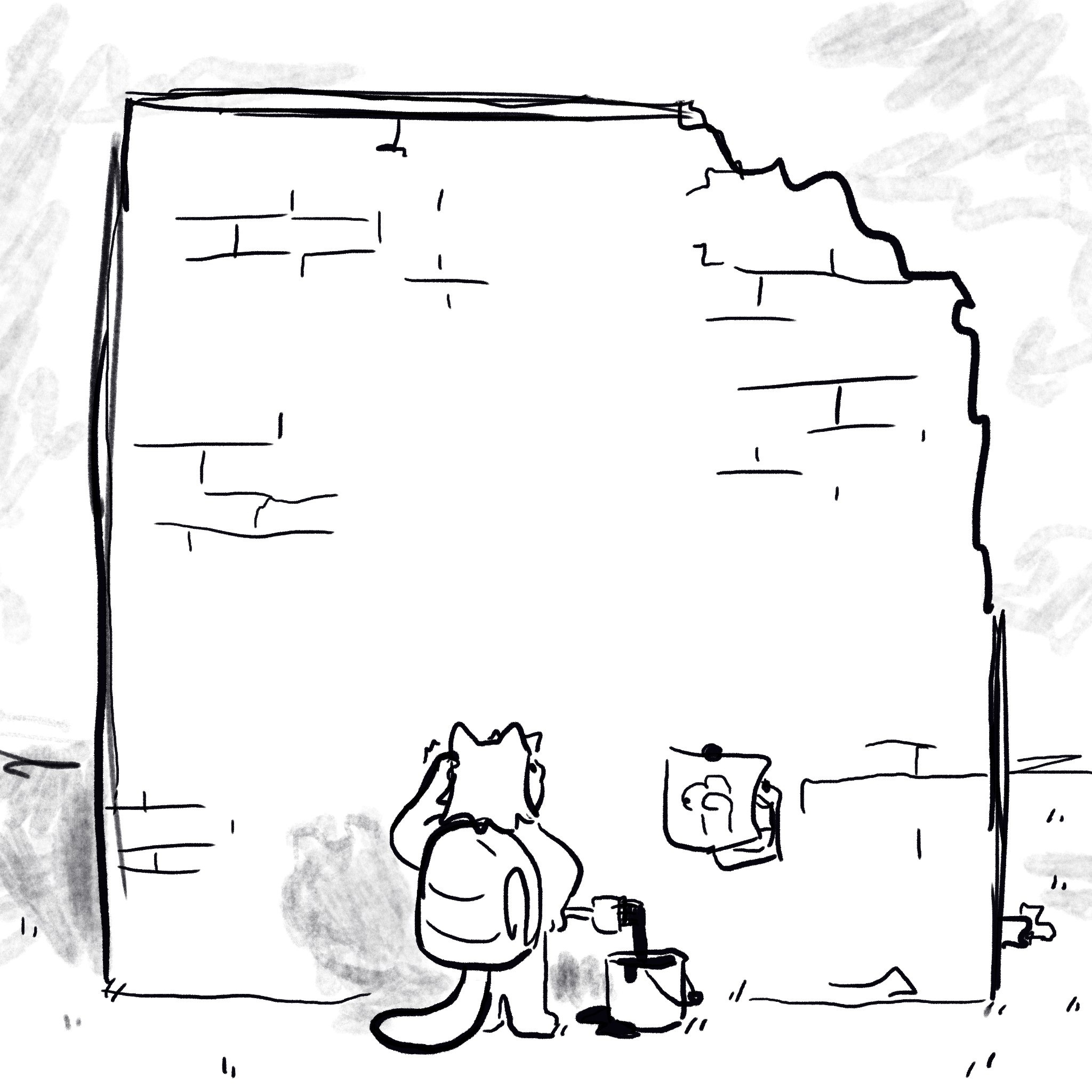
A quick sketch I made for this post. This is a very toned-down version of where I’m at. (photo ID: a black-and-white sketch of a small humanoid “snailcat” with his back, shell, and tail to the viewer, holding in one hand a paintbrush with black paint over a bucket while scratching his head with his other hand. he is staring at a brick wall, his shadow over it to his left and a couple of minimally detailed posters to his right.)
Whenever something big and horrible happens, one of the biggest coping mechanisms I have is to redirect any overwhelming crushing despair or anxiety I have about it into doing my part, and doing what I can. I’m an artist, so I know I can make art about it, and I’m a GWST scholar, so I know I can write about it.
That is, I would be able to. IF I DIDN’T HAVE SO MUCH WORK TO DO.
I am unemployed and taking 15 credits this semester, 3 of those including an (UNPAID!) internship where I have to produce 55 entire pages of full illustrations, 5 of which have animated components. I am 3 whole weeks behind on that work, and my timing should work out but it is going to be awful and crammed and I feel sick just thinking about how much catch-up I have to do. I’m not getting paid but it’s good work that I can use in a future portfolio, and it’s for a good cause (books suited to an older reader demographic while providing illustration and comprehension assistance for readers with cognitive disabilities). Meanwhile in my actual classwork I have a major final project with a deadline coming up alarmingly soon that I want to get perfect because it’s an analysis of a video game (ULTRAKILL) and topic (Jack Halberstam’s Queer Art of Failure) that I really care about. So I am already diverting energy into two interdisciplinary activist/GWST-related things I genuinely want to get exactly right. And I feel confident in saying that I am Burnt Out.
All of this was already stressful before, you know. WEDNESDAY NOVEMBER 6TH 2024.
My social media pages that day were full of posts encouraging me to get organized, make art, write thought pieces detailing my unwillingness to give in to the doom and roll up my sleeves. And I would love to participate in any movements that are mobilizing in the context of The Horror That Is Unfolding Before Our Eyes. I know I have the skill to contribute art and work beyond just sharing resources and mutual aid drives (though that is always helpful). And I know I shouldn’t hold myself to the standard of a “good” project being one that is always perfect and brilliant and revolutionary. But in times like this the pressure to make art that perfectly encapsulates the rage just adds to the crushing pressure of the world itself.
It’s a rage I fear I can’t put into words, and seeing all of the art and performance work in disability activist movements we’ve been looking at for class makes me feel like I have something to live up to. But that potential I have is shrouded by the labor required to survive, to get a job, to build a portfolio, to get a degree. And I am grateful that this is labor I can direct passion into, but man I wish it was easier. I wish I had time!!!!!!!
(all this being said, the first thing im doing once i have time is making a sticker with shadow the hedgehog holding the trans flag and saying a raw as hell quote from sonic ’06 so if thats something that interests you, keep an eye out!)
I’ve always been weird about physical touch. Even from a young age, I have been hyperaware of my body in relation to others’ bodies. I have also always been fat. I have also always been queer.
In first grade during cheer practice, I was always the base. Everyone took turns being a flyer, but I stayed the base. Even at 6 years old I told myself I was too big to be lifted. Even at 6 years old I saw my weight as a burden. Even at 6 years old I felt like people would be repulsed by touching me because I was fat.
Growing up, I was always the biggest person in my friend groups. Everyone around me was tiny and cute. They would pile on top of each other and carry each other and joke about being “too heavy”. I stood to the side and watched. If they were “too heavy” then what was I?. There was no way they would want to carry me or let me be a part of the pile.
From elementary school through middle school, I remained the biggest girl in class. Then in high school, I came out as a lesbian. And I was still one of the biggest people in class. And was still in a friend group of thin people. I would look around and see all the (straight, thin) girls climbing all over each other and being all touchy-feely with each other without reservation, meanwhile I was too afraid to even hug a person or lean on them. No doubt my weight would crush them. I was probably disgusting to them. I didn’t want to be the weird, predatory, fat lesbian at the all-girls Catholic high school. I didn’t want people to see me as that fat dyke who stands too close for comfort (think Big Boo in Orange is the New Black). So I once again distanced myself. I never leaned on someone unless they leaned on me first. I overthought every interaction. My mind went into a panic whenever I accidentally stepped on someone’s foot or grazed their hand or bumped into them. How could I? How could I enter their personal space? How could I repulse them by my presence.
It is this intersection of being fat and queer that I think has held me back from so many relationships, familial, platonic, romantic, sexual, you name it. Da’Shaun Harrison said it best in Belly of the Beast: “The feeling that your gut is figuratively and literally keeping you from experiencing what it’s like to wrap your whole self around someone and for them to do the same to you is almost suffocating” (Harrison 22). Who would want me? I can’t go on a date because I’m a fat lesbian. I can’t cuddle because I’m a fat lesbian. I can’t have sex because I’m a fat lesbian. No one wants to touch a fat lesbian.
This insecurity is why I allowed myself to be in a toxic friendship/relationship. She called me beautiful. She allowed me to put my weight on her. She initiated physical contact and made me feel like my body wasn’t a burden. I saw past all the toxic things she did because of the way she treated my body, even though she just wanted to use me to experiment with a (fat) lesbian.
This feeling, this anxiety that I ingrained in myself from childhood has been nearly impossible to shake. I am still trying to teach myself that my fatness shouldn’t prevent me from living and loving. Starting small with letting my arm touch my friend’s arm if we are sitting close together. Initiating a hug. Laying my head on my friend’s shoulder. Slowly, but surely, allowing myself to just be a fat lesbian.
Growing up, mental health was just one of those things we never talked about. Within my community, illnesses such as depression or anxiety, or even everyday stresses, were looked at as weaknesses, something you had to bottle inside you or defeat on your own. And I will be honest; I am guilty of once believing the same stereotypes-that people who struggled with their mental health were somehow less capable or resilient. I lived by these assumptions ever since, feeling that if anything similar happened to me, I would simply get over it somehow. Life does not work that way, however, and finally, after a while, I ended up suffering in silence. The burden of all the things was more than I can bear, and then I realized how my beliefs about mental health had been not only wrong but damaging-too much to myself and others.
It wasn’t until I faced my own battles with anxiety and depression that I truly understood how damaging stigma could be. I remember feeling so isolated and ashamed, somehow convinced that I was failing, that I was somehow “weak” for needing help. But in time, through some therapy, support from friends, and my own reflections, I came to learn that struggling with mental health does not make you weak; it makes you human. The shame I grew up with was based on illusions. As I regained my freedom from stigma, self-compassion fostered my journey. Now, I see that there is nothing different between mental health and physical health. And for healing to take place-not just for me, but for everyone-silence and stigma surrounding mental health have to be broken.
In my freshman year of high school when I was either 14 or 15 years old, my mom found out I had depression. Long story short it was through a situation that happened at school and they had to inform my mom about it. Let’s just say that things didn’t go the best. But for a backstory, I grew up in an Ethiopian household which included my mom, sister, and aunt. It is pretty common for most Ethiopian households to be religious, as religion is deeply rooted in the Ethiopian culture. Although my mom and family have always included me in our religious practices and have taken me to church since I was a kid. I have always felt conflicted when it came to our religion (but that’s a whole other story). But going back to high school, when my mom found out I had depression the school had recommended I get a therapist, which I did. The only thing is that since the second I had gotten the therapist, my mom was against the idea. She kept on telling me that therapy would not help me and would say something along the lines of “Just pray and you will feel better” or “Jesus will help you”. This honestly made me feel more of a burden and I felt that something was wrong with me and that I was causing my mom stress and suffering. So after a while of doing therapy and my mom’s persistence, I finally gave up on therapy.