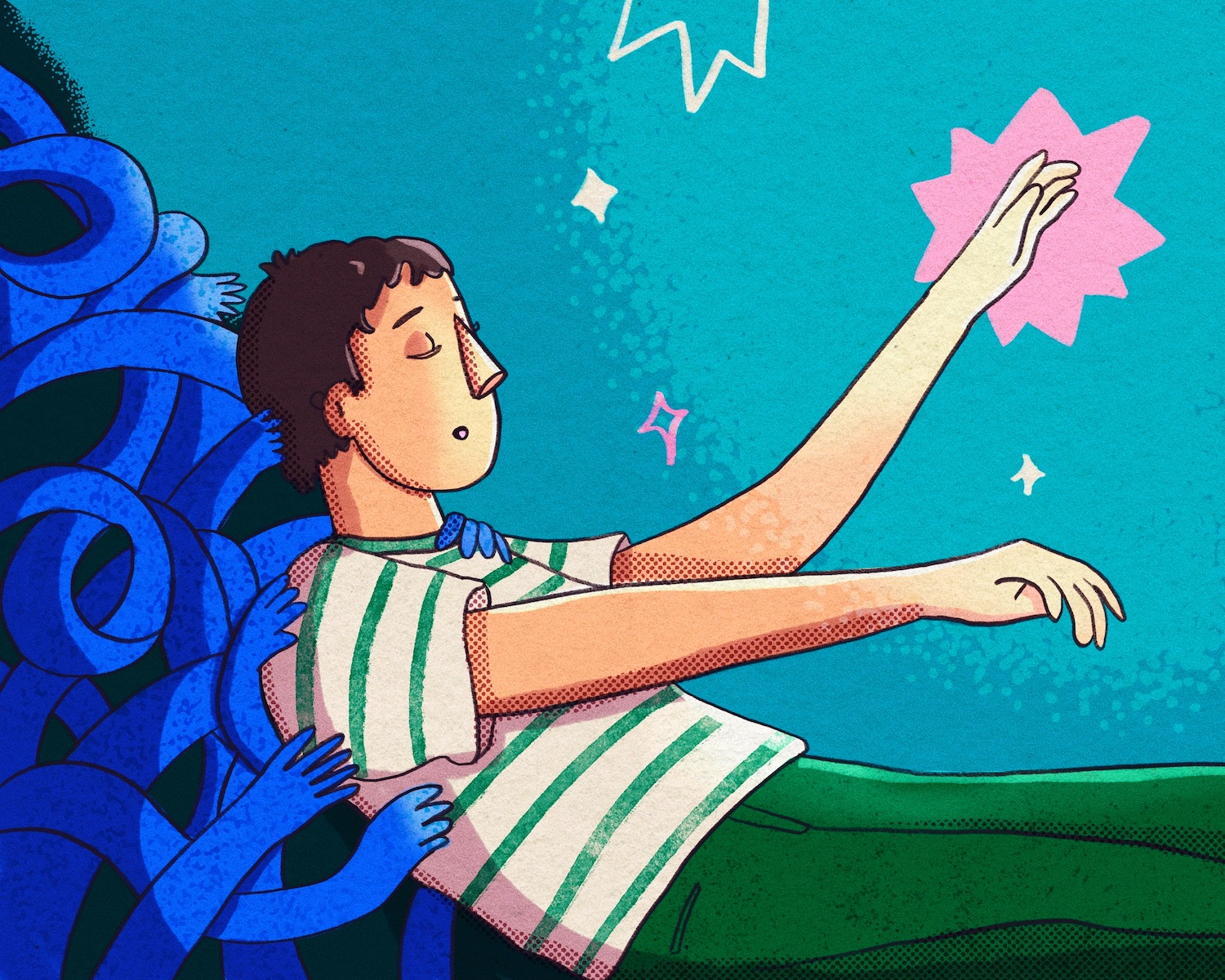
I learned about this in another class and found it to be very relevant to this class. In general, Emily Martin’s The Egg and the Sperm: How Science Has Constructed a Romance Based on Stereotypical Male-Female Roles, talks about how the language in medical textbooks reinforces patriarchal views of men’s and women’s roles in reproduction. Enjoy!
In Emily Martin’s The Egg and the Sperm, she asserts that even when we learn about basic biology, such as eggs and sperm, these notions from the patriarchy are reinforced. This subtle but very deliberate assertion is intentional. It reinforces gender norms and says that the sperm is dominant while the egg is submissive. The sperm travels through the female reproductive system and penetrates the egg. This is very much a Western idea. Now, modern research has found that the egg is the dominant one. Instead of the sperm penetrating the egg, the egg, “traps the sperm and prevents their escape.” (Martin, pg. 493)
The reason these narratives are so problematic is because it devalues the egg’s role in reproduction and, in doing so, reduces the whole female reproductive system and women in general and vice versa. Other things also reinforce this. Like how menstruation is viewed as a failure. The language medical textbooks show menstruation, “as a chaotic disintegration of form, complementing the many texts that describe it as “ceasing,” “dying,” “losing,” “denuding, “expelling. ” (Martin, pg. 486) As if a women’s role is purely reproductive and she is deemed useless or otherized when she is dealing with a completely normal biological function.
Reference
Martin, Emily. “The egg and the sperm: How science has constructed a romance based on stereotypical male-female roles.” Signs: Journal of Women in Culture and Society, vol. 16, no. 3, Apr. 1991, pp. 485–501, https://doi.org/10.1086/494680.
In Alcoff’s piece we learn about the three basic pastimes for understanding race and one of them being essentialism. In essentialsim the key piece is that racial identities are stable across time and space. And that is not true. And I say that is not true because of factors like time period and location. Identities like African-American, Afro Latino/Caribbean are new identities. They are literally only identities because of the transatlantic slave trade. 450 years ago African-American Afro Caribbean Afro none of those things were being used by anyone because they were not terms until mid 1600s . As an African-American woman myself one thing me and my Caribbean or Latino friends always talk about is that there’s somewhat of a disconnect between us and Africans because Africans are like lucky in a way. They are going by the original term. Yes there was death and destruction and colonization for them but they have that tiny fact that they didn’t get shipped off to other continents. They got to keep the OG term. Technically we should just be African or even like the term black woman back in 1191 and 1347 no one was using that. Same with people in Malaysia and they weren’t saying oh I’m Malaysian/ I’m a south east Asian they went by their tribal identification. All those terms like black girl, asian girls, etc…
Last night I started rewatching an anime called “Soul Eater”. When I first watched the show in Middle School I easily fell in love with it and binge-watched the show over the course of 3 weeks. I found the show interesting with its storyline and also loved the two main characters, Maka and Soul. I just started rewatching the show last night and the way that I’m only less than 10 episodes in and the amount of fan service is actually ridiculous. I know you guys probably know what I mean by “fan service” but it’s basically the “material in a work of fiction or in a fictional series that is intentionally added to please the audience, often sexual in nature, such as nudity.” Fan-service in anime is really common and I feel as though it’s especially common in anime’s that are action based like Fire Force, Fairy Tail, One Piece, Seven Deadly Sins, etc. I think the reason why most action-based anime have a lot of fan service is because the majority of viewers are male.
I recently saw an Instagram reel from @arlenezhxo where she shows her original outfit and then adorns this oversized shirt with Kermit the Frog wearing a Santa hat over it. With the text on the screen saying, “shoutout to my subway shirt” and the caption saying, “what’s ur subway shirt?” Here it is: https://www.instagram.com/reel/C_wOd2SyAHV/?hl=en
The idea behind a Subway shirt is to conceal your body and stop or reduce harassment from people who ride the Subway. This is not the first Instagram reelI have seen about the Subway shirt (I do not have TikTok). It brings up the idea of not wanting your body to be perceived.
This can be understood through Featherstone’s critique of consumer culture and the focus on the body. Featherstone (1990) highlights that the consumerist obsession with leisure and consumption, especially regarding the body, is often seen as empowering by granting individuals greater freedom to express themselves through fashion and appearance. However, this constant focus on appearance also leads to a form of “ideological manipulation,” wherein the body becomes the primary site of self-worth and identity. The pressure to present oneself in a specific way reinforces conformity to consumerist ideals, which may limit true freedom and alternative ways of being in the world.
In this case, the “Subway shirt” can be seen as a reaction to that manipulation. It symbolizes a rejection of the consumer-driven pressure to always make one’s body available for public consumption and appraisal. The oversized shirt is worn not for leisure or self-expression but as a tool of protection, concealing the body to avoid unwanted attention. This aligns with Featherstone’s view that while consumer culture promises freedom and individualism, it can also act as a means of control, encouraging individuals to conform to certain norms and aesthetics. In this case, the “Subway shirt” might represent a deliberate disengagement from this consumerist gaze, offering a temporary escape from the endless cycle of bodily visibility and scrutiny.
Who am I? I, I’m my thoughts, My dreams, My aspirations. I’m my name, My looks, My imagination. That’s what I see, When I stare, Into my reflection.
My reflection, Ripples in the river of life, The shallow, Shallow river of life. To the world, I am my reflection: I am only what the world sees, Only what the world decides I am. My body is but a vessel; Why must the world ignore me, But acknowledge the vessel?!
Books, merely objects Are still judged By only their covers, So who am I to demand They not judge me By only what they can see. The inside of a book Is where the value lies But most people don’t bother; It’s easier to judge From the outside
My body is a part of me, It embodies my soul My personality, But it is not all I am. I am not my scars, My disability, I am me, A completely separate entity. I, Me, Not just what you see
Why is it that when men sleep with multiple women or have multiple partners that its empowering and applauded, but when women decide to experiment and embrace their sexuality they’re shamed? Growing up I’ve seen the different ways that sexuality has a huge double standard. But I feel like as long as both partners are being safe and considerate, why does it matter who sleeps with who? It’s not like it effects anyone else’s life other than the ones involved, but yet someone always has something to say.
Girls are always told while growing up if you have multiple partners throughout your life time that you are of lesser value then someone who has waited to save themselves for marriage or someone that has slept with only one or two people. But in reality, just because you haven’t had as much experience it doesn’t make you any different than someone who has lots of experience. Sometimes women feel the need to experiment with their bodies, just like men do. Women just want to feel pleasure, just like men do.
This generation of young adults are completely shifting the views on sexuality and what is now considered ‘normal’ and ‘acceptable’ and it’s amazing. But let me say this, no im not promoting people to sleep around, catch unnecessary bodies and to be unsafe because there are still things to worry about such as disease and unwanted pregnancy. All im saying is stop demonizing women that also enjoy sex and don’t want commitment. There are now female artists that talk about their sex life in their music, such as Nicki Minaj, Megan the Stallion, and Sexy Redd. But it’s not just about sex, it’s about female empowerment, it’s about women being able to express what they like and what they don’t like.
Many thoughts and questions go through my head with the world of ignorance we live in today. How do I keep going? Will I be successful? Will I be able to have the dream family, dream lifestyle, dream anything that I want? Sitting back and deeply thinking, you won’t know unless you do something for yourself and those protective around you. Being a young Afro-Latina in today’s society is hard, whether it’s in terms of pregnancy, civilization, or my own self-image. I come from a family line of women who dealt with traumatic pregnancy terms, or even reproductive issues in itself. A line of men who have suffered from cancers varying from lung to low blood cell count leading to other health issues. Thinking about starting my own family scares me. I always track back to the story my mom told me: the doctors didn’t catch my faint, irregular heartbeat at eight, almost nine months. The umbilical cord was wrapped around my neck. What if that were to be me in about 6-7 years with my first born and I’m not conscious of it? Or if I am ignorant and decide to not get check ups and discover something too late? I always tend to think the negative rather the positive, so clearly that’s a sign of something psychically that I need to work on.
I woke up one day with a new body and it wasn’t the first time.
The earliest memory of my first body was when I asked my father, “if I cut myself and then bleed out, will I get smaller?” He laughed and said that it doesn’t work like that. I remember having thought long and hard before asking him this question because at 6 years old, it just made sense. Perhaps that was the first time I got a new body. Surely I had one before but I didn’t notice it but this new one I saw was too much. Too much of what exactly, I wasn’t sure yet but I knew I hoped it would shrink some to make me feel better. I kept that body for a while, probably until 8th grade right before I went to high school. Throughout that time I began to realize what I didn’t at six. That this body was too big. I was always the tallest person amongst my peers and sometimes I was the fattest too. In middle school I found a way to cope with these feelings of taking up too much space by making that body the punch line in jokes. I saw how others who had bodies like mine were treated and figured it was better to be the one to take charge of my own disparagement rather than be on the receiving end. When we learned about whales having blubber in science class, some students started naming classmates who had “blubber” (i.e. were fat) and I quickly decided that it would be funny to call the fat on my arms blubber and I would shake it to make my friends laugh. For me, it was better for that body to be laughing, not crying even though it felt the same inside.
I got a new body the day I was helping my older sister move into her college dorm and she commented on the size of my butt. I was confused because we all knew to have a big butt meant you were sexy and attractive and everything this body was not. I was suddenly aware that the body didn’t look the same as when I was six but was somehow the exact same. It seemed that the body I gained that day had new forms. It was still Ugly but…? I kept that one until I was 19 years old. I grew to accept the polarizing experiences I had in that body. That body got catcalled while playing volleyball because of the spandex we wore but also was stared out because of how it looked compared to the white, thin girls who dominate the sport. I could go a day with it being the last thing anyone wanted to be around and later that same day it could be the object of someone’s desire. That desire was typically sexual and the person was likely older than me. I always thought that this body had potential but…… At 19, I hated that body. I saw myself going back to the ways of my youth by saying to people, “I’m so ugly. Aren’t I ugly? Tell my the truth, I’m ugly right?” Initially I got the responses I likely was looking for, denying my assertions and telling me no. Then one day after I went through the whole act with my sister she sighed, exasperated and said “Yes!” I think that was something I wanted to hear too. I needed validation for my feelings of hatred towards the body so many other people told me was not the ugly I saw in the mirror.
Since 19, that body changed shape a few more times but really it’s still the same. What’s really changed is how I view it. I enjoy being in this body despite constantly working to change it. This body likely has an eating disorder (LOL) but I don’t remember a time when I didn’t avoid mirrors or taking selfies so I wouldn’t have to look at it so I’m taking that as a net positive. I haven’t decided whether or not my body is my own. I thought I was getting a new body (it’s always either a “good” one or a “bad” one) every time I realized there were different ways that people were perceiving it. In reality, this body may have grown taller, changed shape, or lost and gained weight but it was the same fat Black feminine body in an anti-Black, anti-fat, and misogynistic world. This world both fetishizes and disposes of people with bodies like mine and it’s always confusing to be on the receiving end of such differing responses to it. A question that has always stuck with me in regards to our bodies and positionalities is “How can I live differently in the same world that harmed my parents when I look just like them?”
“Yes, and the body has memory. The physical carriage hauls more than its weight. The body is the threshold across which each objectionable call passes into consciousness— all the unintimidated, unblinking, and unflappable resilience does not erase the moments lived through, even as we are eternally stupid or everlastingly optimistic, so ready to be inside, among, a part of the games.”
Claudia Rankine, “Citizen”
How is this body my own when it holds the history of my ancestors’ first body in a new world? How can I get rid of the negative thoughts that always linger? This current body has never changed but becomes new whenever its beholder has a new use for it.
I’m hoping for just one more body but I want to see it in a new life.