
Subscribe to continue reading
Subscribe to get access to the rest of this post and other subscriber-only content.

Subscribe to get access to the rest of this post and other subscriber-only content.
I recently saw an Instagram reel from @arlenezhxo where she shows her original outfit and then adorns this oversized shirt with Kermit the Frog wearing a Santa hat over it. With the text on the screen saying, “shoutout to my subway shirt” and the caption saying, “what’s ur subway shirt?” Here it is: https://www.instagram.com/reel/C_wOd2SyAHV/?hl=en
The idea behind a Subway shirt is to conceal your body and stop or reduce harassment from people who ride the Subway. This is not the first Instagram reelI have seen about the Subway shirt (I do not have TikTok). It brings up the idea of not wanting your body to be perceived.
This can be understood through Featherstone’s critique of consumer culture and the focus on the body. Featherstone (1990) highlights that the consumerist obsession with leisure and consumption, especially regarding the body, is often seen as empowering by granting individuals greater freedom to express themselves through fashion and appearance. However, this constant focus on appearance also leads to a form of “ideological manipulation,” wherein the body becomes the primary site of self-worth and identity. The pressure to present oneself in a specific way reinforces conformity to consumerist ideals, which may limit true freedom and alternative ways of being in the world.
In this case, the “Subway shirt” can be seen as a reaction to that manipulation. It symbolizes a rejection of the consumer-driven pressure to always make one’s body available for public consumption and appraisal. The oversized shirt is worn not for leisure or self-expression but as a tool of protection, concealing the body to avoid unwanted attention. This aligns with Featherstone’s view that while consumer culture promises freedom and individualism, it can also act as a means of control, encouraging individuals to conform to certain norms and aesthetics. In this case, the “Subway shirt” might represent a deliberate disengagement from this consumerist gaze, offering a temporary escape from the endless cycle of bodily visibility and scrutiny.
Reference
Featherstone, M. (1990). PERSPECTIVES ON CONSUMER CULTURE. Sociology, 24(1), 5–22. http://www.jstor.org/stable/42854622
Who am I?
I,
I’m my thoughts,
My dreams,
My aspirations.
I’m my name,
My looks,
My imagination.
That’s what I see,
When I stare,
Into my reflection.
My reflection,
Ripples in the river of life,
The shallow,
Shallow river of life.
To the world,
I am my reflection:
I am only what the world sees,
Only what the world decides I am.
My body is but a vessel;
Why must the world ignore me,
But acknowledge the vessel?!
Books, merely objects
Are still judged
By only their covers,
So who am I to demand
They not judge me
By only what they can see.
The inside of a book
Is where the value lies
But most people don’t bother;
It’s easier to judge
From the outside
My body is a part of me,
It embodies my soul
My personality,
But it is not all I am.
I am not my scars,
My disability,
I am me,
A completely separate entity.
I, Me,
Not just what you see

Why is it that when men sleep with multiple women or have multiple partners that its empowering and applauded, but when women decide to experiment and embrace their sexuality they’re shamed? Growing up I’ve seen the different ways that sexuality has a huge double standard. But I feel like as long as both partners are being safe and considerate, why does it matter who sleeps with who? It’s not like it effects anyone else’s life other than the ones involved, but yet someone always has something to say.
Girls are always told while growing up if you have multiple partners throughout your life time that you are of lesser value then someone who has waited to save themselves for marriage or someone that has slept with only one or two people. But in reality, just because you haven’t had as much experience it doesn’t make you any different than someone who has lots of experience. Sometimes women feel the need to experiment with their bodies, just like men do. Women just want to feel pleasure, just like men do.
This generation of young adults are completely shifting the views on sexuality and what is now considered ‘normal’ and ‘acceptable’ and it’s amazing. But let me say this, no im not promoting people to sleep around, catch unnecessary bodies and to be unsafe because there are still things to worry about such as disease and unwanted pregnancy. All im saying is stop demonizing women that also enjoy sex and don’t want commitment. There are now female artists that talk about their sex life in their music, such as Nicki Minaj, Megan the Stallion, and Sexy Redd. But it’s not just about sex, it’s about female empowerment, it’s about women being able to express what they like and what they don’t like.

Many thoughts and questions go through my head with the world of ignorance we live in today. How do I keep going? Will I be successful? Will I be able to have the dream family, dream lifestyle, dream anything that I want? Sitting back and deeply thinking, you won’t know unless you do something for yourself and those protective around you. Being a young Afro-Latina in today’s society is hard, whether it’s in terms of pregnancy, civilization, or my own self-image. I come from a family line of women who dealt with traumatic pregnancy terms, or even reproductive issues in itself. A line of men who have suffered from cancers varying from lung to low blood cell count leading to other health issues. Thinking about starting my own family scares me. I always track back to the story my mom told me: the doctors didn’t catch my faint, irregular heartbeat at eight, almost nine months. The umbilical cord was wrapped around my neck. What if that were to be me in about 6-7 years with my first born and I’m not conscious of it? Or if I am ignorant and decide to not get check ups and discover something too late? I always tend to think the negative rather the positive, so clearly that’s a sign of something psychically that I need to work on.
I woke up one day with a new body and it wasn’t the first time.
The earliest memory of my first body was when I asked my father, “if I cut myself and then bleed out, will I get smaller?” He laughed and said that it doesn’t work like that. I remember having thought long and hard before asking him this question because at 6 years old, it just made sense. Perhaps that was the first time I got a new body. Surely I had one before but I didn’t notice it but this new one I saw was too much. Too much of what exactly, I wasn’t sure yet but I knew I hoped it would shrink some to make me feel better. I kept that body for a while, probably until 8th grade right before I went to high school. Throughout that time I began to realize what I didn’t at six. That this body was too big. I was always the tallest person amongst my peers and sometimes I was the fattest too. In middle school I found a way to cope with these feelings of taking up too much space by making that body the punch line in jokes. I saw how others who had bodies like mine were treated and figured it was better to be the one to take charge of my own disparagement rather than be on the receiving end. When we learned about whales having blubber in science class, some students started naming classmates who had “blubber” (i.e. were fat) and I quickly decided that it would be funny to call the fat on my arms blubber and I would shake it to make my friends laugh. For me, it was better for that body to be laughing, not crying even though it felt the same inside.
I got a new body the day I was helping my older sister move into her college dorm and she commented on the size of my butt. I was confused because we all knew to have a big butt meant you were sexy and attractive and everything this body was not. I was suddenly aware that the body didn’t look the same as when I was six but was somehow the exact same. It seemed that the body I gained that day had new forms. It was still Ugly but…? I kept that one until I was 19 years old. I grew to accept the polarizing experiences I had in that body. That body got catcalled while playing volleyball because of the spandex we wore but also was stared out because of how it looked compared to the white, thin girls who dominate the sport. I could go a day with it being the last thing anyone wanted to be around and later that same day it could be the object of someone’s desire. That desire was typically sexual and the person was likely older than me. I always thought that this body had potential but…… At 19, I hated that body. I saw myself going back to the ways of my youth by saying to people, “I’m so ugly. Aren’t I ugly? Tell my the truth, I’m ugly right?” Initially I got the responses I likely was looking for, denying my assertions and telling me no. Then one day after I went through the whole act with my sister she sighed, exasperated and said “Yes!” I think that was something I wanted to hear too. I needed validation for my feelings of hatred towards the body so many other people told me was not the ugly I saw in the mirror.
Since 19, that body changed shape a few more times but really it’s still the same. What’s really changed is how I view it. I enjoy being in this body despite constantly working to change it. This body likely has an eating disorder (LOL) but I don’t remember a time when I didn’t avoid mirrors or taking selfies so I wouldn’t have to look at it so I’m taking that as a net positive. I haven’t decided whether or not my body is my own. I thought I was getting a new body (it’s always either a “good” one or a “bad” one) every time I realized there were different ways that people were perceiving it. In reality, this body may have grown taller, changed shape, or lost and gained weight but it was the same fat Black feminine body in an anti-Black, anti-fat, and misogynistic world. This world both fetishizes and disposes of people with bodies like mine and it’s always confusing to be on the receiving end of such differing responses to it. A question that has always stuck with me in regards to our bodies and positionalities is “How can I live differently in the same world that harmed my parents when I look just like them?”
“Yes, and the body has memory. The physical carriage hauls
Claudia Rankine, “Citizen”
more than its weight. The body is the threshold across which
each objectionable call passes into consciousness— all
the unintimidated, unblinking, and unflappable resilience
does not erase the moments lived through, even as we
are eternally stupid or everlastingly optimistic, so ready to
be inside, among, a part of the games.”
How is this body my own when it holds the history of my ancestors’ first body in a new world? How can I get rid of the negative thoughts that always linger? This current body has never changed but becomes new whenever its beholder has a new use for it.
I’m hoping for just one more body but I want to see it in a new life.
Subscribe to get access to the rest of this post and other subscriber-only content.
Is it possible to adopt a body neutral mindset in the face of external structural notions about what the body should be?
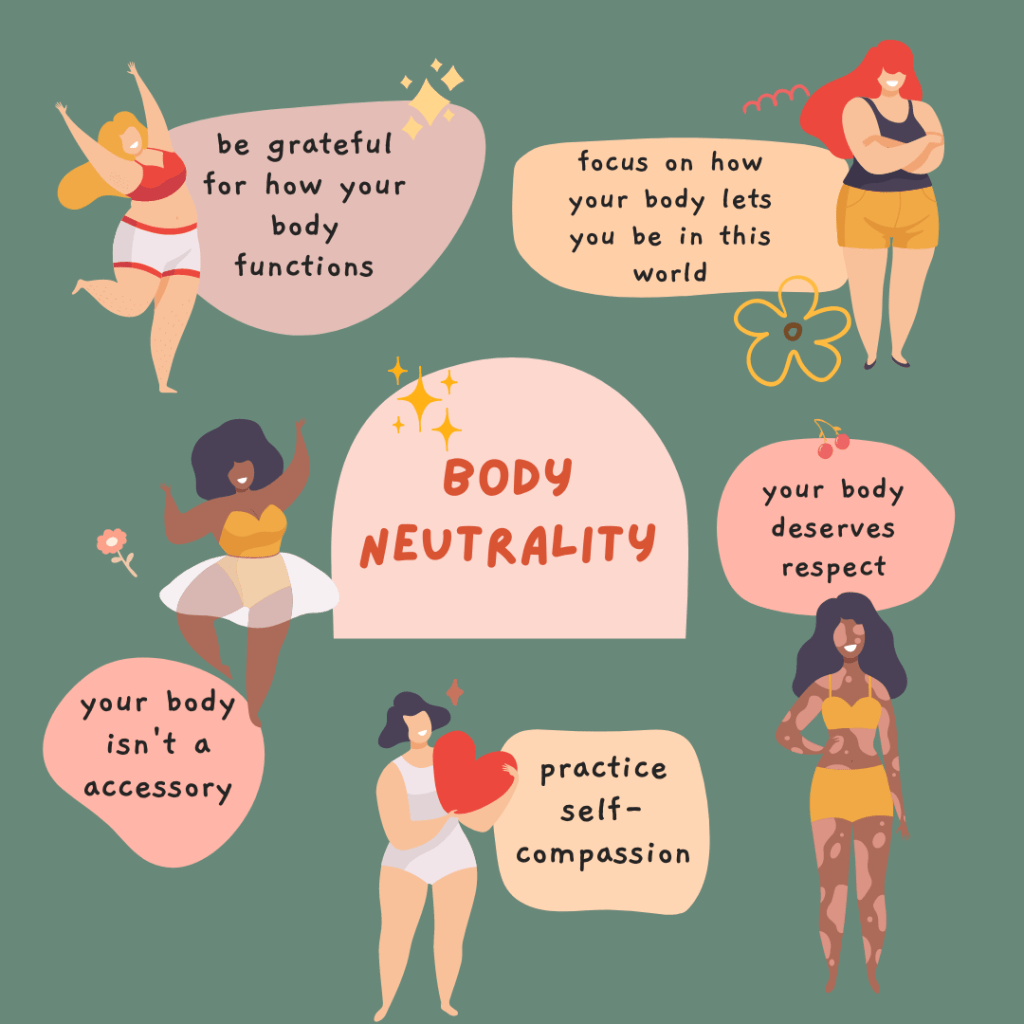
Image Description: The image depicts a graphic from bewitching.net that has a green background and colorful splotches with text. The middle pink splotch says Body Neutrality. It is surrounded in a circle by 5 other splotches that say be grateful for how your body functions; focus on how your body lets you be in this world; your body deserves respect; practice self compassion; your body isn’t an accessory. Each text has a different body next to it posing.
Body neutrality is a contemporary concept that describes the practice of adopting an objective, arguably more function-oriented mindset towards one’s physical self. Popularized in 2015 by Annie Poirier, body neutrality as a concept encourages individuals to view their bodies as physical vessels that allow them to experience and conduct through daily life. Some find it to be a stepping stone to body positivity, however in its fundamental ideology body neutrality is intended to promote a more peaceful relationship between the mind and body that does not focus on negative nor positive conceptualizations of the body, especially in those ways that can consume and strain the mind (i.e., significantly focusing on the size, shape, or color of the body). The concept of body neutrality is designed to operate in contrast to societal expectations that systemically operate to burden individuals to fit into physical and emotional molds in order to be legible as human beings and gain access to various spaces both physically and socially. It is critical to note that societal standards of physicality and being often disproportionately impact minority communities, who often may be denied access to other mechanisms of legibility such as personhood and femininity.
As the concept of body neutrality manifests as an individual effort—where one must rewire their thoughts to accept themselves in their current existence—it is critical to consider to what extent this mindset is sustainable. For sustainability seems unlikely in a world where one’s internal perspectives are competing with the perspectives ascribed to them by other social actors and the implications of structures more broadly (i.e., the spaces their physical and emotional selves may be accepted in or denied access to). It appears to be the case that the body neutral mindset can only exist in the individual bubble, as venturing out of those individual boundaries forces one to be confronted with realities of dominant thought about the superiority of thinness, smallness, whiteness, etc. that will inevitably, even momentarily, impact the way one views themselves and others. It can be said, then, that genuine bodily neutrality is an in-achievable pursuit in our current world where subjects are “locked in” their bodies unable to transcend to a space of being that allows them to shed their physical and spatial identities. While this perspective is less than optimistic, it does offer a more pragmatic contextualization of how societal influence is imperative in creating an environment where humans are categorized and then held to physical and emotional standards that are historically long-lasting and seemingly intrinsic, which hinder individual and population-specific liberation.

As a cis woman, I have personally worked in multiple jobs, primarily full of men. I gravitate towards more physical jobs, meaning I work with more men. Throughout my life, I’ve heard many phrases to try to put down a woman for expressing an opinion different from the male’s perspective. Some of the insults they use to try to shut up women are, “Go back to the kitchen where you belong.” or “Shut up and go make me a sandwich.” some men will even refer to women as objects like dishwashers. However, in the work industry, those two tasks of cooking and cleaning are dominated by men. While working in the kitchens over the years. I have had to work and train grown men twice my age. While instructing these grown men, I was constantly disrespected and was not listened to during instruction, which ended up causing safety problems. I was only treated with respect when the male manager noticed them actively ignoring and disrespecting me. He called them out and explained that I was well-trained in my job and that they needed to take me seriously since I played a role in whether they got to keep this job. During these experiences, I had men flat-out tell me that I don’t belong in the kitchen due to my gender and size, which is ironic because I’ve heard men tell me that I do belong in the kitchen. While working my shift, I had to listen to their opinions about my inability to get things done due to my body not fitting the standard for someone to work in the kitchen. I heard, “She is too weak to do this,” “She is too bubbly to work back here,” or “She is not going to make it long in the kitchen because she is too sensitive.” It made me feel like I needed to constantly prove to myself and my male coworkers that I was someone to be respected for my work ethic. I always worked the hardest, and my personality started to change to be more aggressive and louder for my male coworkers to listen to, but then I was labeled as a “bitch”. However, if I told my male coworker to do the same thing I did, he would be seen as “forward” and “direct.” It is just a simple example of how readings like Not Just the Reflexive Reflex and Throwing Like a Girl mention how we still have these situations where women are still faced with this issue that we are seen as somewhat less than compared to men because of the body women are born with and their potential capability to have children.
When I find myself in need (or want) of new clothes, I often find myself in thrift stores. Early in my transition, this was where I shopped. As soon as I could drive, I would make my way to the local Goodwill and buy a $4 oversized rugby shirt. It was low stakes, high reward. I did not have to drop $20 every time I was curious if I might like to wear something, especially since I was still figuring out my style and tended to wear something for a week before burying it in my closet.
Now in my life, I can comfortably buy brand new clothing from target, but I rarely do. Something about thrift stores is so inviting and comfortable, and on the contrary, something about department stores has such Bad Vibes. Foucault kind of helped me understand why.
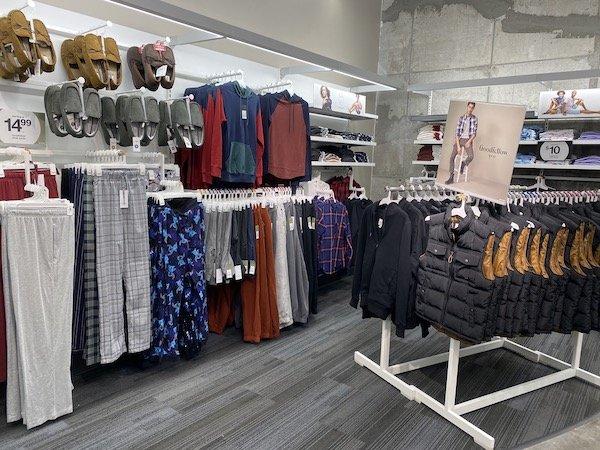
Discipline is written all over department stores. Everything is in its place, to a meticulous extent – clothes folded or hanging from hangers in neat rows, sleek monochrome mannequins with ironed outfits, identical products stacked in rows of tens. The bodies of the employees have to work on their feet, constantly scanning to see if anything needs to be refolded or if they can smile for a customer or answer a question. The clothes themselves are even surveilling the customers, with tags that will sound an alarm if one step is taken outside of the store with them. I think the worst part for me in department stores is how much power I can feel being taken from me when I look at the options of clothes I can buy. The ultimate reduction of individuality is a stack of the same exact shirt in any size.
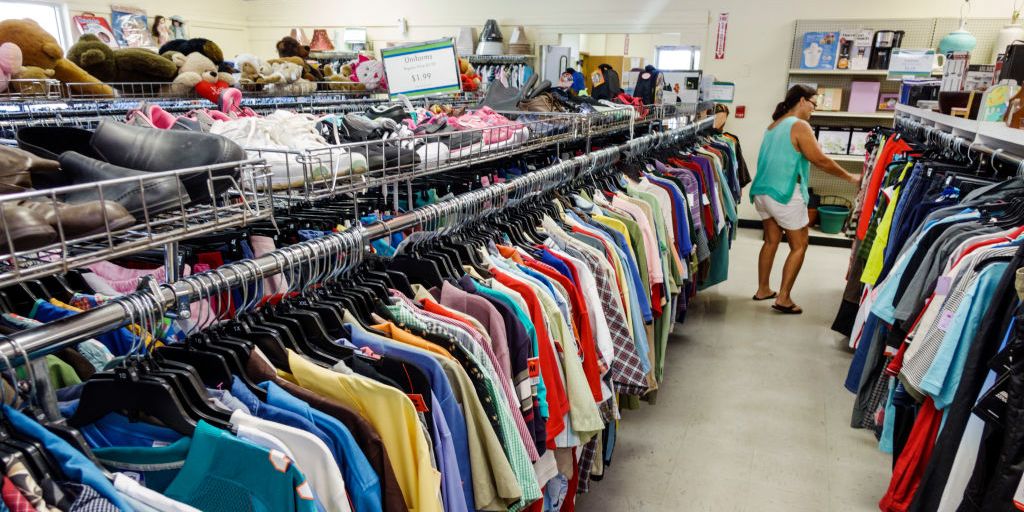
Alternatively, the relaxing, comforting feeling of walking into a thrift store is unmatched. There are so many ways thrift stores subvert discipline and control. Thrift stores defy the intended life cycle of a piece of clothing or product. Our society wants us to buy new, use, and buy new again, and by ignoring this rule, we can escape a kind of control. Further, thrift stores neglect little details – there is imprecision everywhere! Stains on clothing, clothing you can tell has been worn for a lifetime, clothing that has been out of style for at least 20 years, differently gendered and sized clothing all mixed up together. The maximization of time and money is not evident, either. Employees take their time checking out customers, sometimes impressively slow, and products are usually less than $5! Even considering all of these glories, my favorite thing about thrift stores is the community it takes to curate what is inside. Anyone can contribute to what a thrift store/consignment shop sells, effortlessly ignoring trends in society, providing a vast array of options, and encouraging people to listen to their own desires.

