
I have struggled with menstrual pain since I first got my period. When it first began, it was just light cramping, but soon escalated to a stabbing feeling. It is painful to the point where I sometimes cannot move, or have to lay on massagers all day just to keep from taking more medicine before the allotted time is up. My first doctor prescribed estrogen to help, but I had bad reactions and experienced a lot of the side effects. After I communicated this to my doctor, I was told that without estrogen there was nothing else I could do to take away the pain; and that those pills were my only solution. I went to see another doctor because I couldn’t come to terms with being told that nothing could stop the pain I was experiencing.
Continue readingBiases
Impression Management – Putting a Term to My Actions
Growing up, I was taught of the stereotypes against black people, a lot of things were seen as “ghetto” and if I acted a certain way or presented myself a certain way, then I could be seen as the “angry/aggressive black man”, the “scary black man”, the “loud black person” etc. It hurt then me to hear that that is how I can be perceived, because I knew in my heart that was not who I was. And so, I began overcompensating by never wearing certain things, such as durags, never getting cornrows/twists/other protective styles, and even policing how I spoke/walked/acted in general. I would say that at least some of these things have begun to change once I started college. One example is how my relationship with a durag has changed entirely. My mom, to this day, does not like when I wear them outside of the house because she sees them as “ghetto”, and that used to affect my perception of them. But, currently, I do find them nice to wear, for practical and stylistic reasons. Another example is my speech patterns. I am a naturally loud person with a resonant voice that carries to some degree without trying. But when I didn’t want to be seen as the stereotypical “loud black person”, I would either remain relatively quiet, or speak in a small voice that is not only softer, but higher in pitch, so I was also less likely to be seen as aggressive. Nowadays, that type of behavior only happens when I’m meeting new people, or simply surrounded by strangers (hence why I don’t talk much in class, but I’m working on it). But I am glad to say that once I get comfortable around people, I can come out of the mask I made for impression management and just be myself.
The Physicality of A Girl
Oxford defines the term physicality as follows, “The fact of relating to the body as opposed to the mind” (Lexico, Oxford). While, Merriam-Webster defines the term as, “predominance of the physical orientation usually at the expense of the mental, spiritual, or social” (Merriam-Webster). I’m referencing these terms because they are relevant to how many women and young girls are viewed on a daily basis. To be viewed more often as a body than a mind. The same way that girls are less likely to be called on in math class but more often criticized for appearance. More often to be dress coded then asked to write an answer up on the board in stem classes. This is often a daily struggle that goes unnoticed by many. Often times it is reinforced since birth through the media, pop culture, kids cartoons, music, etc. Some examples, would include over sexualized female characters and only including women with the same body type or skin tone. Not only does this cause body image issues for young girls, but it also reinforces the stereotypical expectations of what a girl or woman should be to young boys. This trend is especially seen in video games, superheroes, and some comics. Some well known over sexualized characters include Lara Croft and Harley Quinn. The following picture shows Margot Robbie and her character Harley Quinn. The link posted under the pic goes on to talk about how other countries even photoshopped the length of her shorts. She talks about how uncomfortable she felt wearing the outfit on set but she did it for her character (Dailymail.com).
Continue readingHealth Conscious
TW: Restrictive eating/ED
From the time I could chew my diet was heavily restricted. There were rules for what foods were okay and what foods were not – the latter being a far longer list. My mother had a goal to raise her children on only “nutritious” food. Desserts were for special occasions, vegetables were the focus of every meal, organic only, no GMOs, no processed foods, no refined or added sugars. Even raisin bran was considered unhealthy because the raisins had added sugar; so instead our version of raisin bran consisted of low sugar bran flakes with raisins to be added in separately.
The pressure to eat healthy followed me around everywhere, not just inside the home. At sleepovers with friends when dinners consisted of any “bad” food, I would often go without eating if there was no alternative. As a result of both this disordered relationship with food as well as genetics, I was skinny and it became my identity.
I felt as though my thinness made me more deserving of my mother’s love. She took pride in how willingly I adhered to her strict food rules. When other parents would complain about not being able to get their children to eat vegetables, my mother would boast that they were practically all I ate. My sister on the other hand, had the build of a normal healthy child and received the opposite treatment from my mother. My mom would constantly talk to me behind my sister’s back about how she was concerned on how “chubby” her 6-year-old daughter was getting. She began refusing my sister snacks even on special occasions.
It was through these conversations with my mom that I became even more conscious of my food consumption, terrified that if I were to gain weight, she would treat me like my sister. Eventually, my restriction exceeded that of which was encouraged by my parents. I started skipping breakfast and lunch on the weekdays when they wouldn’t notice. On nights where I was in charge of making my own dinner, I’d go without it as well.
As a dancer, I received so many positive comments on my sickly body. My teachers would compliment me or make comments on how they wish their bodies were as thin as mine. Ballet also gave me a chance to constantly critique my own body, standing in a room covered in mirrors in nothing but a leotard 7 days a week. My classmates would make fun of me for my stick like legs and my protruding ribcage, but by then even the negative remarks fueled the disorder; they were simply affirmation on the one trait I let consume my entire identity.
Throughout all of this, I was so unaware that I was being unhealthily restrictive. I even diagnosed myself with a food addiction because of how often I thought of food and how I was unable to restrict as much as I wanted to. It took major life events and years of separation from my mother for me to realize I was sick and then a couple more years for me to forgive my mom for her influence on the development of my fear of food.
I am…?
I’m from Seattle, when I was growing up, I wasn’t exactly…popular. I got used to being the outsider, I made a friend or two, but I still felt like I didn’t fit in.
I moved to DC when I was 13, a critical age in development, where change, no matter how much, makes an impact. Not only was I depressed from this move, I was distanced from what I thought were friends and half my family. I experienced culture shock and was mainly isolated from everyone at middle school. I was new, spoke “white”, I dressed funny, I’m heavy-set, and I wasn’t as pretty as most girls at school. I was picked on and due to my depression I lashed out on anyone I could. I apologize to my mother every chance I get.
Moving on to high school, I still felt like I didn’t fit in. I felt different and always in my skin. The only important thing about my high school years is that I found my best friends and I don’t want to lose them. Between the years of high school and the first year of college, I found that all my friends were finding out who they were. Trans*, Bi, Gay, Non-Binary, etc., while I stayed the same person as before. While I’m still stuck in my self-consciousness and fear, they found their courage and found out who they were and where they belong.
Society demands us to know who we are and to live with a purpose set in mind. While I’m completely clueless, everyone finds out who they are, and I’m left wondering…who am I? What’s my purpose? Am I doing life correctly? What should I be doing? Am I really happy? Will I ever experience what my friends do? Will I truly be happy? Is life worth living?
I feel like I can help almost anyone around me find a purpose for them to be happy and to keep pressing forward. But when it comes to me, I really don’t know. When it comes to finding out who I am, I am so afraid to label myself. Whenever I think I find a label good enough, it doesn’t feel right. Am I cis? Am I trans*? Am I really pan? Am I really good at anything? I always second guess myself whenever it comes to anything pertaining to me. I’m afraid and anxious about what I should do and how I should act.
Though I have all of these things I am afraid about, here are some things I am certain about, which help me get through the day. I am 22, I love music, I am a good friend, I have friends and family who love me, and I’m trying my best. That there is some purpose for me in the future, even if I haven’t found it yet. And for right now that feels like enough.
Unruly Intern
In Summer of 2020, I did my second engineering internship at a very well known defense company. I was grateful to be able to work considering many people I knew had their internships cancelled, but it was also a pretty chaotic time to have an internship (summer class, long commute, COVID-19, and the death of George Floyd). With all this going on, an internship just felt exhausting in so many ways. I had to be in the lab everyday by 6am while commuting from Silver Spring.
I tried to make the best of it but honestly, this internship was pretty miserable for me. I was working with mostly <conservative> white people and they didn’t give me enough work to do. My manager was friendly to me but she wasn’t really present much. I didn’t make a big deal of it since I had other people looking out for me there and I knew she was a brand new manager so I figured she just didn’t know what she was doing yet. I came to realize later though I was not being given the same grace by her.
Continue readingTemple
TW: Alcohol, Depression, Transphobia

My body is a temple, or
at least that’s what I used

to think. Anxiety over poison
disappeared with my patience,

I don’t need it to feel numb,
but I like the way it tastes

Bitter, and hides in my bloodstream
Like I hide from my problems
Like I hide from her illness
Like I hide from his pain
Like I hide from his

Embrace. What would he have done
If I hadn’t been there

And even though I’m not there
for myself

He looks up to me and asks
his future as if my word was gospel

I’m unable to clock out because
I smiled

for too long and dried out my concrete face
But someone has taken this body like a sculptor

And carved meaning from the cracks
And shown me the beauty hiding underneath

She was able to turn herself
from stone to mud

So I became clay
And was determined to rebuild
my temple
Context:
My younger brother and I are both trans. Our parents are tolerant but kinda pretend we’re not trans, or at least, seem to think that we can play the part of their son and daughter for their sake while we’re at home. I went a couple years without really getting to talk to my brother much, and only learned this year that he was also trans, since he spends most of his time at home, while I spend most of my time away from home, partially because I try to hide from difficult conversations and want to avoid conflict. I haven’t been entirely kind to my body, and I am far more concerned about my weight than I should be. I used to be a very religious kid, and also had an incredibly strong aversion to alcohol, since my grandfather is an awful person, and an alcoholic, I didn’t want to become like him. However, this year, I started to get over this aversion, only to find that the effects of alcohol weren’t all that different from how I feel usually, especially with the sleep deprivation factored in. It’s hard to feel emotions, and the only thing I really have is the constant happiness I perform for the sake of: my dad who is under enormous mental and physical stress from his job, my mom since her illness may become chronic, and my brother so he can see a future for himself. The emotional labor of essentially acting happy 24/7 is exhausting, and when I finally get a break, I’m too used to performing to stop. My partner is my inspiration, because she has struggled with similar problems in her life. I was with her as she found a way to make it all bearable over the course of years. She always makes sure to remind me of my worth, and when I’m with her, it’s almost as if the numbness goes away. She helps me feel good about my body, and it’s especially appreciated during this time of my life where I feel like I have little control, and I’m unable to physically transition. I look forward to the day that I’m able to shape my own body, but until then, I’ll try to stay positive, for my own sake, and for those I love, who depend on me.
A Revolution; Late Night on Strike
The wealth gap in America is currently more than the wealth gap observed in France during the French Revolution. This being problematic and telling how history historically repeats itself if the lesson is not learned the first time. As money is a deciding factor of what people are willing to endure at work, this is pertinent when discussing the physical and emotional labor associated with minimum wage jobs. Within 1770s France, the French people were upset as they were starving and the french elites were afforded the luxury of food, water, and other riches. This is not far off from today as the American lower class is forced to work multiple jobs, not afforded safe drinking water (Flint Michigan), and is susceptible to food insecurity. Within the hours that individuals put in, they are forced to work in a capitalistic society that nickles and dimes the fuck out of their workers.
Continue readingBeing A Girl: Exhausting Edition
Growing up my whole life, I was always a very tiny girl: I wore XXS until my freshmen year of high school. I had always been very active playing softball, basketball, and soccer. But no matter what I did I couldn’t seem to figure out how to put on some weight. My comment about not being able to put on weight will push at least 10 people reading this to think “She’s so lucky why is she complaining about being skinny?”. And as most of you would think that wouldn’t bother anyone, but it did and I became so insecure about my weight that I started to destroy my own mental health because of it. In my personal opinion, it is just as rude to make comments about how skinny someone is then making comments about how big a girl is. My whole life I’ve constantly been reminded how lucky I was and was never even thought to be given credit for working out, playing sports, and maintaining the fast metabolism I was born with. I felt like people rather than promoting me for staying healthy and maintaining a body I felt comfortable in , I was constantly made feel bad because other girls wished they looked like me. I realized how insecure I became once guys started making comments about it. My new nickname around school became skeletore. I was laughed at because all of my clothes were too big and didn’t flatter my boobs or butt which is what guys wanted because their hormones were raging. I went on eating binges where I would eat 2 meals for breakfast, lunch, and dinner just praying I would somehow put on weight and feel happy with myself again. My parents quickly shut that down and constantly reminded me that everyone is their own type of beautiful and there is nothing wrong with being a skinnier girl.
Continue readingGrowing up as the Chubby Kid
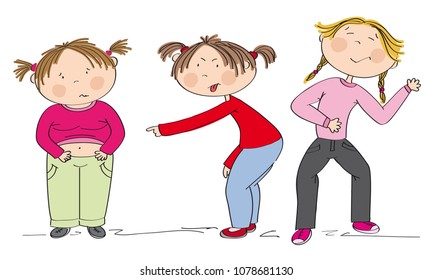
When you grow up as the chubby kid you constantly face many more challenges then the skinny kids. As a female who was bigger than many of the other females you constantly get teased and picked on. I vividly remember the terrible names the boys would call out as I walked the halls. I remember throwing away half of my lunch because I was deathly afraid of people seeing me eat. I would skip lunch too on most days hoping I would lose weight. I was around 12 years old praying that I would lose weight. No 12 year old should be so consumed with their weight the way that I was. Along with the challenges of bullying at school, it carried on into my home life.
Continue reading
