
Subscribe to continue reading
Subscribe to get access to the rest of this post and other subscriber-only content.

Subscribe to get access to the rest of this post and other subscriber-only content.
There is something strange and unsettling about living within a body and at times being so keenly aware of that body, and at other times observing this thing from the outside. One moment, feeling every nerve, every joint, ever stretch and tensing of the muscles. The next, existing solely as a hypothetical. Understanding that there is a body in which you are tied, but not having any real sense of what that means.
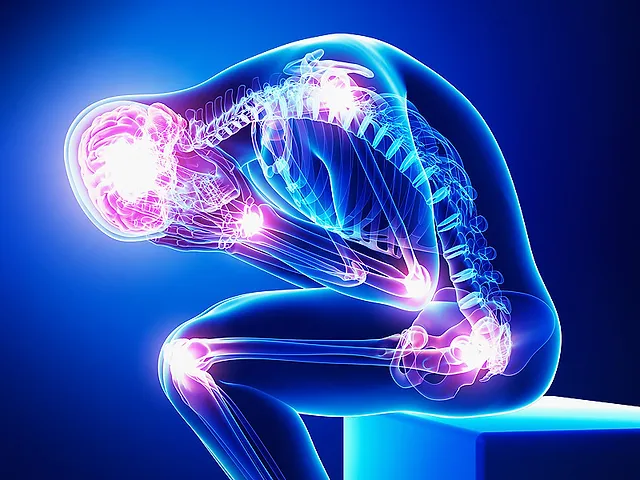
I often struggle to feel control of my mind and body. Between chronic pain and fatigue, grueling mental stress, and an innate distrust of my own perceptions, there is no wonder why I journey through these phases of sensory overstimulation or complete dissociation. My body often feels not like a safe haven or a medium through which I can experience the world, but like a thing that I must manage and shape and drag through the day with me. To me, my body has rather become like an entity. A thing of its own, with its own experiences, goals, abilities.
Young writes, “We often experience our bodies as a fragile encumbrance, rather than the media for the enactment of our aims” in Throwing Like A Girl. And how true these observances ring for me! As a child, I had trusted my body so much. I hiked and climbed and ran and I was a gymnast, performing stunts that required so much control and trust in my body. But as I grew older, I was cautioned and held back and encouraged to be less rambunctious, to be more ladylike, to be safe, calm, quiet. I was inundated with the fears and anxieties of my mother, with the expectations of politeness from my church and school community, with the judgment from the other children at school, encouraged to become something digestable, something other than the rowdy and adventurous child that I was. I tried desperately to be what everyone wanted me to be, to be likeable, to escape from the constant deluge of opinions and rules and admonitions. I ran away into my mind, focused on school, read books, read people, became a chameleon. I stopped running, playing. Had to quit gymnastics as we moved, and never joined another sport, lost touch with my body. I became so lost, so depressed. I wasn’t myself, didn’t know who “me” was or could be, didn’t know how to find her. I was terrified of being perceived yet so vastly lonely and desperate to be seen. I didn’t know how to reconcile these opposing needs, and my brain learned how to just turn off, to walk away from it all while my body went through the motions of the day. I was not living an embodied experience, in the way that Kosut and Moore describe, or really even living at all. I simply existed.
It took me being harassed and assaulted to hit my limit, to decide that I needed to be present within my body, to be a person again, or at least try, before I really went off the deep end. An intense anger fueled me for two years as I worked to learn who I was, what I thought and believed, gave me strength to shed the skins I had grown to disguise myself, to shed the need for approval, to be willing to stand as a person outside the expectations of my parents, of my peers. It took another two years to realize that part of why I had struggled so much in the first place was that I was raised and expected to behave and think the way a neurotypical person would, but I wasn’t neurotypical. Definitely ADHD, most likely autistic, my brain functions so differently from what was seen as “normal” and when I expressed those traits it was labeled as weird or defiant or annoying. I learned to mask those traits, my body learned to turn itself off and dissociate in order to fit into the expectations of those around me. When I realized those things, I finally began to come back into my body, to feel as though it were MINE. And then the consequences of long term shut down and chronic stress began to take effect. Chronic illness struck, pain and hormones and fatigue combining to make this body that I had once trusted my enemy. I sought the things that had brought me a sense of joy and freedom and belonging in my childhood, ran back into nature. But now, I was living in a body I didn’t know, one that had changed with age and had betrayed me. I monitored myself constantly, hedging myself, not taking any risks lest I create more pain for myself. I lost my sense of wonder. Like Young, hiking across a stream was not something I could do without thinking, without planning, it was something to assess, to plan. I needed a safeguard, that branch from the tree to balance me. I had spent so long not using my strength. my balance, my physicality to exist in the world, that to do so now required energy.
I miss myself sometimes, that young girl who might have made a game of jumping from rock to rock to cross a stream, who would have climbed to the top of the pines and swayed in the wind with them, who might have sprinted across a field without fear of rolled ankles or a migraine that lasts a week. I grieve the woman I could have been without fear, without the strain of existence weighing her down, that caused her to lose herself so thoroughly in her youth. I wonder what it would be like to live fully within my body, what it would have been like to live without pain and fatigue, had I had the chance.
Ever since I discovered that I could download music on my phone and listen to it whenever I’d like, I’ve been a headphones addict. Throughout middle school, I constantly listened to my favorite artists, and looking back now I’d probably be embarrassed if anyone found out who I used to listen to. Going into high school I discovered music production, and it became my main hobby. Every day after school I would work on music in some way, still listening to my headphones the whole time. After a few months I even started to make some money off of it, which was really cool for a fourteen year old. I also loved going to concerts, and an upcoming concert was enough to keep me motivated to keep going until it came up. I say all of this to say that music was my main outlet throughout my teenage years.
About two years ago, I noticed that something was different about my ears. They started to get fatigued really quickly and would cause me a lot of pain. I also started to hear a loud ringing noise whenever it was too quiet. These things really freaked me out and I sat with them for a while without telling anybody. The worst part of my experience with hearing problems weren’t the problems themselves, but the feeling of stress. I was stressed that I would lose my hearing, that I would never experience silence again, that I wouldn’t be able to listen to music the same way again, and that it was all my fault for wearing headphones too frequently.
Eventually, I built up the courage to go to the doctor’s office for my problems. I felt so nauseous going there that I almost fainted when he started to describe what could be wrong with me. It turns out that my hearing issues weren’t caused by my headphone use at all, and they were actually related to my orthodontic work. I also finally got names for what I had been experiencing; hyperacusis and tinnitus. What I noticed was that once I went to the doctor, the worst of it was over. Even though there isn’t really a treatment, just knowing what was wrong alleviated me of much of the stress. It was then that I realized that most of my problems were mental.
My experience showed me just how much the mind and the body are connected. It also made me wish that people talked more about the other aspects of having a physical problem. I’ve never really heard people talk about how mentally taxing it can be to have a health problem and not know what it is. One positive thing that I took away from my experience was listening to ambient music. Sometimes, listening to quiet music was all that my ears could handle. I also discovered the joy of ear plugs, and got some custom made to fit my ears that are super comfortable and great at concerts.
I don’t think a day goes by where I am not aware of my body. One of our readings “Throwing Like a Girl” brings up how some girls do not put their whole bodies into potion because they see their bodies as a burden, and at first I did not realize that I could relate to that. When I walk, I have to wear an uncomfortable, lined bra that holds my breasts in place. Unfortunately, my breasts move up and down when I walk and this is something I cannot change. While I like my body, I am also made aware through the stares of random men that my body is not for my eyes only. It feels even worse when I see a grown man staring at me while his wife is beside him at the grocery store.
When I was in middle school, I remember being told for the first time that I had to cover the strap of my bralette. Back then, I used to wear nude-colored bralettes because I obviously did not wear bras yet. I was told by a teacher, while walking to lunch with a friend beside me, that I had to cover my bralette strap and it was the first time I felt embarrassment from my chest. And I remember seeing my breasts as a burden from middle school to high school.
During my first couple years of high school, I developed an eating disorder and became obsessed with looking slimmer. This included wanting smaller breasts and even saying that I would get breasts reductions when I was older. Having bigger breasts made my silhouette look bigger than I would like. I was jealous that people with smaller breasts could wear whatever shirt they wanted without worrying about it fitting over their chest or showing too much cleavage and getting stares. It was not until turning 18 when I started to appreciate my body for what it was and I no longer wanted to change the body I had. I started to realize that people with different bodies have to go through different obstacles of their own. While I still get self conscious about the stares I get, I try to ignore them because at the end of the day I will wear whatever I want with the body I live in.
I myself do not identify as a cis woman, but I was born with female anatomy and that is still how the world perceived me. At the same time that the world was perceiving me, I was right there, taking in all of the experiences and learning from them. The perception others saw of me has been reflected back onto me. I say this meaning that I have been treated as a woman my whole life, treated as if I needed help, as if I were dumb, as if I was hysterical, and always that I was in the wrong. This perception and energy stays with me, even today. I doubt myself in every action I take, my biggest fear is taking up space, or being a burden. The gender roles are in fact deeply ingrained in my brain, and I find myself in these situations often.
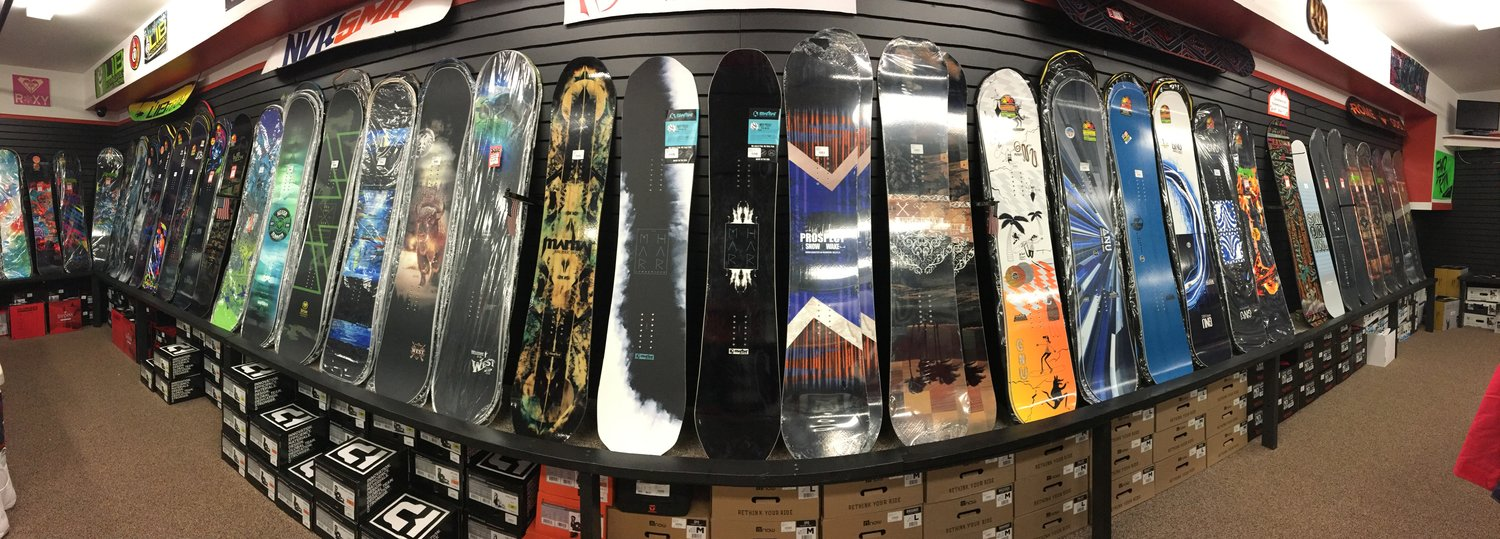
(Image by the Mothership Snowboard Shop)
The other day I was in a ski supply warehouse with my partner looking to get him a snowboard. While my partner was getting his feet measured and chatting with the man who was helping us, I just sat on a bench staring at a huge wall of snowboards. More than anything, my brain wanted to touch the boards and sift through them. I could see that there were so many different types and I wanted to feel the patterns and the differences. I also wanted to find the cutest one for my partner, obviously. But I was too afraid to touch them because I know snowboards are hundreds of dollars and I wasn’t sure if I was allowed to them. I thought if I touched them I would get yelled at or someone would tell me to stop or I would immediately break something or maybe even an alarm would go off. So I just sat there for 25 minutes. Then, as my boredom was hitting peak, our friend (he/him) came in to our joint appointment. He was 25 minutes late, had never been there before, is not even a snowboarder (he ski’s) and just started feeling up the Snowboards immediately like it was his birthright. I stood there shocked, waiting for someone to yell at him. I thought surely his entitlement is about to get slapped with reality. But no, he was right. This was a place built for him and he is there using the space as he should. I am sure I could have also done this, but my conditioning in society put a huge roadblock in my path. I saw the path that I could take to fulfill my desire, but I didn’t have the mental capacity to do it.
No matter how they identify, people who grew up AFAB are instilled with a discontinuous unity. The gender roles associated with being born as a female include; weakness, empathy, staying on the sidelines, taking up as little space as possible, thinking of others before yourself, and more. Phenomenology explains how the body and the mind are the same. The experiences of growing up like this will teach a person that they do not have the capacity to achieve their highest goals. This holds women and AFAB people back from big things like advocating for themselves and little things like sifting through snowboards.
Women have an inability to transcend the way that Men in society do.
My initial recollection of experiencing symptoms indicative of Obsessive-Compulsive Disorder (OCD) dates back to the eve of my fifth birthday. I distinctly recall experiencing distress as I grappled with the concept of aging, a concern that revolved around the perceived inevitability of losing loved ones in tandem with my own maturation. This psychological episode unfolded contemporaneously with my parents’ tumultuous divorce proceedings, marked by my father’s departure from our family home. Given my tender age of five, my cognitive faculties were ill-equipped to comprehensively process these complex emotional circumstances. Consequently, I found myself unable to rationalize the apparent loss of my father and the underlying reasons for this disruption in my familial structure.
I experienced several recurring episodes of Obsessive-Compulsive Disorder (OCD) before ultimately deciding to seek professional help. Initially, I became preoccupied with the unwarranted fear that my hair was falling out, leading me to adopt two distinct coping mechanisms. On one hand, I would refrain from brushing my hair altogether, and on the other, I meticulously counted the hairs that would accumulate in my hairbrush every time I attempted to groom myself.
However, the predominant intrusive thought that haunted me was the persistent dread of dying, particularly in my sleep. To mitigate this fear, I developed the compulsion of staying awake until the early hours of the morning, often disregarding the necessity of waking up early. In my mind, this self-imposed vigilance was rooted in the belief that if any adverse event were to befall me, it would inevitably transpire by 3 AM.
Regrettably, these intrusive thoughts extended to include distressing visions related to harming my beloved cat, prompting me to entrust her care to my sister temporarily, as I grappled with my own well-being. Similarly, I experienced intrusive thoughts revolving around causing harm to my mother, leading me to diligently lock her bedroom door each night to prevent any potential actions stemming from these distressing thoughts.
As the severity of these OCD episodes escalated, I reached a point of profound despair, contemplating suicide. Paradoxically, the fear of dying itself served as a deterrent, rendering me unable to act on these distressing impulses. This tumultuous period underscored the urgent need for professional intervention and support to address the debilitating impact of OCD on my life.
The reason for my initial diagnosis of Generalized Anxiety Disorder (GAD), as opposed to Obsessive-Compulsive Disorder (OCD), can be attributed to a combination of factors. Firstly, at the time, I lacked a comprehensive understanding of what OCD truly entailed, leading to a profound fear that the distressing thoughts I experienced reflected reality. This fear of potential consequences, such as being institutionalized, compelled me to keep my struggles hidden.
Secondly, my compulsions did not conform to the stereotypical external behaviors often portrayed in the media or typically associated with individuals displaying Type A personalities. Instead, my compulsions primarily manifested as internal mental rituals, making them less conspicuous to others and potentially less recognizable as classic OCD symptoms.
Lastly, many healthcare professionals are not be fully aware of the complexities and varied presentations of OCD. This lack of awareness can lead to the condition being overlooked or mistaken for something else.
It was not until I reached the age of 28 that I finally received an accurate diagnosis of OCD. The moment I began to educate myself about the disorder was both bittersweet and enlightening. I experienced a profound sense of sadness for my past self, who had endured the torment of OCD without understanding it, and frustration at the prevailing misunderstandings surrounding this condition. The belated recognition of my OCD was a pivotal moment, allowing me to access appropriate treatment and support, and fostering a greater appreciation for the importance of mental health awareness and accurate diagnosis.
I am genderfluid, but I was still born in a female body. However, I didn’t learn about different genders until high school, and for most of my childhood I presented as and was viewed as a girl. So of course, I was subjected to the horrors that come with living in a female body.
Especially in Catholic middle school. I looked feminine, so everyone around me thought I must have a “feminine attitude” (as mentioned in “Throwing Like a Girl”), although it did vary from person to person.
The girls were kinda judgy. A lot of them wanted to straighten my hair, on account of it being “prettier” than my frizzy curls, but I always said no. One day a girl asked to brush a strand of my hair. I allowed her to brush a single strand, and she learned very quickly why you can’t brush curly hair dry. She was horrified.
Meanwhile, the boys in my class thought of me as the embodiment of innocence. I looked feminine and I spoke in a high pitched voice, but I couldn’t really change that. I also followed the rules, but that was out of wanting to avoid punishment. I learned that the guys thought that I never heard a curse word in my life (I knew plenty). One time they approached me by the lockers, giggling, and told me to curse. I said “fuck”, and they went wild with shock and bewilderment.
So, girls saw me as a girl, but also someone who wasn’t doing enough to be a girl, or someone who needed to be molded into their form of femininity. Someone they had to fix. The boys thought that I was some kind of dainty, clueless, innocent being based on mannerisms that were out of my control, and fully intended on mocking me for it.
My teachers (all women), shared a similar if not more intense sentiment of the girls. One time in class, I was sitting the way that a bored student with undiagnosed ADHD would sit. The teacher looked at me and told me to “sit like a lady.” Then there was the dress code. One time we had a free-dress day (otherwise we wore uniforms) and I was wearing thick, snug pants. At lunch my teacher called me over, and calmly explained to me that my form-accentuating clothing could distract the boys or give them ideas, and I couldn’t wear anything like that again without getting a conduct referral. I almost cried on the spot.
My teachers shamed me for not being feminine enough and for being too feminine. They saw me living my life in my body and wanted to police that. I learned that no matter what I did, I would be shamed for not acting the way I was “supposed” to. This was even more confusing given my complicated feelings on my gender identity, but not even knowing about genders off the binary (Catholic school education). I felt uncomfortable in my own body.
It was hard for me to learn to be comfortable with my own body. After realizing my gender identity, I had to work out how I really felt about my body. I had to figure out which uncomfortable feelings were from body dysphoria, and which were from all the gross, sexist ideas that I was bombarded with.
And after that, I felt a lot more comfortable.
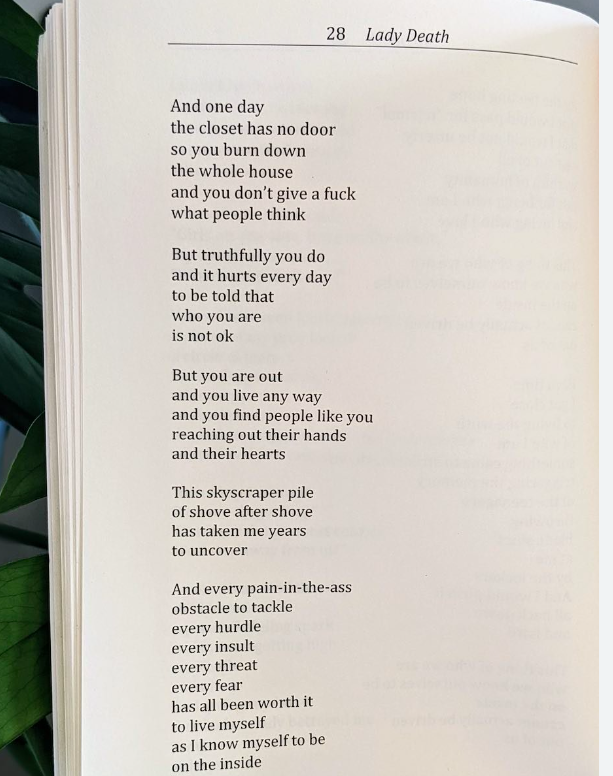
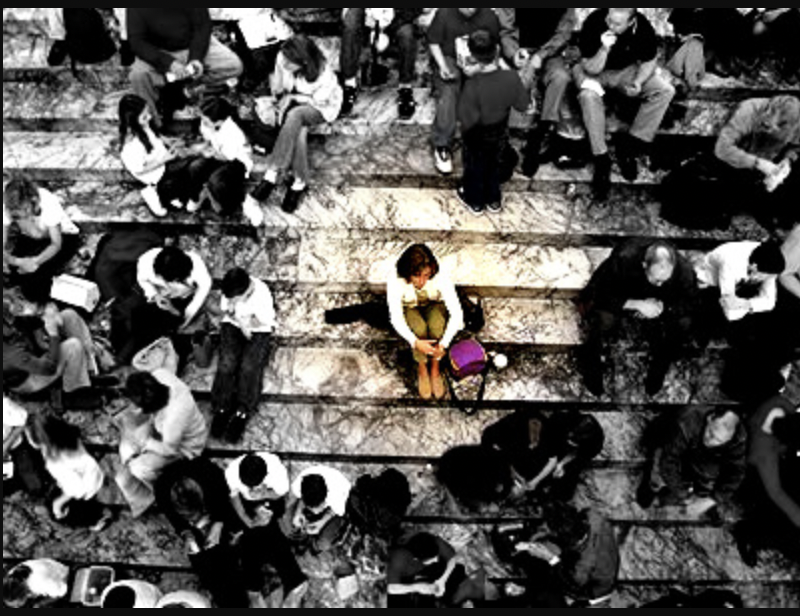
Much of my academic day is spent in observation of the environment I am in. While I am capable of diligently taking notes and tuning into the main themes and key points of the class, my brain is also taking notes of the people sitting around me, the mannerisms and postures of the professors in front of me, and the general feeling I get from being in this world. More often than not I wonder: do I belong here?
Why do I feel this?
Believing one has the capacity to freely take up whatever space they occupy is a luxury, a privilege, seemingly designated only to those who have not spent their entire lives hearing that they take up too much space. I donʻt even think they were necessarily encouraged to exist in this way as much as there was the absence of actively being discouraged to do so. I marvel at what that must be like to not feel the internal burning shame that revs up my pulse and creates a subtle dizziness in my head anytime I open my mouth in class. My entire childhood surges forward in those moments and my nervous system is immediately dysregulated in anticipation of being made to feel like nothing I have to say ever matters.
Itʻs silly, I know.
Of course what I say matters. Of course I have contributions to make to important conversations. Of course Iʻm allowed to take up space, especially in a college classroom where ideas are meant to be exchanged and explored. Iʻm a human being with a beating heart and a curious mind, like most here. But could somebody please tell that to my central nervous system? It always seems to forget this in moments when I need to remember it most.
This is my reality. It is my phenomenological experience. What are the enabling conditions that allow for this? Well certainly my childhood is a large component – how I was taught to behave as a child, how I was taught to view myself, and how I was taught to move through the world. But beyond the formative programming and environment that laid the foundations for my current configuration, I have found that Academia as a whole, systematically infused with patriarchal and racist ideologies, plays a part.
There is a competitive expectation here, that if you do not speak fast enough, cleverly enough, articulately enough, then you are exposed for who you are not – intellectually superior. That to showcase intelligence automatically assumes others want to hear what you have to say. That if you are a member of the prioritized categories of social being – in particular, white and male – then the gravitas of what you speak is appreciated before you even speak it. This pressurized environment all the more draws out the deep-seeded fears and insecurities surrounding my internal question of intellectual capacity. Can I take the wellspring of thought and insight contained within and adequately give it voice so as to give myself the appearance of competitive intelligence? Can I do this all the while fighting against the belief that the space I am taking up does not belong to me?
To this, I have no answer. Only a sense of “I guess weʻll see” and the burning desire to crawl into bed and get lost in the latest reality dating TV series, where I can freely exposit to my laptop why I think everyone is an idiot.
I sometimes miss how disconnected I was from my body when I was younger. Though not a monolith, I think most adolescents feel some degree of invincibility when it comes to how their bodies move throughout the world. The carefree attitude of “nothing is going to hurt/stop me or slow me down” is one that accompanies a life lacking experience (and might have something to do with an underdeveloped frontal lobe). But I think it’s a necessary part of the growth process that allows us to have lived experiences with a certain degree of fearlessness that encourages us to explore the world.
The older I get, however, the more my body’s limitations prevent me from living as fully as I’d hope. For one thing, sleep doesn’t come as easily as it once did. As a child, I’d often fall asleep in random places whenever I got tired. As a teenager, I’d sleep for 12 hours at a time. No insomnia, no nightmares, no getting up twice to pee. Now it takes pharmaceuticals and magnesium and turning off screens in order to clear my brain long enough to fall asleep. Wash, rinse, repeat.
In 2018, I started to experience intense pain in my shoulder, swelling and pain in my fingers and toes, and debilitating fatigue. The pain would come and go and I would sometimes go weeks feeling totally fine, so I ignored it for a while. I’ve been tired since I had my first child in 2000, so fatigue has never been a good barometer for my health. After the shoulder pain woke me up in the middle of the night, I made an appointment to see my doctor the next day. Many, many blood tests later, I was diagnosed with two autoimmune diseases – one of which is called rheumatoid arthritis. There is no cure for RA, and the causes are unknown. Left untreated or if my body does not respond to the medications, the disease can cause organ failure and severe deformation of hands and feet and other parts of the body. My life, and by extension my body, was forever changed with that diagnosis. Every decision I make is now governed by how it is going to affect my disease. Food that I eat, alcohol that I consume, stress that I experience – all of these things can cause a flare of the disease.
I’ve learned to manage my symptoms with the help of medicine and doctors, but it will never not be a part of me. I am who I am today as a result of the limitations of my body, and though it often frustrates me, it has shaped my resilience. I still would love to look at my young self and tell her to be more grateful for her sense of invisibility. Youth really is wasted on the young.
Is it possible to adopt a body neutral mindset in the face of external structural notions about what the body should be?
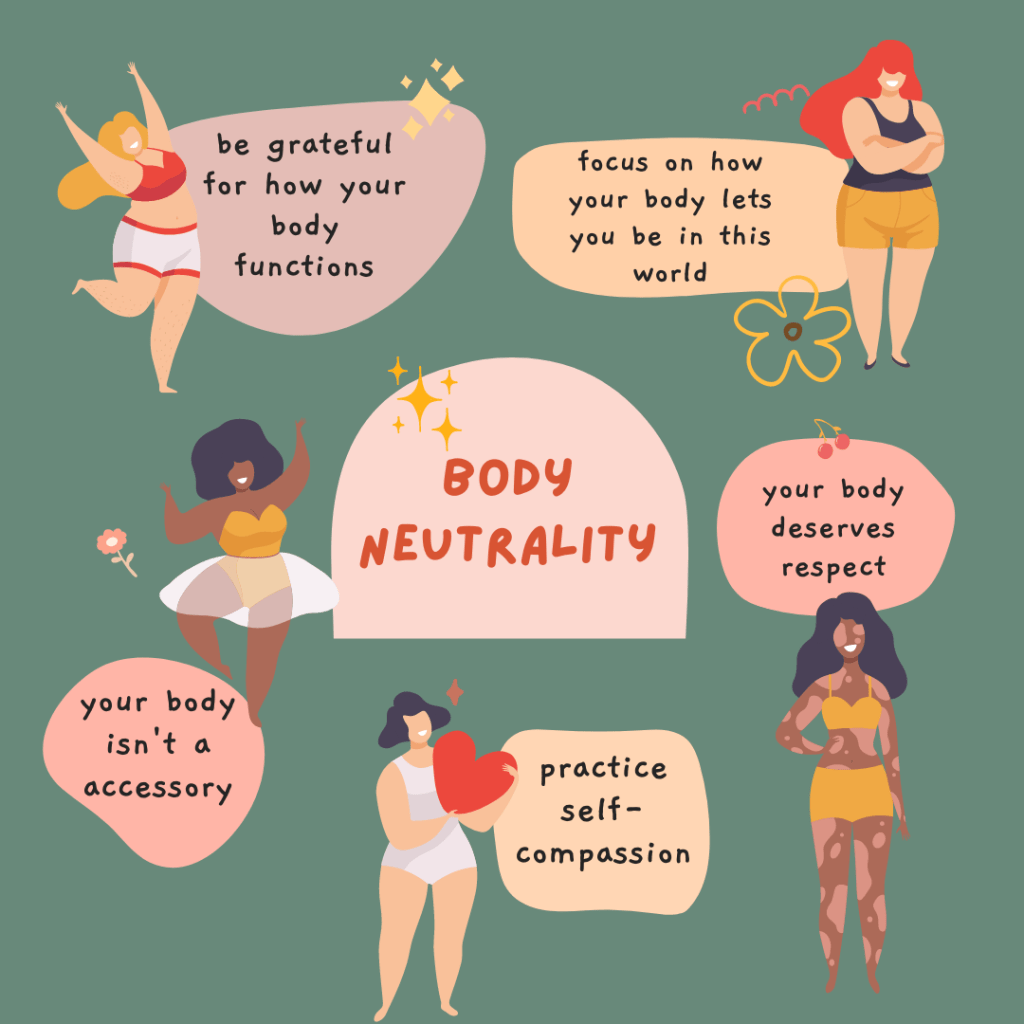
Image Description: The image depicts a graphic from bewitching.net that has a green background and colorful splotches with text. The middle pink splotch says Body Neutrality. It is surrounded in a circle by 5 other splotches that say be grateful for how your body functions; focus on how your body lets you be in this world; your body deserves respect; practice self compassion; your body isn’t an accessory. Each text has a different body next to it posing.
Body neutrality is a contemporary concept that describes the practice of adopting an objective, arguably more function-oriented mindset towards one’s physical self. Popularized in 2015 by Annie Poirier, body neutrality as a concept encourages individuals to view their bodies as physical vessels that allow them to experience and conduct through daily life. Some find it to be a stepping stone to body positivity, however in its fundamental ideology body neutrality is intended to promote a more peaceful relationship between the mind and body that does not focus on negative nor positive conceptualizations of the body, especially in those ways that can consume and strain the mind (i.e., significantly focusing on the size, shape, or color of the body). The concept of body neutrality is designed to operate in contrast to societal expectations that systemically operate to burden individuals to fit into physical and emotional molds in order to be legible as human beings and gain access to various spaces both physically and socially. It is critical to note that societal standards of physicality and being often disproportionately impact minority communities, who often may be denied access to other mechanisms of legibility such as personhood and femininity.
As the concept of body neutrality manifests as an individual effort—where one must rewire their thoughts to accept themselves in their current existence—it is critical to consider to what extent this mindset is sustainable. For sustainability seems unlikely in a world where one’s internal perspectives are competing with the perspectives ascribed to them by other social actors and the implications of structures more broadly (i.e., the spaces their physical and emotional selves may be accepted in or denied access to). It appears to be the case that the body neutral mindset can only exist in the individual bubble, as venturing out of those individual boundaries forces one to be confronted with realities of dominant thought about the superiority of thinness, smallness, whiteness, etc. that will inevitably, even momentarily, impact the way one views themselves and others. It can be said, then, that genuine bodily neutrality is an in-achievable pursuit in our current world where subjects are “locked in” their bodies unable to transcend to a space of being that allows them to shed their physical and spatial identities. While this perspective is less than optimistic, it does offer a more pragmatic contextualization of how societal influence is imperative in creating an environment where humans are categorized and then held to physical and emotional standards that are historically long-lasting and seemingly intrinsic, which hinder individual and population-specific liberation.

