Her Body Versus His Name 


*Spoilers for the halfway point of the play John Proctor Is The Villain* 

Last year I had the pleasure of reading John Proctor Is The Villain for the first time. A new play written by Kimberly Belflower about girlhood, friendship, and what it means to believe women.

My whole life I have been told that I am too much, too loud, and most of all, “too dramatic.” and I’m not alone. Women are taught that their bodies should be smaller and unseen. Women don’t get to take up space; that’s for the boys. Belfower sees and explores this thought through her cast of high school-aged girls discussing the Crucible in their drama lit class. 

Now, in case you don’t remember anything from reading The Crucible in high school, I’ll catch you back up.
Arthur Miller created a famous example of a “tragic hero.” A man who gave up his life to protect his good name. He chose not to lie and be killed rather than say that he was a part of the witchcraft. 

And then there’s Abigail, she is 16 and works for John Proctor and his wife. Abigail likes to go out into the woods with her friends and dance. When some men caught onto this they accused the girls of witchcraft. Abigail is quick on her feet and rapidly throws the blame onto someone else when the witch trials first begin.

When John Proctor is questioned about her use of witchcraft, he originally lies for her because of the affair/ feelings he has for Abigail. 

Usually, Abigail’s story is perceived as one of a manipulative and conniving girl who sets out to destroy John Proctor’s reputation…Does this sound familiar?

Belflower sets her piece in a one-stoplight town in Georgia in the heart of the MeToo movement(2017).

Let me give you a run down of the characters from the scene I will be looking at:

Shelby: Quick thinking 16 year old. Her mouth often moves quicker than her thoughts. She’d been out of school for a month or two and no one knows why. She just returned earlier this week.

Carter Smith: Fun-loving English teacher. Cares about his job; the students love him.

(The other students are important to the plot but are less so important to the text I am showing you. )
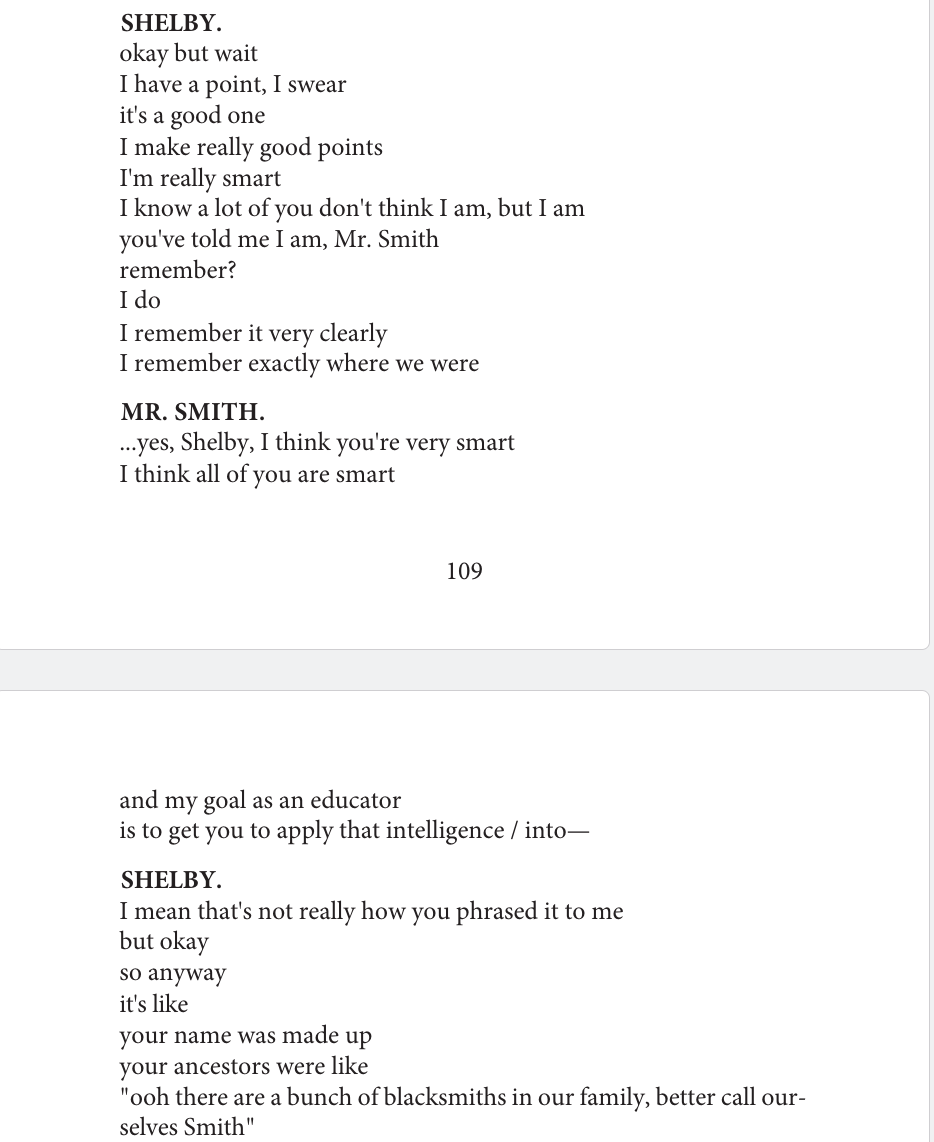
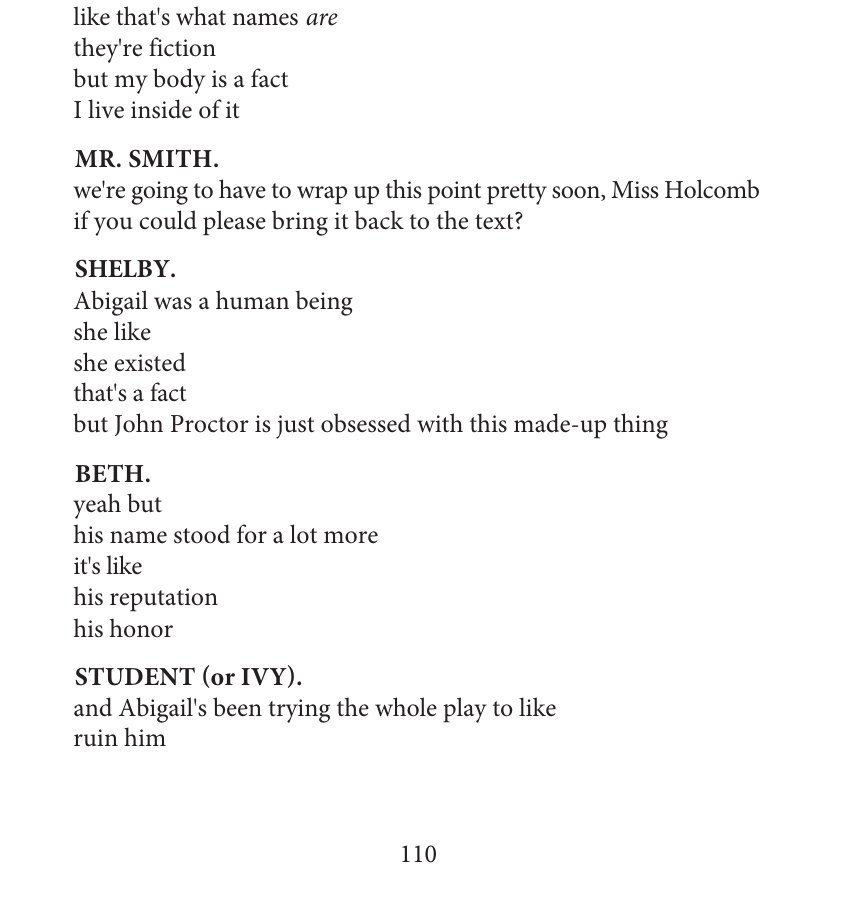
Our bodies and the space we take up is fact. They stay with us for eternity. From a young age we are told not to take up space and that we can’t because we’d be stealing it from men. Oppressors want our space and are terrified of what will happen if we take it back. This is the same concept that Iris Young states in Throwing Like A Girl. The feminine space is supposed to be enclosed and confining. But it doesn’t have to be.

We’re told that a man’s reputation and his “future” are more important than our facts. We shrink ourselves and our experiences so that way the people who hurt us can go on and be happy. His name and reputation means nothing in reality. He can move and change his name and no one will know what happened.

However, our bodies can’t do that. Our bodies remember.

In this play, Carter took Shelby’s space and girlhood away from her, and we get to watch her fight in taking it back.

If you are interested in reading the whole play, here is a link to a PDF:
https://www.cliffsnotes.com/study-notes/24356801 🙂

to my mind

dear,

it’s been so long since i’ve last written to you.

have you missed me? i’ve missed you. terribly, terribly so. i look in our bathroom mirror (the one that you would let your body draw smiley faces on when the glass fogged from a too-hot shower, remember?) and see you again. we share the same eye-bags and bright, big eyes that are hard to miss. i think that is one of my favorite things about you two.

i wish i could give you a hug right now.

Continue reading →

Understanding Privilege

As a cisgender woman, I’ve grown up aware that my body fits the societal norms laid out for me. From an early age, I was taught that my body should look and act a certain way, especially in sports. While I’ve had access to opportunities and acceptance in athletic spaces, I’ve come to understand that this isn’t the reality for everyone. Transgender athletes—especially transgender women—face barriers that often seem impossible to overcome.

Read more: Understanding Privilege

In the article, “Beyond Physiology: Embodied Experience, Embodied Advantage,” Torres et al. delve into the challenges transgender athletes face. They show how discussions about their participation in sports are often reduced to debates about physiology, particularly for transgender women. These athletes are often subjected to scrutiny about their bodies, which overshadows their identities. The article highlights not only the social and political hurdles they encounter but also the privilege cisgender athletes like myself often take for granted.

Reflecting on my own experience as a cisgender woman in athletics, I realize how much privilege I carry. My body is rarely questioned or scrutinized in sports; it is accepted without hesitation. I’ve been able to compete without worrying about being excluded or misgendered. In contrast, transgender women often have to fight for the right to compete—against opponents and, more often, against institutions that marginalize them.

This constant fight can take a toll, and creates mental and emotional barriers. It’s not a question of whether they can succeed in sports but whether they’ll even be allowed to try. Recognizing my privilege as someone whose body aligns with societal expectations reminds me of the need to advocate for more inclusive spaces in sports, where everyone has a chance to thrive without fear or discrimination.

Medical Terminology and the Patriarchy

I learned about this in another class and found it to be very relevant to this class. In general, Emily Martin’s The Egg and the Sperm: How Science Has Constructed a Romance Based on Stereotypical Male-Female Roles, talks about how the language in medical textbooks reinforces patriarchal views of men’s and women’s roles in reproduction. Enjoy!

In Emily Martin’s The Egg and the Sperm, she asserts that even when we learn about basic biology, such as eggs and sperm, these notions from the patriarchy are reinforced. This subtle but very deliberate assertion is intentional. It reinforces gender norms and says that the sperm is dominant while the egg is submissive. The sperm travels through the female reproductive system and penetrates the egg. This is very much a Western idea. Now, modern research has found that the egg is the dominant one. Instead of the sperm penetrating the egg, the egg, “traps the sperm and prevents their escape.” (Martin, pg. 493)

The reason these narratives are so problematic is because it devalues the egg’s role in reproduction and, in doing so, reduces the whole female reproductive system and women in general and vice versa. Other things also reinforce this. Like how menstruation is viewed as a failure. The language medical textbooks show menstruation, “as a chaotic disintegration of form, complementing the many texts that describe it as “ceasing,” “dying,” “losing,” “denuding, “expelling. ” (Martin, pg. 486) As if a women’s role is purely reproductive and she is deemed useless or otherized when she is dealing with a completely normal biological function.

Reference

Martin, Emily. “The egg and the sperm: How science has constructed a romance based on stereotypical male-female roles.” Signs: Journal of Women in Culture and Society, vol. 16, no. 3, Apr. 1991, pp. 485–501, https://doi.org/10.1086/494680. 

Shy Girl Workout

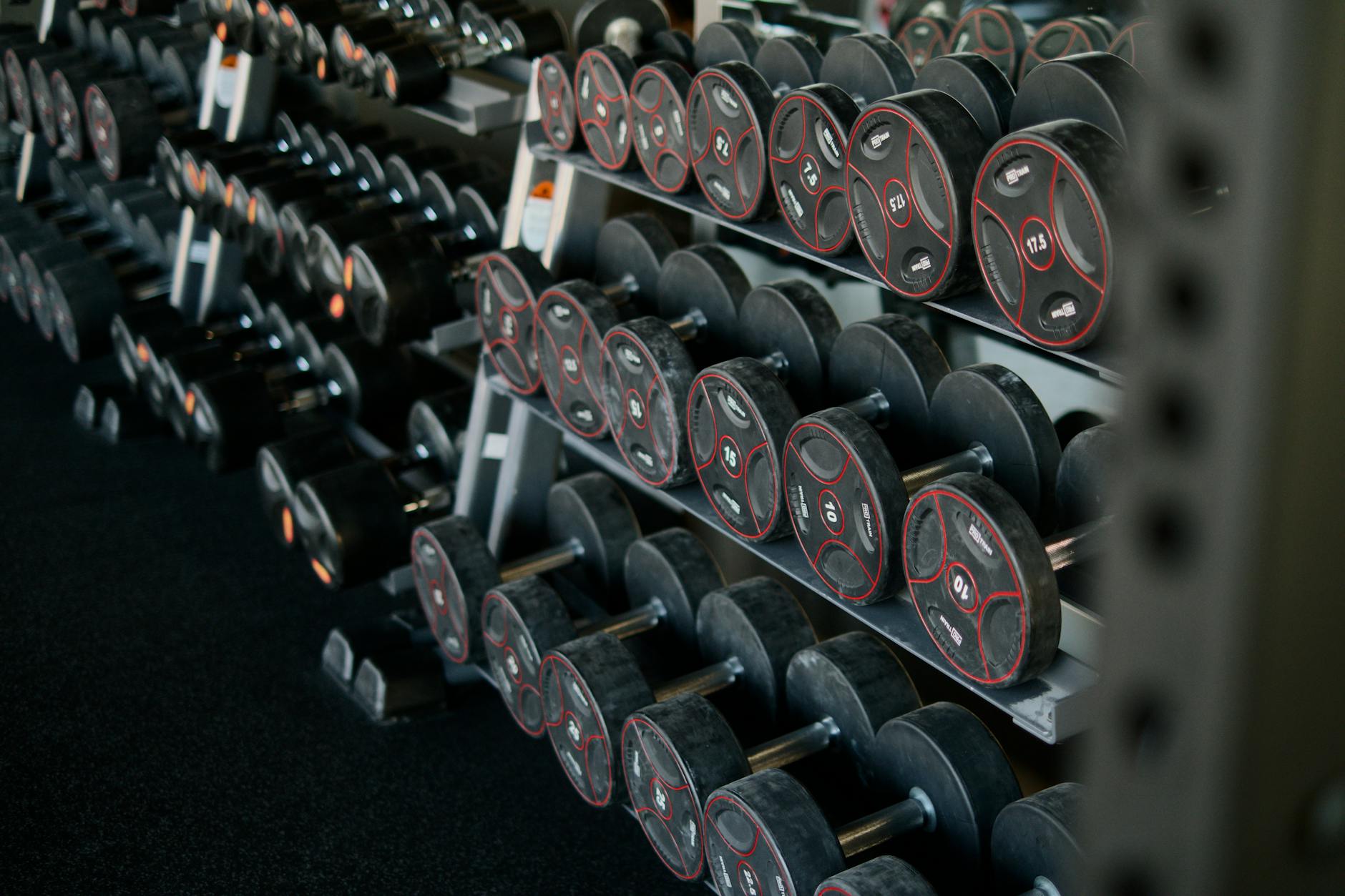
Photo by Ivan Samkov on Pexels.com

Imagine you walk into a gym, a not-quite 20-year-old feminine presenting person. After months of working out in the peace of your own home and improving your self esteem, you finally build up the courage and confidence to work out in public for the first time. You sign in and find the weight room. You look up and…wow that’s a lot of men. You struggle to even find one girl. Just a bunch of grunting gym bros with all their buddies lifting weights that are probably too heavy for them to safely lift. Not to worry though! You’ve been training for this moment. All the (Instagram) research you’ve done has led up to this moment. You take a deep breath, grab your 2 dumbbells and find a corner to begin your Shy Girl Workout…

Your Shy Girl Workout allows you to stay in one place with one set of weights the whole time, taking up minimal space so as not to draw any attention to yourself. To be virtually imperceptible. Invisible.

Continue reading →

What Were You Wearing

“I was seven,
Wearing play clothes,
When he decided,
I was his experiment
I was seven,
Playing in my home,
When he decided to
Claim my innocence”

“I was eight,
Wearing a black shirt,
And pj pants with pink stars
When it all started
I was eight,
In the trusting lap
Of my uncle,
Too young to question,
Too young to debate”

“I was three,
Or possibly five,
When it became,
A monthly encounter,
I think I was three,
Sometimes in a sundress,
Others in pajamas,
When he decided
He had the right to me”

This poem was inspired by an exhibit called What Were You Wearing. The title of the exhibit is a question commonly asked to victims of rape/sexual assault, implying that what happened to them was somehow their own fault. The exhibit proves that clothing is irrelevant when it comes to sexual assault, and that we should stop victim-blaming by asking this question. 

The Many Facets of Dance

Dancing is both an art form and a sport. It is one of the few places where the mind body connection is joined and exhibited in a such a way that it can be seen as tangible. There is beauty in watching a piece, its emotions and story, be fully embraced in this more visual way. There is also beauty in being able to commit to the act of dancing, training the body in a way where one can escape the mind and rely solely on the body to perform as it has been practiced. The experience of dancing can be further nuanced depending on the circumstances in which the action is taking place. In the case of dancing competitively, there is the need to have the physical body look and move a particular way and if the situation calls for it a reliance on the team and the desire to feel like a full accepted member for which the utmost requirement, in my experience, has often been felt to be the amount of skill one possesses.  

As someone who has been training in dance since the 1st grade, and allegedly dancing well before then, my experience with the art has been multifaceted. When my skill-level increased to the point of notice to others (around my last year of middle school) I was offered positions to teach a few classes weekly for my dance school. It was during this time that I finally felt the most included by my peers and their parents. Rather than commenting on the shortcomings of any rehearsal, parents would instead exchange niceties. I was able to exchange practice questions and answers with my peers as they began approaching me in a way they had not before. As the chubby, short girl, I was finally able to prove that I belonged in a space that revolved around bodies, despite mine not being of an “acceptable type”. Such dynamics can, in many cases including my own, a dual judgement first from the other players/teammates and their respective communities as well as judgement from the internal self about the internal self which can have long lasting impacts on self-esteem and the mental self.  

The point of team sports like this can and should be to have fun, create community and experience movement in a healthy way. However, in spaces where the emphasis is placed first most on the body and the specific ways in which it moves, it can be difficult for bodies that do not conform to social expectations to achieve the same community experience.

My Reflection

Who am I?
I,
I’m my thoughts,
My dreams,
My aspirations.
I’m my name,
My looks,
My imagination.
That’s what I see,
When I stare,
Into my reflection.

My reflection,
Ripples in the river of life,
The shallow,
Shallow river of life.
To the world,
I am my reflection:
I am only what the world sees,
Only what the world decides I am.
My body is but a vessel;
Why must the world ignore me,
But acknowledge the vessel?!

Books, merely objects
Are still judged 
By only their covers,
So who am I to demand
They not judge me
By only what they can see.
The inside of a book
Is where the value lies
But most people don’t bother;
It’s easier to judge
From the outside

My body is a part of me,
It embodies my soul
My personality,
But it is not all I am.
I am not my scars,
My disability,
I am me,
A completely separate entity.
I, Me,
Not just what you see

F-A-S-H-I-O-N What Spells Gender Neutral Fashion?

First it has to be acknowledged that there is no one “look” and everyone perceives labels to mean different things. How one styles their clothing is going to reflect what they think looks good on them and expresses themselves accurately. Everyone has a unique perspective that has been shaped by their experiences. Just because I perceive these things as gender neutral does not mean everyone does and it should also not be assumed that wearing any style associated with gender neutral or gender non-conforming makes someone gender-non-conforming. To that end, wearing or dressing in a way that might convey a gender (such as wearing more masculine or feminine clothing) does not mean that someone identifies as how you are perceiving them. As tik toker kissmychaase put it “Even when I’m fem I’m still a them.” meaning even if this person dresses feminine they still go by they/them pronouns and that should be respected.

The clothes, shoes and accessories we put on our bodies says a lot about who we are and deeply influences how others interact with us. In “not just the reflexive reflex” by Mary Kosut and Lisa Jean Moore clothing and accessories are described as part of an identity-kit. When this identity-kit is stripped away it takes a chunk of someone’s individualism and uniqueness. Clothing is important, it allows self expression and can create comfort.

Fashion is outfits (clothing and accessories) and make up that project one’s belonging to a certain group. There are many types of Fashion. All of it is subjective and while some outfits are easier to deem as part of a subculture, others are harder to identify or explain. Some examples of fashion subcultures are Goth, Lolita, Hipster and so many more.

Gender neutral fashion is one of the most extensive groups of fashion. Mostly because it encapsulates so many other subcultures and can drastically change with each one. Each subculture, country and group of people are going to have another perception of gender and normal, and with that the idea of gender non-conforming changes.

America and many other parts of the world live in a gender binary, the perpetuation that there are only two genders male and female and someone is either part of one or the other. In Western society things like skirts, frills, lighter colors and dresses are considered feminine and associated with women. While simpler colors, pants, collared shirts, and suits are considered masculine and associated with men.

Gender neutral fashion usually aims to make it unclear what someone’s gender is, this can include techniques such as baggy or more rectangular clothes to hide body shapes, underwear like boxer briefs which can work for anyone, and culottes which can be described as pants that are flowy enough to also look like a skirt.

Here is an article with some brands and examples of gender neutral fashion :

https://www.bustle.com/articles/100668-7-gender-non-conformist-gender-neutral-clothing-brands-to-support-right-now

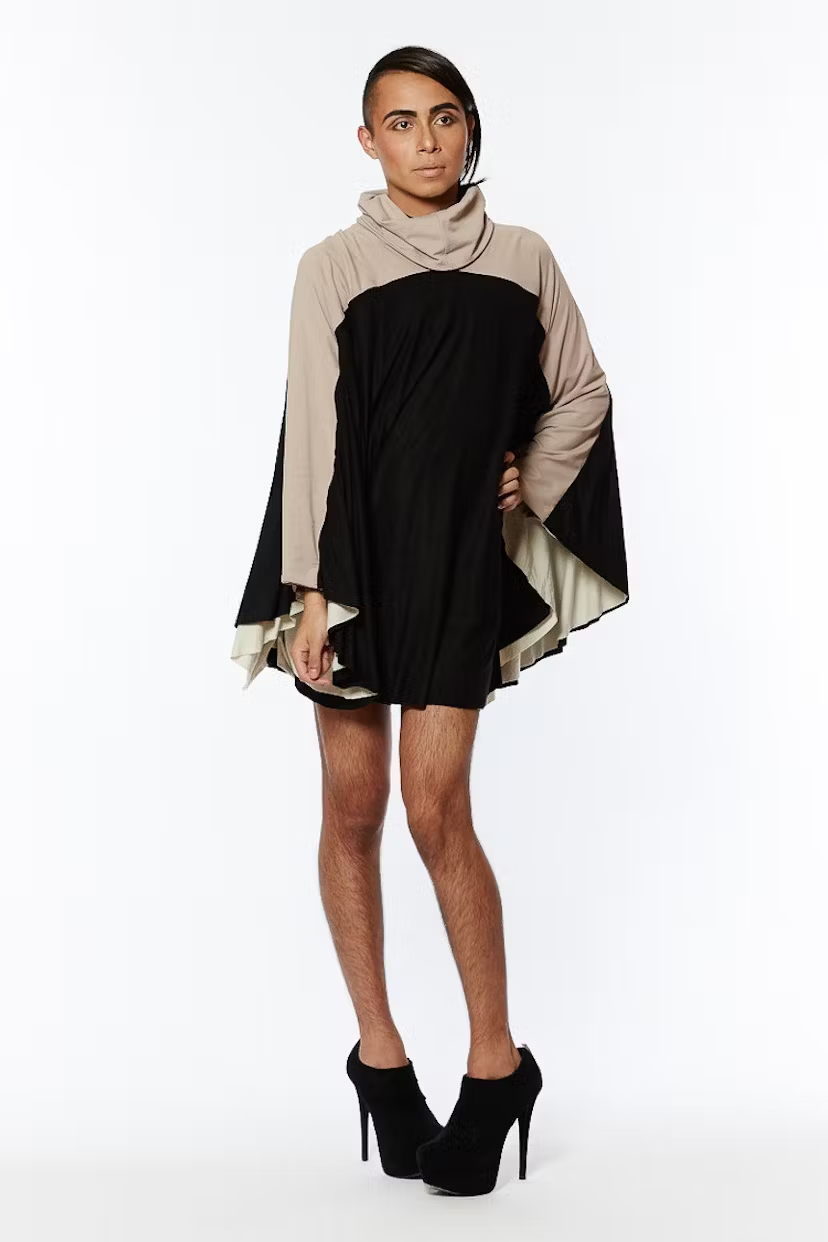
and here is one of the pictures that stood out to me

Person with Nude make up
unshaved legs 
wearing a black poncho with cowl turtle neck and arms are sewn in to make sleeves that are part of the poncho, the arms, shoulders and turtle neck are all a light beige making a single light beige stripe at the top of the garment
black boot heels 
white backdrop

Also worth noting gender and pronouns are not the same thing, gender neutral, genderqueer, genderfluid are all labels and can only be applied if the individual chooses to apply them themselves. No one gets to say “oh you use [some set of pronouns] you must be [this gender]” and vice versa. No one has to have a label and you can also have multiple labels. They are just sets of words to help unify groups of people.

And make looking for clothes easier (mostly joking).