Am I Faking It?

I have chronic migraines. I got diagnosed when I was probably around 13 or 14, but I’ve never felt like I could call myself disabled or claim identity with the chronic illness/pain communities. It’s not that I feel put off by those labels– I’ve done plenty of introspection on that, to make sure that the reason I didn’t feel comfortable with those labels wasn’t because of some subconscious bias. Rather, I feel like my migraines just aren’t bad enough, don’t affect my life severely enough to “count.” I feel like claiming those labels would be exaggerating, or speaking over someone who “fits” better than I do. 

Which is stupid, by the way. I essentially live my daily life with a near-constant headache clocking in between 1-4 on the pain scale, with occasional spikes to higher levels. When it escalates to a migraine, I get nauseous and can’t eat or drink for a day or more, until it goes away. Before a migraine hits, I often get visual aura, which looks like TV static taking up most of my vision. During a migraine, I become extremely sensitive to sounds and smells, and I get so photosensitive that, especially combined with the visual disturbances, I can become effectively blind for several hours. Depending on weather patterns, stress, and other situational factors, I average between 3-10 true migraine episodes per month, with other severe headaches in between for spice. This has impacted my academics, my work life, my social life, my mental and physical health and development, etc. Everything. Like, what part of that experience doesn’t sound disabling??? And yet, I struggle to feel justified in identifying as such.

Continue reading →

When Failure is Radical.

Affirmations from an unreliable drop out –

I have failed to work with a system that prioritizes productivity over personhood.

I have chosen moving forward over suffering

I will accept myself to spite a value system that does not want acceptance – but always striving for “better”. If I internalize it, that I am always striving for “better”, then I build a comfortable place for the belief that I will never be enough, to rest upon. Instead, I will build space within myself to be less than ideal. 

Continue reading →

Bedroom.

A view from my bed [ID: Hazy photograph of a window illuminated by vibrant red and purple lighting. In the center there is an electric candelabra sitting on the window sill, slightly obscured by sheer curtains.]

2011 was the year I began distancing. By which I mean, I began a life lived from my twin bed, fueled by goldfish crackers and electrolyte drinks, seldom able to access the outside world. It wasn’t mine to call home anymore.

I was drowning in conditions that these doctors hardly knew about. I had no choice but to become my own doctor, nurse, and historian. More than anything, I became my own community.

The outside world was stolen from me by sickness, uncertainty, and administrative violence – this world was never built for my survival. Such predicaments were met with constant calls to push through – go into the world anyways, risk it all for a “normal” life. They said adapting to it would make me better. It wrecked my body and my mind. Being bedridden was extraordinarily taxing and painful in a way that cannot be understood by those who have not been fully immersed in it in this way, yet. But I am inseparable from my bedroom life, I am made of soft pillows and the world I built among them. 

Continue reading →

Misophonia: a new sense of disability.

Misophonia is a neurological disorder that is defined as the extreme hatred of a sound. These sounds are usually common sounds caused by other people, such as chewing food. The sound will trigger a fight or flight response in the misophonic person which can have psychological and physical manifestations. Misophonia is a relatively new and understudy disorder, only first being recognized in 2001. While new, the disorder is still impactful, and that is where this story begins. 

Brief 2017 Harvard Medical School article on Misophonia.

My sister has Misophonia. It started when she was about 6. We would be at the dinner table, I would take a bite, and she would turn to me, tense up, and scream. This continued for years. It advanced to even my coughing or sniffing my nose triggering her too. After years of therapy, doctors, and diagnosis she is now finally able to control these responses.  

Continue reading →
Case Study and Character Analysis: Joe Swanson

Case Study and Character Analysis: Joe Swanson

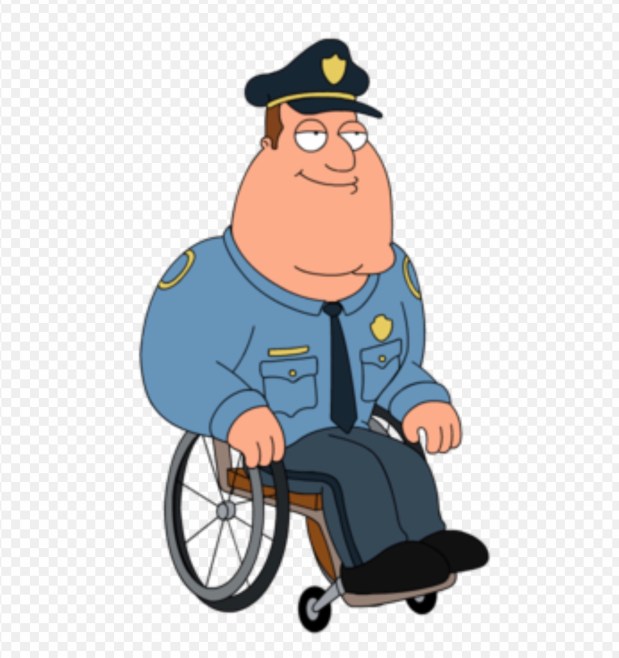
“Men with physical disabilities are marginalized and stigmatized in American society.” This is the first line written by Thomas Gerschick and Stephen Miller in their chapter titled “Coming to Terms”. And for Joe Swanson, a character in the popular cartoon show “Family Guy”, this hits close to home. For those unfamiliar, “Family Guy” focuses on a crazy family pictured here. 

The husband named Peter Griffin, wife named Lois, and three kids named Chris, Meg, and Stewie live in a Rhode Island home on Spooner Street. They get into all sorts of crazy shenanigans but them aside, ever since I started watching, my favorite character has always been Joe. This deep voiced and friendly neighborhood cop, that also happens to be paraplegic, consistently struggles with his physically impaired identity. This, in part, is because of the inconsiderate and sometimes plain mean people around him. In fact, many jokes on this show directly make fun of his disability. Here, for example. Poor Joe…

Coincidentally, this character reflects some of the things that Gerschick and Miller had to say about the relationships between men, disability, and masculinity. According to these anthropologists for disabled men, because of societal stereotypes, “being recognized as masculine is especially difficult, if not impossible.” And in Joe’s case, this proves to be especially true. Countless times, he is shown to be in need of care from his wife, Bonnie. Others in the show, including his friends Peter, Quagmire, and Cleveland, repeatedly make fun of him for this and portray him as useless. Multiple times, he has relationship troubles with Bonnie with the inability to sexually pleasure her being the issue of contention. As Gershick and Miller have established, Joe’s “hegemonic masculinity” is being endlessly challenged. Many times he reacts violently and harshly when his masculinity is questioned, shouting loudly, and shooting his gun. In these times, in the logic of these authors, he could be described as someone in the state of “reliance”, where he “internalizes” hypermasculine ideals and acts with those in mind.

However, what is lovable about this character is that ultimately, he always disproves the stereotypes of disabled men being “weak, pitiful, passive, and dependent”. And often times, he does so not with internalized social expectations of masculinity but with grace. A prime example is the episode of when Joe and Bonnie were fighting about Joe’s disability, thus a perceived of the lack of masculinity, hindering their love and they were close to divorce. Joe recalls when he he first met Bonnie when she was a stripper in a police bust of a strip club, a time when he was still able to walk. She gave him a lap dance. To make things right, Peter took the initiative to plan to have both Bonnie and Joe go to the same strip club that day to recreate such a romantic scene. But when he gets there, instead of having her give him another lap dance, he gave her a lap dance instead using his hands to maneuver his legs. I would say that Joe is in a state of “rejection” at this point. He refuses the social expectations of masculinity and able-bodiedness and instead, developed his own masculine and disabled identity by doing a lap dance which is normally seen as feminine but is masculine to him in that he is assertively trying to fix his marriage. And it works. They go home together afterwards.

Instances like these happen time after time again to Joe. And this leads me to believe that his depiction is relatable to the “Coming to Terms” article. He constantly goes through both physical and emotional hardships and reacts in ways that are consistent with the patterns of literally coming to terms with his disability and living on. And that is what he does each and every time. Say what you want but Joe Swanson is inspiring to me. I’m not going to say that he ever gets to live happily ever after. But he is challenged with societal challenges that attempt to invalidate and debilitate his very being, his very identity. Disabled. Male. Husband. Person. But through utter defiance and a strong will, he is able to live on, defy these restrictive and problematic notions, and ultimately overcome.


Disability and Media

To start off, I would like to say… I love Netflix and mostly recently have been watching a series that I think you all should see.

It is called 3%, I do not want to give too much away but think Hunger Games + Portuguese and you got the right idea. In the show, 97% of the population lives in scums and poverty but if you get registered, at the age of 20 years old, you can go through a process called “The Process” (shocking right?) to see if you are the special 3% that gets to live in the island that has everything you can ever dream of, called The Offshore.

All the characters have their own special thing about them but the one that stood out to me was Fernando, would is played by an actor named Michel Gomes (Here is his Instagram, if you are curious).

Want to know why Fernando stood out to me…. I’ll tell you why… Continue reading →

Video Games, Representation, and Disability: What is Empowerment?

As a person who is considered disabled in mainstream American society, video games have become a way for me to escape feelings of marginalization and feel powerful. More specifically, Western role-playing video games that allow the player to design what their character will look like, as well as the specific attributes they will have, are a very effective escape from the marginalization I often feel as a woman of color who is considered disabled. The player character also becomes very physically and politically powerful over the course of the game and has a significant amount of control over the world around them, contributing to my feelings of empowerment.

Continue reading →

Is Our Campus Allergic to Accesibility?

I am an able-bodied person. I take advantage of this fact every day of my life as I walk around campus. At times I get winded or my legs hurt, but for the most part, I have no trouble walking to my classes, the dining hall, or common spaces on campus. As such, it is not immediately obvious to me and other able-bodied people around me how inaccessible this campus is. Every single one of my daily routes involves stairs. I hate them, but I can climb them. This is not the case for everyone on campus.

Continue reading →